
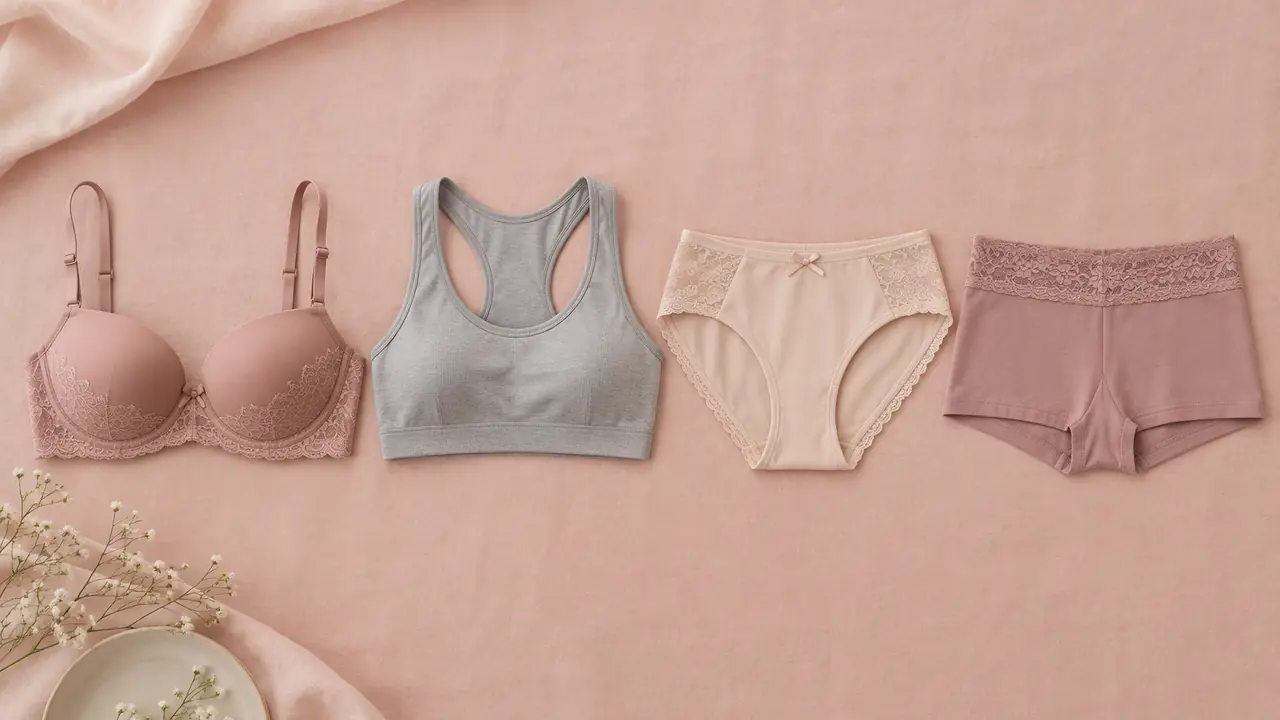
Two cellulosic fibers, two behaviors
Cotton is a natural staple fiber spun from the seed-hair of the cotton plant; modal is a regenerated cellulosic fiber produced from wood pulp and extruded as filament, then cut and spun. Both are cellulosics, which is why they share the qualities buyers care most about at the skin: they absorb moisture rather than repelling it, they breathe, and they dye deeply. The differences come from fiber structure - staple versus filament, and the different cross-sections - and they show up in exactly the places a spec sheet controls.
For a panty program the comparison is rarely cotton versus modal as absolutes; it is which fiber leads which line. Everyday basics lean cotton and cotton-rich blends. Smooth, dark-colorway, close-fitting lines lean modal. Blends split the difference and dominate mid-market programs. The rest of this note walks the differences that move a specification.
Hand feel and drape
Modal reads smoother and cooler to the hand than cotton at the same weight, because the filament fiber spins into finer, more even yarns with a low hairiness. Cotton reads as texture - pleasant, familiar, slightly matte - and its short-staple character is what gives cotton knits their soft, dry surface after washing. Neither is better; they answer different briefs. A seamless body in modal reads as second-skin; a rib-knit brief in cotton reads as classic basics.
Drape follows the yarn. Modal knits fall closer to the body and resist wrinkling in the pack, which suits body-hugging cuts and dark colors. Cotton knits hold a slightly fuller shape, which suits rise ladders and waistband-heavy styles where the fabric needs body. Buyers choosing between them for one program should handle the same knit construction in both fibers, because the construction amplifies or softens the fiber difference.
Moisture behavior in wear
Both fibers absorb moisture into the fiber itself, which is why both are comfortable next to skin compared with films or non-absorbent synthetics. The differences are in rate and release: cotton absorbs readily and dries slowly, holding a damp feel longer after heavy wear or washing; modal absorbs and releases faster, feeling dry again sooner. In wear this shows up less in ordinary days and more at the edges of the envelope - hot climates, long wear days, frequent laundering.
The honest framing for range copy is qualitative, not absolute. Neither fiber keeps skin dry by magic, and neither is a functional layer; the panty category solves the contact-surface question with the gusset, not the shell. Claims discipline matters here too: describe the fiber behavior in ordinary language, keep certification claims tied to documents, and leave functional language to the styles that actually carry functional layers.
Blends deserve their own line in the thinking. A cotton-modal blend with a modest elastane share is the workhorse of mid-market panty programs: the modal smooths the hand and deepens the color, the cotton keeps the familiar dry surface and the basics story, and the blend narrows the wash-behavior gap between the two pure fibers. Blend ratios are a specification item - named per fabric, tested per lot - rather than a marketing round-off, because a 60/40 knit and a 40/60 knit wear like different fabrics.
Care, shrinkage and color
Cotton knits shrink more and relax more through laundering, which is why shrinkage is a standard per-order test item in the category and why cotton programs measure fit after the declared wash cycle rather than out of the box. Modal is more dimensionally stable across wash cycles and resists the growth that heavy cotton knits show. Both fibers take deep dye; modal takes it with a depth and evenness that has made it the default for solid dark colorways, while cotton colorways live and die by the dye house. The declared care cycle should match the fiber - the care labeling note covers how the US rules frame the label.
Side by side
| Dimension | Cotton | Modal |
|---|---|---|
| Fiber origin | Natural staple fiber | Regenerated cellulosic from wood pulp |
| Hand feel | Textured, dry, familiar | Smoother, cooler, low hairiness |
| Moisture behavior | Absorbs readily, dries slowly | Absorbs and releases faster |
| Wash stability | More shrinkage and relaxation | More dimensionally stable |
| Dye depth | Deep, dye-house dependent | Deep and even; dark colorway default |
| Sustainability route | GOTS or BCI per certificate per lot | Per the fiber producer documentation |
| Contact-safety standard | OEKO-TEX Standard 100 per certificate per lot | OEKO-TEX Standard 100 per certificate per lot |
The table reads as a specification menu, not a verdict: most mature programs run both fibers, with the line assignments decided by channel and color story.
The gusset question
One constant across the comparison: the gusset lining stays cotton in both routes, across most programs, because the lining is the contact surface and cotton is the category standard there. Buyers specifying an all-modal body should still expect a cotton-lined gusset and should write the lining fiber into the spec explicitly, then verify it on the approved sample; the construction details are in the gusset construction note. The blend choice is about the shell, not the lining.
Choosing for a program
- Assign fibers by line, not by program: a cotton basics line and a modal smooth line can share a plant and a block.
- Set the declared care cycle with the fiber in mind, and test fit after the wash cycle, not before.
- Fix the gusset lining as cotton in the spec regardless of shell fiber.
- Match certification claims to documents: OEKO-TEX Standard 100 for contact safety, GOTS or BCI for cotton programs, per certificate per lot.
- Handle both fibers in the same knit construction before deciding; construction changes the read as much as fiber does.
The certification routes are mapped by market in the certifications guide, and the certificate documents themselves are explained in the fabric certifications note. Typical reference MOQs for fabric-led panty programs stay in the category band of 2,000-5,000 pieces per color, confirmed in writing per program; when the fiber ladder is sketched, the quote form captures fiber, gusset lining and certificates in one specification step before sampling begins.