
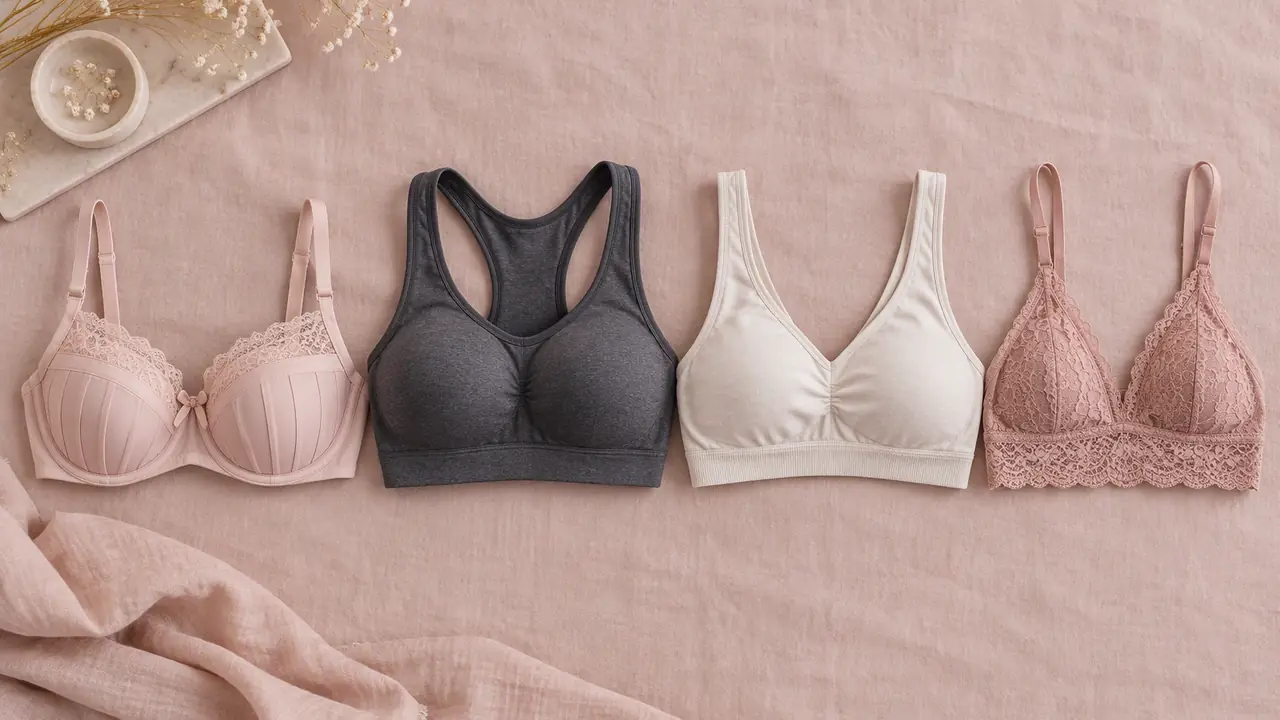
Three axes that separate the families
Ask three questions and most bra confusion resolves. How much cup does the style show - full, half or a low cut? What carries the load - an underwire, a firm band with powermesh wings, or engineered knits? Where do the straps sit - centered, outward-set or convertible? The answers place a style in a family, and the family decides tooling, grading and the sewing skills a partner plant needs.
The families below are the six lines in the bra hub. Demi and plunge appear here as cut descriptions because buyers ask for them by name; on this site they are discussed as variants of the half-cup and deep-gore constructions rather than as separate lines, and a program specifies them on the balconette card with the cut written into the cup line.
Balconette, demi and plunge
The balconette covers roughly half the bust with a horizontal neckline and slightly outward-set straps. A demi cuts the cup lower still, leaving a more open top edge; a plunge lowers the center gore so the style sits unseen under deep necklines. For a plant, the differences concentrate in two places: cup pattern height, and the wire angle and gore depth that keep a deep cut stable. That is why a plant that molds a clean balconette is not automatically the right plant for a plunge program.
| Family | Neckline and coverage | Typical spans | Sourcing notes |
|---|---|---|---|
| Balconette | Horizontal neckline, half cup | Cups A-DD+, bands 30-44 | Cup molding precision decides the fit |
| Demi | Lower cup edge, open top | Per program chart | Fewer panels and simpler sewing, less forgiving on fit |
| Plunge | Deep center gore, low front | Per program chart | Gore depth and wire angle need experienced tooling |
| Strapless | Straight across, band-led | Cups A-DD+, bands 32-42 | Silicone gripper and internal structure carry it |
Coverage also decides wardrobe fit, which is why range plans usually keep one half-cup family and one lower-cut style rather than five variations of the same geometry.
Push-up padding levels
Push-up describes padding placement, not a body effect: graduated foam along the lower and outer cup, built in one to three levels of thickness. Level one reads as a lightly padded cup; level three uses the deepest graduated foam in the category. Most programs order removable pads alongside the graduated build so one style covers two preferences. Push-up cups run A-D with bands 30-40, and the molding tolerance is tighter than an unlined cup because the foam is bonded to the cup shell before assembly.
Wireless versus underwired
An underwired bra takes part of the load into a curved wire; a wireless bra moves the work into the band, the wing and the knit or cut of the cup. Neither route is a lesser version of the other - they are different engineering choices with different grading consequences. Wireless lines in this range are graded to DD+ depending on the plant, and the constructions that grade highest lean on wider bands, side powermesh and structured cup seams rather than on wire. The wireless bra line shows the layer card; the trade-offs are easy to read once support is described as structure instead of wire.
Sports bras and impact levels
Sports bras separate by how they control movement: compression builds hold the bust close to the chest wall, encapsulation builds use structured cups around each side, and many high-impact styles combine both. Impact grades run low, medium and high, and the grade drives fabric weight, four-way stretch content and strap engineering. Cups run A-H across the line, the widest span in the range, which makes grading discipline the main quality risk. The sports bra line carries the construction card and the impact levels guide explains the grading in depth.
Bralettes and the comfort tier
Bralettes remove both wire and padding: triangular or sports-inspired fronts in lace, cotton or modal, sized XS-2XL. Construction is simple enough that bralettes often share dye lots with a panty program, which makes them a common second line after a brand's first wired style. The simplicity cuts both ways: with less structure in the garment, fabric quality and elastic recovery carry almost the whole quality story, so the inspection plan leans harder on the materials file.
Choosing a launch mix
A workable first range keeps the geometry decisions deliberate: one half-cup family, one comfort or sports entry, and a panty pairing on the same color ladder. Adding a plunge or a strapless before the first balconette batch ships usually delays the whole program on tooling. When the mix is set, band spans, cup ranges and padding choices are recorded per family so plants quote the same garment - the sizing and fit guide covers the chart side, and the quote form captures the rest in the format plants answer against.