
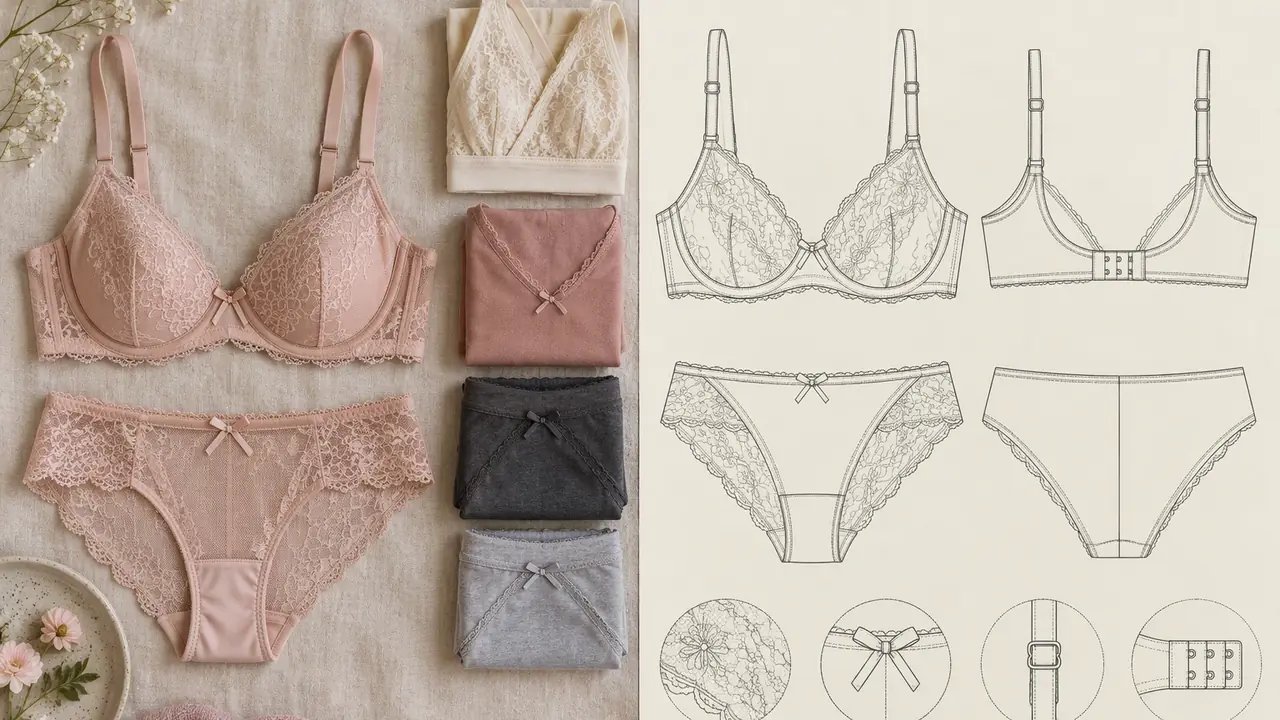
What an intimate apparel program involves
A women's underwear program is a plan, not a purchase. It decides which of the eleven lines launch first, which color ladder runs across them, how sizes are graded, which certificates back the fabrics and which documents travel with each shipment. Because intimate apparel sits close to skin, the documentation bar sits higher than in most apparel categories, and because the lines share elastics, laces and dye lots, a decision made for one line ripples through the rest of the range.
The desk coordinates the program end to end: it agrees the range plan with the buyer, writes a spec card per line, shortlists partner plants by construction strength, books samples stage by stage, verifies certificates per lot and inspects every shipment against the approved sheet. Lissea holds no factories; the plants that cut and sew are partners, selected per program. The commercial side of that flow is described on the sourcing process page; this page stays on the product side.
The layers every garment shares
Bra or panty, every style in the range is specified in the same six-layer order. Keeping the order fixed means a plant quotation, a fit sample comment and an inspection report all point at the same layer with the same words, which is what makes a multi-line program manageable.
| Layer | On a bra | On a panty |
|---|---|---|
| 1 Cups and front | Molded, cut-and-sew or lace cups; unlined or padded | Front panel in lace, cotton blend or modal |
| 2 Band and waist | Underwired or wire-free band; hook-and-eye closure | Waistband; covered or bonded elastic |
| 3 Straps and sides | Adjustable straps; side boning or powermesh wing | Side seams or seamless bonding |
| 4 Rear and gusset | Wing closure; hook rows per band depth | Rear panel; cotton or OEKO-TEX-lined gusset |
| 5 Fabric and trims | Lace, microfiber or cotton blends; elastics | Lace, mesh, modal; leg elastic |
| 6 Hardware and pack | Sliders, rings, bows, woven labels | Printed or woven labels; poly bag or box |
The eleven lines
The range divides into six bra families and five panty families. Each line page carries its own spec card with layers, options and reference ranges; the notes below are the short version.
- Balconette bras - half-cup construction with a horizontal neckline; usually the first bra a brand specifies.
- Strapless bras - silicone gripper and optional detachable straps; band engineering does the work.
- Push-up bras - graduated padding in one to three levels; removable pads are common.
- Sports bras - compression or encapsulation builds, graded low, medium or high impact; four-way stretch fabrics.
- Wireless bras - no metal underwire; support comes from band, wing and knit engineering.
- Bralettes - wire-free and unlined in lace, cotton or modal; XS-2XL.
- Brief panties - full coverage in high, mid or low rise; the volume line for most programs.
- Bikini panties - low rise with short sides; the second core style.
- Boyshorts - full-coverage flat cut; popular in cotton and modal.
- Thongs - T-shaped rear, seamless or lace; XS-2XL with a cotton gusset.
- Period panties - four-layer absorbent build, leak-resistant per spec, graded light or heavy flow.
How to read a spec card
- Check the layer order first: body, band or waist, sides, rear and gusset, fabric and trims, hardware. A quotation that skips a layer is an incomplete quotation.
- Read options as decisions, not decoration: molded or cut-and-sew changes the tooling, and covered elastic changes the hand feel of a waistband.
- Find the reference ranges - size spans, hook rows, gusset composition - and treat them as typical across the category, not as a datasheet.
- Note which options are customizable; that is where a brand's colors, lace and labels go, and where the desk writes the program sheet.
- Follow each layer to its document: fabric safety to the certificate file, packaging to the retail sheet, sizes to the grading chart.
- Close with quantities and dates. MOQ and lead ranges are confirmed in writing per program before anything is booked.
A spec card is deliberately boring. Its job is to make two plants quote the same garment and two inspections measure the same points, so that when a color reads warmer in the third batch there is one document that records what the second batch was.
From brief to batch
Reference ranges across the category run wide. Bras commonly start at 500-1,000 pieces per color on a stock catalog model and 1,000-3,000 on a private label pattern; panties at 2,000-5,000 per color; period panties at 1,000-2,000. Samples take about 7-15 working days on a catalog model, 15-25 for a branded sample and 20-35 where a custom print or lace is developed. Batch lead runs 30-45 days on catalog models and 35-50 private label, with a first ODM order at 60-90 days. Every figure on this page is a typical range, and the numbers that matter are confirmed in writing per program.
Fabric safety and documents
Intimate apparel is worn against skin for long hours, so buyers treat fabric safety as the entry ticket rather than an upgrade. The baseline is OEKO-TEX Standard 100, which screens more than 300 harmful substances from yarn to finished product, including threads and elastics rather than the face fabric alone. In the United States, retail units carry fiber content, country of origin and an RN number under the Textile Fiber Products Identification Act, plus care instructions under the FTC Care Labeling Rule, and the fabrics fall under 16 CFR 1610 flammability testing. The fabric certifications guide walks through each document and who holds it.
Where buyers start
The ranges that succeed usually start narrow: one bra family and two panty styles on a single color ladder, so the lace, the elastics and the dye lots match across the first program. Marketplace sellers often invert that and lead with panties, where SKU counts are high and constructions are simpler. Whichever way the range points, the quote form asks the questions a plant will ask, and the answers shape the first spec card.