
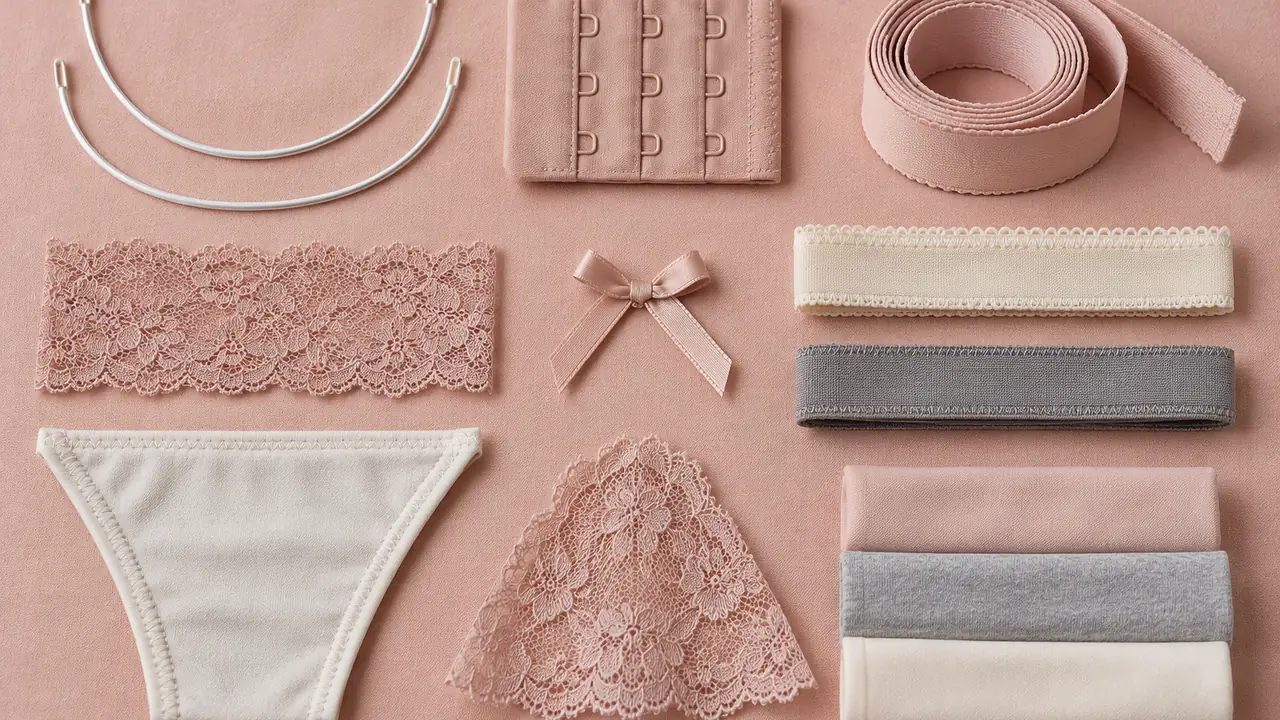
Why cotton keeps its place in intimates
Cotton is the default skin-facing fiber in everyday underwear, and the reasons are practical rather than nostalgic. As a cellulose fiber it absorbs moisture into the fiber itself rather than holding it against the skin, which is why a cotton-rich gusset liner is the convention across the category and appears in nearly every line on the panties category, including styles whose body panels are synthetic. Cotton also takes dye deeply, tolerates warm washing better than most synthetics, and reads as a natural fiber on the composition label in a way that still moves purchase decisions in the United States and Europe.
For a buyer the useful point is that cotton quality is not one decision but several. Staple length, spinning method, fabric construction and blend ratio move independently, and each shows up later in the hand, the wash behavior and the cost drivers of the program. The grades below are category conventions confirmed per spec sheet, not measured values of any particular product.
How cotton is graded: staple, combing and finishing
The first lever is staple length, the average length of the raw fiber. Short-staple cotton spins into coarser, fuzzier yarn; long-staple cotton spins into finer, smoother and stronger yarn. Across the category, buyers meet three loose tiers: standard staple for basic jersey programs, longer staple when a smoother dry hand matters in mid-range lines, and extra-long staple for premium programs where the hand itself is the selling point. Suppliers name these tiers differently, so the desk works from physical swatches rather than grade names, and retains a signed swatch per color before bulk weaving begins.
The second lever is combing. Carded yarn keeps the full fiber mix, and its shorter fibers surface as fuzz that pills over months of washing. Combed yarn has passed an extra step that removes most short fibers, which raises smoothness and strength and slows pilling. Most everyday programs sit deliberately between the two: combed cotton where the consumer judges with a hand, carded cotton where the budget needs a lever. Finishing adds further choices. Mercerizing swells the yarn so it takes dye with more depth and a quiet sheen; enzyme washing softens the surface of the knit. Each finishing step is both a cost driver and a shrinkage variable, which is why finishing belongs on the spec sheet rather than being decided at sample stage and forgotten.
The common cotton constructions
| Construction | Hand and look | Typical use | Watch-outs |
|---|---|---|---|
| Carded cotton jersey | Soft, matte, slightly fuzzy | Basic briefs, liner knits | Pills sooner; color depth limited |
| Combed cotton jersey | Smooth, even, denser | Mid-range briefs and boyshorts | Higher yarn cost; confirm shrinkage |
| Rib knit | Elastic, visible ribs | Leg openings, waistbands, seamless bodies | Recovery depends on elastane share |
| Interlock | Smooth both sides, stable | Smoother panty bodies, lined panels | Heavier hand at equal thickness |
| Organic cotton | Same range as conventional | Organic claims with documents | Chain of custody per lot |
Rib and interlock answer different questions: rib stretches and recovers across the width, which is why it takes leg openings and cuffs, while interlock lies flat and stable, which is why smoother panty bodies use it. A brief program often mixes them - jersey or interlock for the body, rib for the openings - and the construction split should appear on the tech pack per panel rather than as a single word on the fabric row.
Blends: how much elastane and why
Pure cotton knits recover poorly. A brief cut from cotton with no elastane holds its shape at first wear and then relaxes at the leg opening and the waistband within a few wash cycles, which is the most common reason a cotton program goes back to the drawing board. Adding a few percent of elastane changes the equation: the knit keeps the dry, absorbent character of cotton and gains the recovery that keeps openings snug through the life of the garment. The share is usually single digits for cotton-rich bodies and rises at openings and bands, where hold matters more than drape.
Two labeling details matter. First, composition must be declared in descending order of content under the rules of the destination market, and in the United States that is the Textile Fiber Products Identification Act. Second, naming differs by market - elastane in Europe, spandex in the United States - and the care label must use the wording the market expects. The wider mechanics of stretch and recovery are covered in elastane percentages, and the comparison buyers most often put next to cotton is in cotton versus modal.
What to test on a cotton program
Test items are agreed per order, and a cotton panel usually includes colorfastness to washing and rubbing, dimensional stability after washing, pH, formaldehyde content per test report, and pilling resistance. Pilling is the item most often skipped and most often regretted on short-staple programs, because fuzzing shows up after the first month of consumer wear, not at inspection. Shrinkage belongs in the same panel: cotton knits relax in finishing, and a body that measures true before wash and comes up short after wash will drift out of grade across a size run.
For the skin-facing story, most retail programs ask for OEKO-TEX Standard 100 per certificate per lot, which covers a defined list of harmful substances from yarn through finished product. The mechanics of the certificate and its scope are explained in fabric certifications and in more depth in the OEKO-TEX note.
Sourcing notes for cotton programs
China's underwear clusters handle cotton programs at every tier. The Puning cluster in Guangdong reports more than 7,000 textile and apparel enterprises and an annual textile and apparel output above RMB 140 billion in 2025, per the Puning municipal government, with a chain that runs from raw material through testing and certification. Shantou is dense in bras and seamless construction, and Yiwu concentrates thermal and seamless categories. This depth matters for a cotton buyer specifically, because silent yarn substitution between lots is a known failure mode, and a cluster with competitive spinning and finishing capacity makes it practical to hold yarn specifications line by line across repeats.
Reference quantities for panty programs run 2,000 to 5,000 pieces per color for an OEM build and 500 to 1,000 for catalog models, with bulk lead commonly 30 to 45 days for catalog and 35 to 50 for OEM builds - every figure confirmed in writing per program on the MOQ and lead time page. A first brief moves through the desk's quote form, and the quantity logic is unpacked further in the MOQ note.
- Choose the construction per panel and put it on the tech pack, not just on the sample.
- Set the blend ratio and the elastane share per component.
- Agree the test panel, including pilling and shrinkage, before bulk.
- Decide the certificate scope - yarn, fabric or finished garment - and confirm it per lot.
- Confirm quantity per color and the in-warehouse date in writing.