
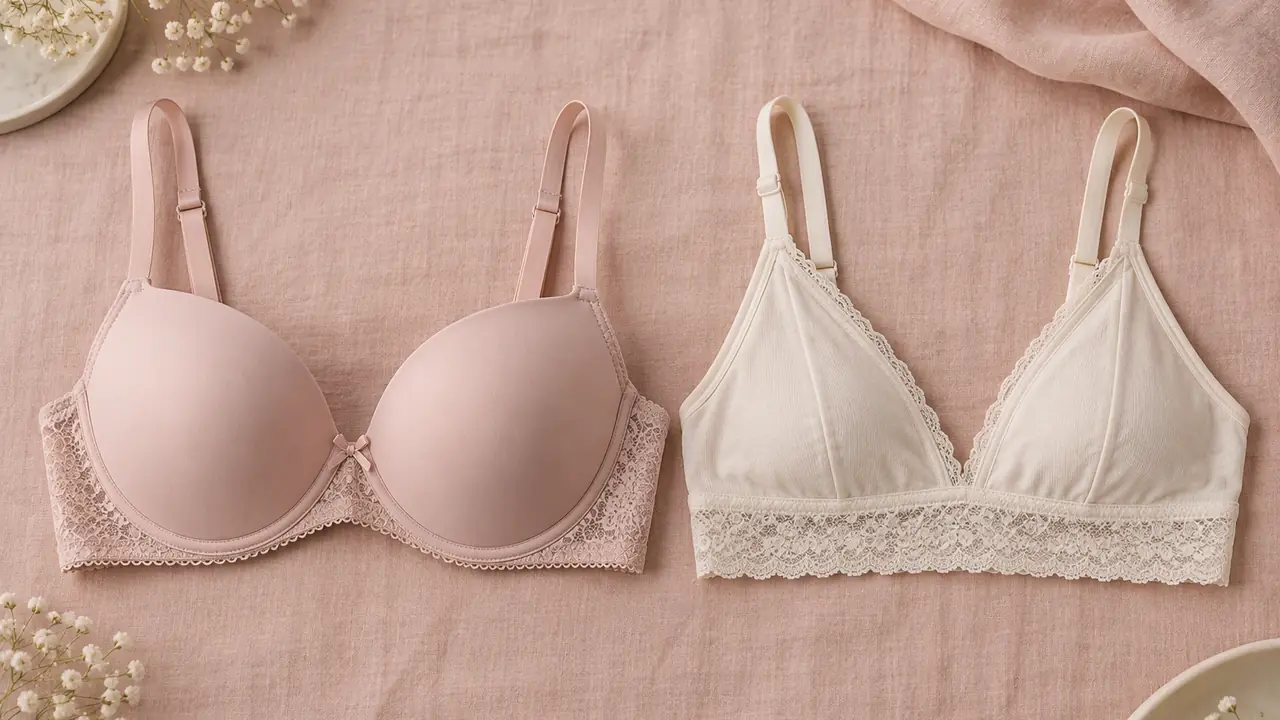
Two materials, two jobs
Lace is a patterned fabric - in panties, usually a stretch lace knitted on raschel machines, with the pattern and the elasticity built into the same structure. Microfiber is a fine-denier knitted fabric, polyamide or polyester with a small elastane share, prized for a smooth surface and a low profile under clothing. One is chosen for what it shows; the other for what it does not show. Most ranges carry both, but they behave so differently in wear and in production that treating them as interchangeable fabrics is the most common planning error in a panty program.
The desk keeps the two on separate specification tracks: lace follows a fabric track with its own minimums and quality markers, microfiber follows a garment track where denier, knit density and edge finish decide the result. The lace types note covers the lace families in depth, and the microfiber versus cotton note covers the smooth-fabric side of the comparison.
Side by side: feel, look and behavior
| Aspect | Stretch lace | Microfiber |
|---|---|---|
| Surface | Patterned, textured, open | Smooth, uniform, closed |
| Stretch | Gives in two or four directions | Even give from knit and elastane |
| Under clothing | Texture can show by design | Disappears under fine knits |
| Snag risk | Yes, at open pattern work | Low |
| Drying | Fast through the open structure | Fast at the fiber level |
| Edge finish | Scalloped or bound edges | Laser-cut or sewn edges |
| Sizing behavior | Forgiving across a size | Exact; wrong size shows immediately |
The last row is easy to overlook and matters for returns: stretch lace forgives a size in either direction because the open structure gives, while a microfiber body is exact - a size off shows as dig or bag with nowhere to hide. Ranges that mix the two in one size run should expect the microfiber styles to be the ones exchanged.
How lace is specified and graded
Lace quality shows in four places a buyer can check on a swatch: the hand (dry and supple rather than stiff or waxy), the repeat (the pattern must be continuous and consistent across the width), the elastane share (which decides recovery after stretch), and the edge finish (scalloped edges should be even and clean-cut). Because lace is bought as a fabric before it becomes a garment, it carries its own typical minimums - 500-1,000 meters per design across the category - which is why lace-heavy panty programs consolidate designs rather than adding one per SKU. The lace in panties note covers the stretch-lace constructions that dominate the category.
Quality grading is visual and tactile, but the durability question is structural: where does lace fail in wear? Two places - snagging at open pattern work, and elastic breakdown where the lace meets leg elastic or waistband. The first is a care and construction issue, covered in the lace tearing note; the second is an elastic specification issue, covered in the elastic stretch note. Both are addressable before sampling, which is the point of specifying rather than assuming.
How microfiber behaves
Microfiber's virtues are mechanical: a smooth low-friction surface, low absorbency so it dries quickly, and opacity from the dense knit. Its specification lives in numbers a buyer can demand: denier (finer yarns for a smoother hand), knit density (which decides opacity and pilling behavior), elastane share (which decides recovery), and the edge finish - laser-cut edges keep the invisible profile on bikini and thong styles, while sewn edges add structure on briefs. Pilling is the watch item at lower densities, and elastane recovery is the watch item after repeated washing; both sit on the desk's per-order test list alongside colorfastness and shrinkage.
Microfiber also carries the hygiene-critical assembly on most styles: the gusset. Whatever the body fabric, the trade norm is a cotton or cotton-rich gusset lining, and microfiber bodies are no exception. The lining is a specification line in the tech pack, not an assumption left to the plant default.
Durability in wear and wash
The two materials age on different clocks. Lace ages at its edges and its elastics: scalloped edges fuzz where they meet leg elastic, and the elastic share relaxes with wash cycles - a lace panty usually retires for looseness rather than for fabric failure. Microfiber ages at its surface and its elastics too, but more slowly: the knit resists snagging entirely, and pilling appears only where density was cut. In both cases the care label drives lifespan, which is why care artwork is checked against the construction before bulk under the FTC Care Labeling Rule - the care labeling note explains what the rules require for United States shipments.
For a range plan, the practical summary: microfiber is the durability anchor and the restock driver; lace is the margin and story carrier that trades some durability for presence. Ranges that reverse those roles - lace as the restock anchor - collect a returns profile the numbers did not promise.
Range planning with both materials
Panty minimums run 2,000-5,000 pieces per color typically across the category, confirmed in writing per program on the MOQ and lead time page, and the fabric minimums stack on top for lace designs. The efficient structure most programs land on: a microfiber core tier in two or three stable silhouettes and core colors, plus a lace tier that consolidates one or two lace designs across several silhouettes - the same lace running through a bikini, a brief and a thong spreads the fabric minimum and reads as a collection on the listing. Hybrid bodies - microfiber front, lace back panels - give listings the lace story at a fraction of the fabric quantity, and are a staple of the marketplace tier.
- Fix the microfiber core tier first: silhouettes, core colors, restock cycle.
- Consolidate lace into one or two designs shared across silhouettes to absorb the fabric minimum.
- Specify denier, density and elastane share for microfiber in the tech pack, not by sample feel alone.
- Check lace swatches for hand, repeat, recovery and edge finish before approving.
- Write the gusset lining into every style spec whatever the body fabric.
- Put colorfastness, pilling and elastic recovery on the per-order test list for both tiers.
When the tier structure is set, the quote form takes body fabric, lace designs, silhouettes and quantity per color in one pass.