
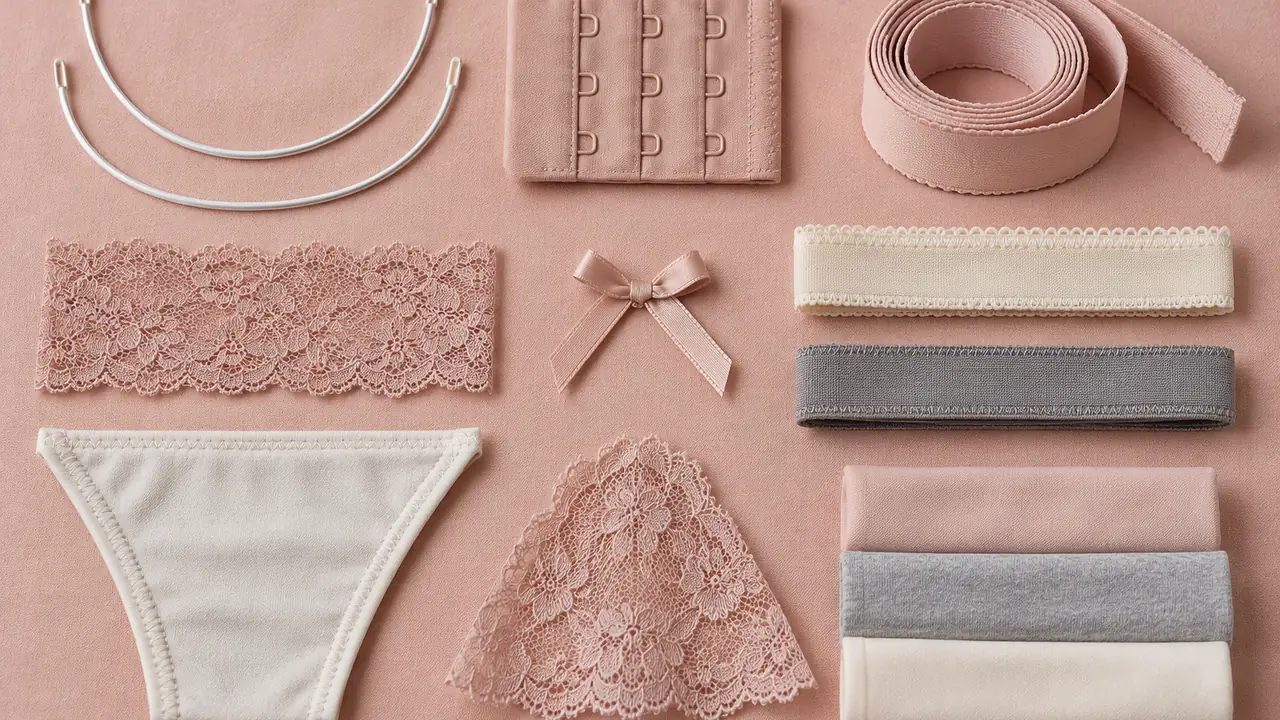
What lace actually is
Most lace in modern intimates is a warp knit: the ground and the pattern are formed at the same time on a raschel or tricot warp knitting machine, with elastic yarns knitted in where stretch is required. The old Leavers looms that gave the category its premium vocabulary work differently - they are slow, mechanical and concentrated in a small number of specialist regions - and the trade word Leaversoy, common in Asian catalogs, generally signals a raschel-built interpretation of that look rather than true Leavers production. Neither is better by default; they answer different briefs and different cost expectations, and the misreading happens when a buyer specifies one while imagining the other.
The practical consequence is simple: when a swatch shows a pattern, the questions that matter are which machine built it, which yarns carry the stretch, and how open the ground is. Two swatches can carry an almost identical pattern and behave completely differently on the body, because the ground differs even when the motif does not. This is why the desk judges lace on a physical swatch under tension, not from a catalog photograph.
The lace families a buyer will meet
| Family | How it is built | Look and stretch | Typical use | Watch-outs |
|---|---|---|---|---|
| Leavers lace | Slow mechanical looms, pattern and ground formed together | Fine, dense, intricate; little or no stretch unless knitted in | Premium cup overlays, occasion pieces | Cost and lead profile; repeat width limits |
| Leaversoy (catalog term) | Raschel interpretation of the Leavers look | Similar pattern language, coarser ground | Everyday lace bodies and panels | Confirm ground density on a tensioned swatch |
| Raschel lace | Warp knit with tall pattern capability | Open ground, defined motifs | Panty fronts, bralette panels | Cut edges need finishing; runs if a loop breaks |
| Stretch (tricot) lace | Warp knit with elastic yarn knitted in | Two-way or four-way stretch, flat edge | Band tops, panty bodies, cup frames | Recovery and elastane share per spec sheet |
| Galloon and edging lace | Scalloped edge built into the knit itself | Self-finished decorative edge | Leg openings, neckline edges, straps | Width must match the pattern piece |
The families mix freely within one garment. A panty may carry a raschel front panel, stretch lace side panels and a galloon edge at the leg opening, all inside one color story. What the buyer controls is which family sits where, because each carries a different durability profile and a different reaction to being cut. That placement decision belongs on the tech pack per panel, not in a general note that the style is lace.
Where lace sits in a garment
Placement follows the structure of the style. In a bralette, stretch lace often is the body: the garment is cut from one lace with a self-finished top edge and a lined gusset. In a wired bra, lace usually appears as an overlay on the upper cup or as band tops above the underwire channel, where loads are lower and the pattern can carry the style. In panties, a raschel front panel with stretch lace sides is a common everyday build, and a galloon edge at the leg opening removes the need for a hem. The component map of a typical bra is in the construction anatomy note.
Edges deserve their own decision. A self-finished galloon edge can be sewn on with a single pass and keeps its look for the life of the garment. A cut raschel edge, by contrast, must be bound, folded or joined with a seam that arrests the ground, because an unfinished cut edge in an open warp knit will run. Which edges are self-finished and which are cut should be visible on the tech pack, and the finishing stitch for each cut edge should be named.
Why lace fails, and how construction prevents it
Lace rarely fails in the middle of a panel. It fails at concentration points: a seam sewn across a ground with too little give, a strap join without a reinforcement, a hook tape that snags the ground yarn, or an elastane that has aged past recovery and leaves the lace sitting loose. Three construction habits prevent most of it. First, choose a stitch with enough elasticity for the zone, which is the subject of the stitching note. Second, put a bar tack or a folded reinforcement at strap joins and at the ends of elastic runs. Third, match the ground density to the load: an open fashion ground belongs in a low-tension panel, while high-tension zones need a denser ground even if the pattern loses some delicacy.
Elastane aging is the quieter failure. A stretch lace that feels perfect at inspection can relax over a season of hot washing, and the complaint arrives as a shape that no longer holds rather than as a broken yarn. Elastane quality, care instructions and realistic expectations belong together in the program brief, and the aging mechanics are in the elastic aging note.
Commercial profile: minimums and lead time
Lace fabric commonly moves at 500 to 1,000 meters per color as a reference minimum, because dye lots and warp beam lengths set the floor; trims and narrow elastics are ordered on a per-thousand basis. Custom pattern development runs longer than garment sampling - for a custom motif or pattern, sampling commonly takes 20 to 35 days before bulk can be scheduled, per category reference, with every figure confirmed in writing per program on the MOQ and lead time page. Cluster depth shortens the loop: the Guangdong coastal belt around Shantou, with Chendi and Gurao holding on the order of 2,000 intimate apparel enterprises per industry media reporting, plus the Puning cluster, keeps lace mills, dye houses and trim shops close enough that a pattern change moves to a counter-sample in days rather than weeks.
For a first program, the desk suggests starting from stock lace patterns in the target color and moving to a custom ground only in a second season, once sell-through justifies the development cost. Swatch references can travel with the brief through the quote form.
What to specify
- Ground yarn and elastane share, per component, on the tech pack.
- Pattern repeat and lace width, checked against the pattern pieces.
- Self-finished or cut edges, and the stitch that finishes each cut edge.
- Opacity on skin, judged on an approved tensioned swatch, not a photograph.
- Care route and wash expectations, matched to the fiber content.
The panty-specific choices continue in lace in panties, the direct comparison with a smooth knit is in lace versus microfiber, and the failure modes are worked through in why lace tears.