
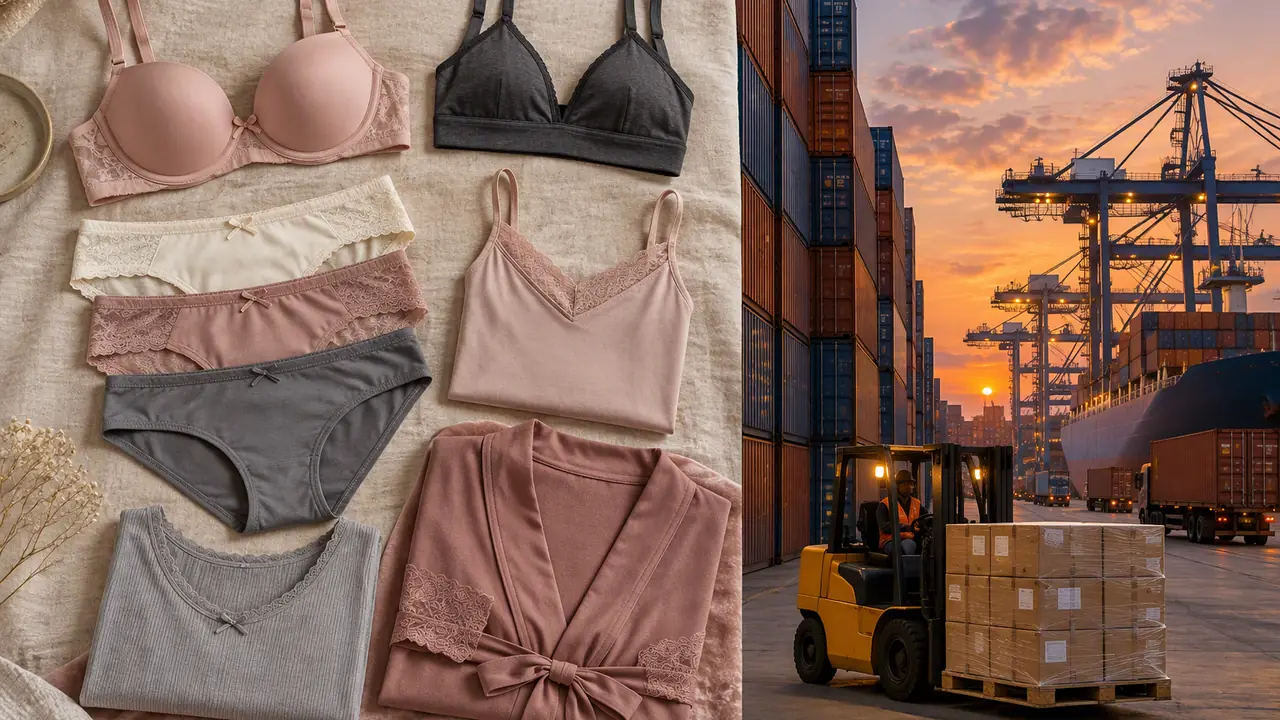
Why China anchors intimate apparel sourcing
China is the world's largest producer of intimate apparel, a framing the industry repeats because the capacity behind it is real: bra factories, panty workshops, lace mills, elastic weavers, dye houses and mold makers sit within hours of each other in a handful of coastal regions. That density matters more than any single factory's capability, because an intimate apparel program is a chain of specialized steps - fabric development, dyeing and finishing, cup molding, cutting, sewing, finishing, inspection - and a missing link anywhere in the chain shows up as delay or as a substitution nobody approved.
Demand depth is the other half of the picture. Keyword-tool data the desk tracks as a demand signal puts the single US query bra at roughly 90,500 searches per month and panties at 49,500, and across seven seed terms the field widens to more than 155,000 keywords with about 15.8 million monthly searches. Deep, stable search demand is what lets a brand reorder the same style for years, and reorders are what make a sourcing program worth building properly. The sections below cover the four clusters, the process, the paperwork and the timing; the cluster detail continues in the note on China's intimates clusters.
The four clusters and what each does best
Four regions carry most of the export capacity a foreign buyer will touch. Each has a signature strength, and matching the program to the cluster shortens the search before a single factory is contacted. The desk keeps the full comparison on the industry clusters page.
| Cluster | Signature strengths | Typical programs |
|---|---|---|
| Shantou (Chenlian and Gurao, Guangdong) | Bras and seamless styles; industry press counts 2,000-2,100 intimate apparel enterprises across the two towns, and bras are reported to anchor more than 60 percent of Chenlian's economy | Wired and wireless bras, seamless underwear |
| Puning (Guangdong) | Women's underwear and homewear scale reported first nationally; local government figures put 2025 textile and apparel output above RMB 140 billion across more than 7,000 companies | Brief, bikini and boyshort programs, homewear |
| Yanbu (Nanhai, Guangdong) | Design and development strength, higher-end OEM work | Branded and premium label programs |
| Yiwu (Zhejiang) | Thermal underwear, seamless styles, multi-category concentration | Thermal and seamless capsule programs |
The boundaries are soft - Puning plants sew bras and Shantou plants sew briefs - but the gravity is real. A buyer who asks for a twelve-size wired bra ladder will find more tooled experience in Shantou, while a marketplace seller filling a twenty-color brief assortment will find the deepest bench in Puning. Cluster choice is the first filter; factory choice within the cluster is the second, and it is where programs are actually won.
The sourcing process, step by step
A program that runs cleanly follows the same sequence almost every time. Skipping a step rarely saves time; it usually moves the cost downstream to a sample round that repeats or an inspection that fails.
- Write the program brief: styles, size ladders, colors per style, fabric direction, the market it ships to, quantity per color and the date the goods must be in the warehouse.
- Shortlist plants by family and cluster. The desk shortlists partner plants per product family, because molding capability, seamless knitting and lace handling sit in different workshops.
- Run the sample round. Catalog-model samples typically take 7-15 days, branded samples 15-25 days and custom-printed work 20-35 days, typical across the category.
- Verify capability and paperwork: an audit or a document review, certificates per lot and the plant's own test reports.
- Align the pre-production sample: a sealed sample, a size set across the ladder and the grade rules in writing.
- Release bulk with in-line checks at the stations that decide fit: cutting, elastic attachment, cup assembly.
- Inspect before shipment against an agreed sampling plan, and hold the balance payment against the result.
- Ship with a document pack that matches the purchase order, line by line.
The sequence is described in more detail on the sourcing process page, and the two verification steps - the audit and the inspection - have their own notes later in this group.
Documents and the compliance baseline
Paperwork is part of sourcing, not an afterthought. On materials, the baseline the desk asks for on every skin-contact program is OEKO-TEX Standard 100 per certificate per lot, which covers more than 300 harmful substances from yarn to finished piece. On labeling, the United States asks for fiber content, country of origin and an RN number under the Textile Fiber Products Identification Act, plus care instructions under the FTC Care Labeling Rule, and general apparel fabric must meet the flammability requirements of 16 CFR 1610. Shipments into the European Union add REACH screening for substances of very high concern. None of these is exotic, but each one is a line on a document that either exists in the file or does not.
Order-agreed test items close the gap between a certificate and the actual cartons: colorfastness, shrinkage, pH value, pilling, stretch recovery, and for period styles the absorbency of the gusset layers. A buyer who names the test items in the purchase order, and names the lab or the accepted report format, gets fewer surprises at destination than one who assumes the plant will test what matters. The market-by-market list sits on the compliance and certifications page.
Timelines and quantities to plan around
Reference ranges give a program its calendar. Across the category, branded bra programs typically start at 1,000-3,000 pieces per color and catalog-model programs at 500-1,000, while panty programs typically run 2,000-5,000 pieces per color and period styles 1,000-2,000. Bulk lead time typically runs 30-45 days for a catalog model, 35-50 days for a branded style and 60-90 days for a first ODM program, with samples in front of all of it. These are planning references, not promises for a specific order; every figure is confirmed in writing for each program, and the current table sits on the MOQ and lead time page.
The arithmetic that matters is per color, not per style. A five-color brief program at 2,000 pieces per color is a ten-thousand-piece program to the sewing floor, to the dye house and to the inspection schedule. Buyers who model quantity per color early make calmer decisions about color counts, ladder depth and which styles earn a branded sample and which start from a catalog model. The mechanics of pieces, colors and sizes continue in the note on OEM and MOQ explained.
How the desk runs a program
Lissea is a sourcing desk, not a factory. We coordinate partner plants across the clusters, run the sample and audit steps in the sequence above, keep a retained swatch per color for batch matching on reorders and check documents before anything ships. The model exists because an intimate apparel program has many small failure points - a wire table that does not match the cup pattern, an elastic that passes at bulk fabric weight but not after wash, a label run with the wrong fiber content - and a desk whose only job is program control catches them earlier than a buyer checking email from another time zone.
The fastest way in is a written brief through the quote form: lines, sizes, colors, market and quantity per color. The desk replies with matched plants, a spec sheet outline, the certification route for the destination market and the reference quantities for the program. From there the sequence above starts, one confirmed step at a time.