
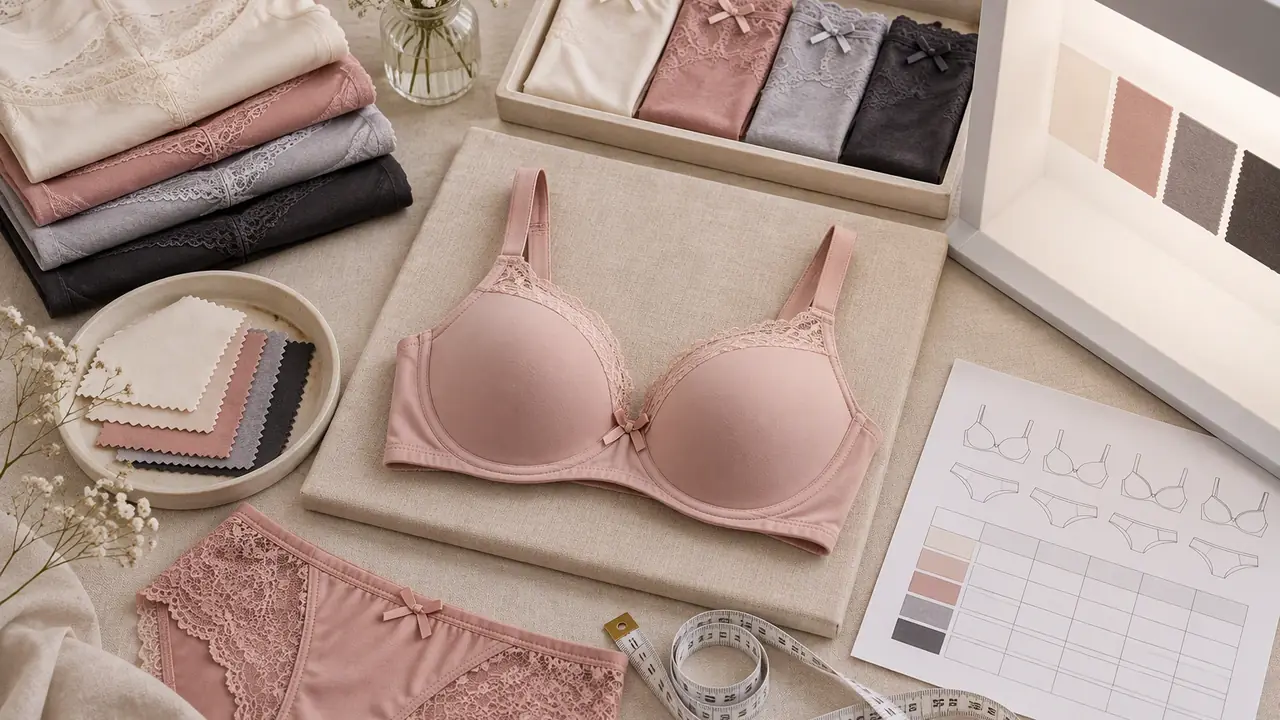
Why the band carries the load
Breast tissue has weight, and that weight has to be held by something. In every conventional construction the band and the wings around it take the majority of the load, transferring it into the ribcage; the cups shape the tissue and the straps hold the cups against the body while carrying a minority of the weight. This division of labor explains most fit advice: when the band is right, the straps settle, the cups sit level and the wires keep their track. When the band is wrong, every other component compensates, and the compensation shows up as the symptoms consumers report - digging straps, dropped cups, wires pressing at the side.
Tightness is the working surface of that anchoring. A band that is too loose cannot transfer load into the ribcage, so the whole system sags and slides; a band that is too tight transfers load perfectly and punishes the wearer for it. The fitting target sits between, and the two-finger rule is the quickest way to find it.
Band width is the second half of the anchoring equation, and it is a specification rather than a fit adjustment. A narrow band concentrates the same load into less contact area, which reads as pressure even when the tension is correct; a wider band spreads the load and can run at lower tension for the same anchor. This is why band depth grows with cup size across the category, why a wider underband is the first structural change in sport and full-bust constructions, and why substituting a narrower band on an approved style shows up in wear tests as pressure complaints without a single change in sizing. Width, tension and elastic grade move together, and the spec sheet should name all three.
The two-finger rule, applied properly
The rule says: fasten the bra and slide two fingers under the band at the side, between the band and the body. The fingers should fit snugly - with clear resistance, but without a fight - and the band should not lift away from the body as they slide. Applied cleanly, the test separates the three states:
- Fasten on the loosest hook row and stand straight, arms down.
- Slide two fingers under the band at the side, knuckles against the body.
- Reading one: the fingers slide with moderate resistance - the band is in range.
- Reading two: the fingers fly through with no resistance - the band is too loose.
- Reading three: the fingers need a struggle, or the wearer holds her breath - the band is too tight.
- Confirm with movement: arms overhead, then a few steps. The band should stay level and down.
The errors are as useful as the rule. Applying it on a tight hook row misreads a correct band as tight, which is why the test starts on the loosest hook. Applying it immediately after exercise or at the end of a hot day misreads swelling as tightness. And applying it while inhaling deeply does the reverse. The test reads a moment; the movement check reads the day.
Hook rows: the adjustment built into the band
Hook-and-eye closures exist because elastic relaxes. A new band is worn on the loosest row so that, as the elastic loses recovery over weeks and months of rotation, the wearer can move to a tighter row and restore the original tension. A bra that starts on its tightest row has no future in it - the fit only decays. This is also why fit checks on new production belong on the loosest row: that is the reference state the grade was written for. The closure hardware itself - rows, gauge, tape - has its own construction logic, set out in the hook and eye note.
| Size range | Typical rows | Reason |
|---|---|---|
| Smaller bands, A-C cups | 2 | Lighter load, shallower band |
| Mid bands or D+ cups | 2-3 | Load and adjustment range both grow |
| Larger bands, DD and up | 3-4 | Load spread across a deeper band |
The table describes category practice, not a rule; constructions vary, and strapless styles often add a row regardless of size because their anchoring budget is thinner. What is consistent is the direction: as load grows, rows grow with it.
Snug but not tight: where the line sits
Between riding up and digging sits a band that is level, stable and forgotten. Wearers describe the wrong states more easily than the right one, so the working definitions run negative: no red marks that persist past a few minutes after removal, no relief when the bra comes off at night, no conscious awareness of pressure during a normal breath. Riding up with a comfortable band points at size - a band step down on the sister-size diagonal; tightness with a level band points at elastic grade or at a construction mismatch between band depth and load. Both symptoms and their fixes are mapped in the riding-up note.
Elastic quality, testing and production tolerance
Whether a band stays in range is a materials outcome. Band elastic is specified by stretch ratio and recovery, and the per-order test items that matter here are elastic recovery after repeated extension and band width stability after washing. Fabric lots arrive with their OEKO-TEX Standard 100 documentation per certificate per lot, and the desk verifies test reports per project rather than assuming continuity between orders. Production is then inspected against the approved sample and the declared tolerances, which is described on the testing and inspection page.
For a program, the band spec lives in the same document as the grade rule: band width by size, elastic type and stretch ratio, closure rows and placement, and the tolerance window for the finished band circumference. Those parameters are what a plant quotes against, and the quote form takes them at the start; reference minimums and sampling timelines sit on MOQ and lead time. A band specified this way is repeatable; a band remembered from a sample is not.