
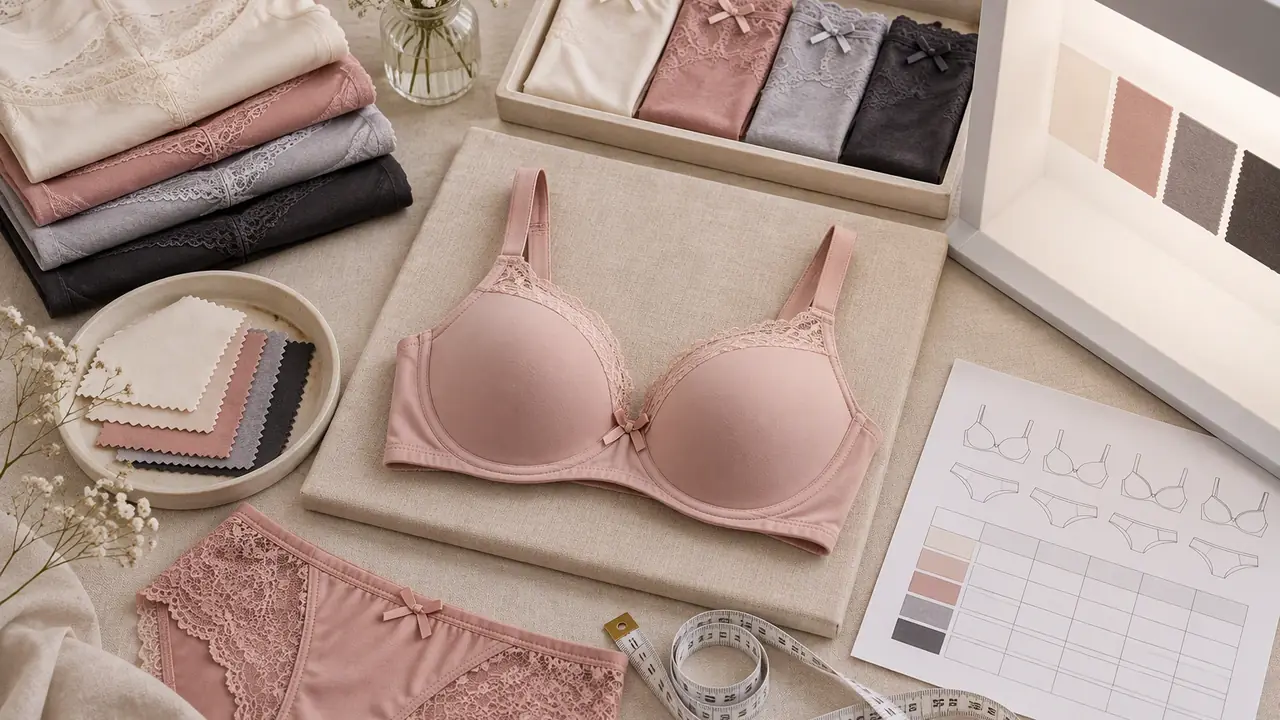
Where the plus segment sits on the size map
There is no regulatory line for plus-size in intimate apparel; the industry reads it as the region where support engineering changes, usually from a D cup upward or from a 38 band upward. The published windows of the common constructions show the territory: balconette lines typically grade 30-44 in the band with cups A-DD and beyond, wireless lines 32-44, strapless 32-42, and sports constructions reach A-H in graded cup runs. Within those windows, the upper corner - bands 38 and above with cups DD and above - is where the design decisions below become non-negotiable.
That corner is also where fit complaints concentrate when a brand treats plus as a simple extension of its core grid. The complaints are predictable: bands that ride up because the elastic was stretched to a length it cannot anchor, straps that carry load they were never dimensioned for, cups that gap at the top edge because the mold was scaled rather than re-drafted. All three are engineering failures, not consumer errors.
What changes in the construction
Above a D cup, the load that the band and wings must anchor grows while the surface area for anchoring grows more slowly. The component answers are common across plants because they follow from the physics:
| Component | Common change | Reason |
|---|---|---|
| Straps | Wider, lower-stretch elastic, often padded | Load per square centimetre of shoulder |
| Closure | Three or four hook rows instead of two | Deeper band, adjustment range, load spread |
| Wings | Powermesh or firm two-ply, sometimes with boning | Lateral containment without digging |
| Cups | Three-panel cut-and-sew or deeper molds | Projection varies more at larger volumes |
| Wires | Longer, flatter curvature | Wider breast roots at larger volumes |
| Band elastic | Lower stretch, higher recovery grade | Anchoring without riding up |
The band tightness note explains why the band, not the straps, carries most of the load in any construction; in the plus segment that principle is simply less forgiving. A two-row closure that is acceptable on a 34B becomes a pressure point on a 40DD, and a decorative strap becomes a complaint generator within weeks of wear. Wire curvature is covered in the underwire note; the short version is that wire length and root width must be graded together or the wire sits on tissue instead of around it.
Grading is not linear
A straight-line grade - add a fixed increment per size in every direction - holds across the middle of a grid and fails at its edges. As the band increases, the cup letter for the same volume decreases along the sister-size diagonal, so a 38DD is not a 34DD enlarged: it is a different volume with a different wire, a different side depth and a different mold. Plants that serve the plus segment well grade each construction from a base pattern placed inside the segment, not from the small end of the core grid stretched outward.
Molding amplifies the problem. A molded cup is only as good as its form, and forms exist per size; a plant without the larger forms cannot serve the segment regardless of pattern skill. Cut-and-sewn, multi-panel cups avoid the tooling constraint and are therefore the usual first choice for a plus launch, at the cost of more sewing operations per cup. This is one of the first trade-offs the desk puts in front of a brand planning the segment.
It also changes the sample plan. A plus program needs its fit blocks evaluated inside the segment - a 40F block, not only a 34C block - because seam placement, wing height and strap anchor points all shift as the pattern is re-drafted. Fit sessions therefore cost more sessions per style in this segment, and the sampling timeline stretches accordingly. Brands that plan for this from the first quote avoid the classic failure mode: a style approved at the middle size that unravels across the top of the grid at inspection, when correction is easiest to refuse and most costly to absorb.
Testing points for larger sizes
The test items agreed per order apply at every size, but the pass criteria at the top of the grid decide whether the program survives contact with wear. The items that matter most in the plus segment are elastic recovery on the band, stretch and recovery on the side wings, strap attachment strength and, for wired styles, the security of the wire channeling closure. Underwear constructions in general are checked for color fastness, shrinkage and pH as agreed per order, and fabric lots carry their OEKO-TEX Standard 100 documentation per certificate per lot.
Documents close the loop: test reports per lot, wire and trim specifications, and the fiber and care labeling that US retail requires. The desk verifies documents per project rather than accepting them on file reputation, and the quality control page describes how inspection sampling is weighted toward the largest sizes in the run.
Planning the range and the size ratio
A plus program is planned from the diagonal families outward. A first drop that covers two volume families across bands 36-44 and cups D-G generates a manageable SKU count while still reading as a serious range on shelf. Grading depth has a direct minimum-order effect: plants quote minimums per color, and the size ratio inside each color lot is a planning decision confirmed in writing per program. Reference minimums and lead times are on MOQ and lead time, and the size run belongs in the first conversation - the quote form asks for it up front.
The wireless question comes up in every plus planning session. Wireless construction is not the absence of support; at full-bust volumes it substitutes structured cups, firm wings and wide bands for the wire, and it is a legitimate line alongside wired styles rather than a compromise. The wireless line grades to 44 in the band for exactly this reason, and the sports constructions graded to H cups serve the high-movement end of the segment.