
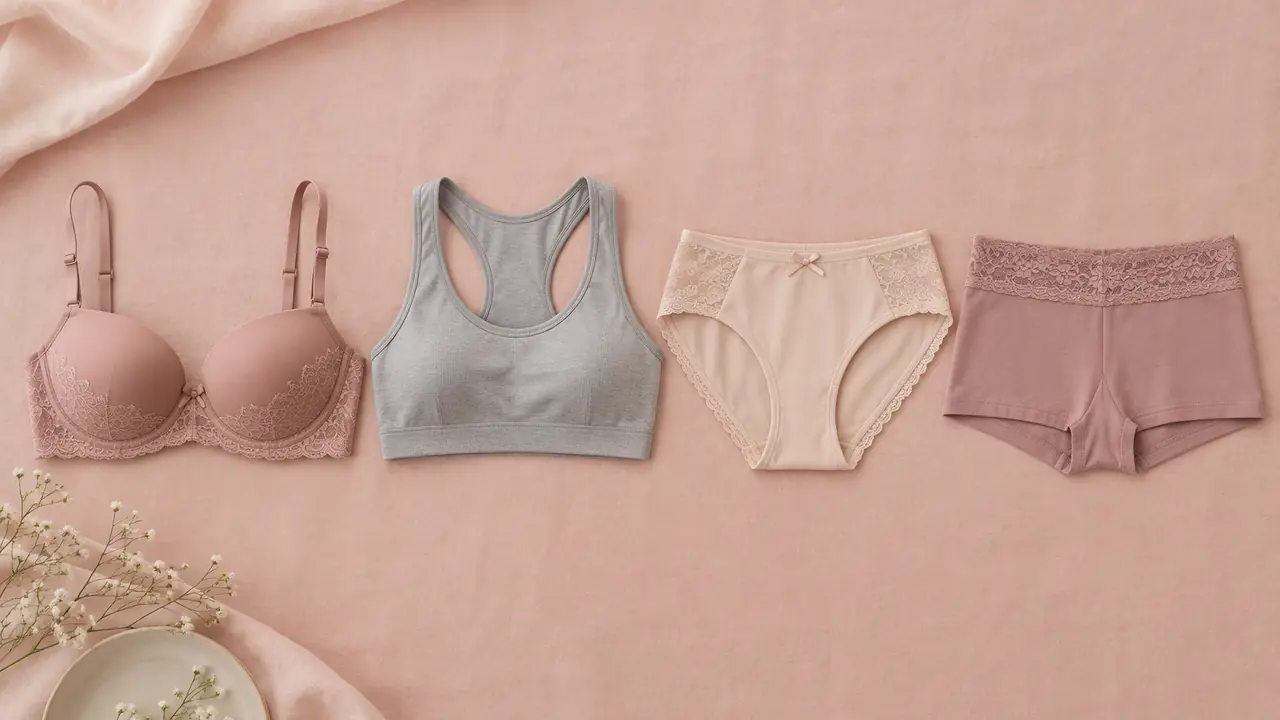
What defines the style
Three features define a boyshort: a mid rise, a rear panel that covers the seat completely, and a leg opening that runs straight across the upper thigh instead of curving up over the hip. The silhouette comes from menswear, but the block is not a scaled-down mens brief - womens grading moves the volume differently, and a proper boyshort block is drafted and graded on womens measurements.
For a buyer the style fills a specific slot: full coverage with a sportier read than a brief, and a straighter leg line that keeps fabric under the seat when the wearer moves. That is also why boyshorts are the usual answer when a channel asks for coverage without the look of a classic brief.
In range terms the style usually sits third or fourth in a panty ladder, after a brief lead and a bikini, often shared across channels: DTC assortments use it as a comfort-forward option, retail chains slot it into basics multipacks, and marketplace catalogs carry it as a coverage answer in mixed packs. Because the silhouette is stable year to year, planning for it behaves more like a basics program than a fashion program, which simplifies repeat orders and batch color matching.
Pattern and seam construction
Most boyshorts are cut-and-sew: a front panel, a rear panel, optional side panels and a crotch gusset, joined with seams chosen for flatness. Flatlock is the default for the seams that pass under or across the seat, because a raised seam on that panel shows through clothing and irritates on long wear. The stitching note compares flatlock, zigzag and coverstitch applications across the category.
A center back seam is a real design decision rather than a cost saving. It lets the rear panel be drafted with contour - two shaped halves instead of one flat piece - which is how a full-coverage panel avoids bagging at the under-curve. Seamless boyshorts exist too, knitted as a tube with zone density changes, and they trade the contoured rear for an edge-free finish; both routes are common in the panty clusters.
Leg openings take one of two finishes: a narrow stitched binding, or a light elastic under a fabric-facing. Heavy leg elastic works against the style, because the straight leg opening is meant to stay put without gripping; if samples show pressure lines at the thigh, the usual fix is a softer, wider elastic or a bound edge, not a tighter one.
Fabric and stretch
Cotton, modal and cotton-modal blends dominate the style, usually with a small elastane share for recovery; lace-trim versions add a decorative waistband or leg edge over a functional base. The elastane share matters more here than in a bikini, because the leg opening has no aggressive elastic to pull the panel back into place - recovery has to come from the fabric itself. The elastane note explains how percentage and recovery behave across weights.
Stretch recovery is the test that predicts wear behavior for this style. A fabric that recovers well keeps the rear panel seated through a day of sitting and movement; a fabric that grows with wear lets the panel sag even though the fit sample looked right. Recovery checks are standard per-order test items and belong in the inspection scope for any boyshort program.
One constant across fabric choices: the gusset lining stays cotton, as it does across the panty category, whatever the shell carries. When buyers propose a fully synthetic shell for a sporty read, the lining is the compromise that keeps the program standard, and it should be written into the spec rather than left to the plant default.
Fit and sizing
Boyshorts grade across XS-3XL in typical runs, and they are graded from the hip more than the waist, because the panel volume sits at the seat. That makes the style less tolerant of grading shortcuts than a brief: if the hip curve does not grow correctly through the run, the rear panel either pulls tight at the top sizes or bags at the small ones. The panty sizing note covers how waist and hip map to letters.
Ride-up is the failure mode to watch. Contrary to expectation, a boyshort does not stay put automatically; if the leg opening sits too high on the thigh or the fabric lacks recovery, the panel creeps up exactly like a shorter style would. Fit samples should be wear-tested with movement - sitting, stairs, a walk - not just inspected flat.
Boyshorts against brief and cheeky cuts
| Feature | Boyshorts | Brief | Cheeky cut |
|---|---|---|---|
| Rear coverage | Full, leg opening low on the seat | Full, leg opening higher on the hip | Partial, narrowed rear panel |
| Rise | Mid | High, mid or low | Mid to hip |
| Leg line under clothing | Straight across the thigh | Curved over the hip | Curved, higher cut |
| Usual fabrics | Cotton, modal, lace trim | Cotton, modal, lace | Lace, mesh, microfiber |
| Grading focus | Hip and seat | Waist and hip | Hip and rear panel width |
The cheeky cut shares the boyshort waist zone but trims the rear panel; the differences are set out in the cheeky cut note. Buyers choosing between them are really choosing how much rear panel the channel needs, and that decision belongs before sampling, not after.
Range planning and quantities
- Position boyshorts as the coverage option in the ladder, alongside a brief lead and a bikini or cheeky fashion line.
- Decide cut-and-sew or seamless first; it changes the plant shortlist more than the fabric does.
- Set the elastane share with the fabric mill, then lock recovery as a test item, not a hope.
- Fit-test with movement in the sample round, especially across the top sizes.
- Confirm quantity per color; the style usually sits on the same panty minimums as other cuts.
Where the style lands in a program - coverage basic or sporty fashion line - decides the fabric ladder and the trim level. The quote form captures that positioning in the specification step, so matched plants can quote the block and the fabric together.