
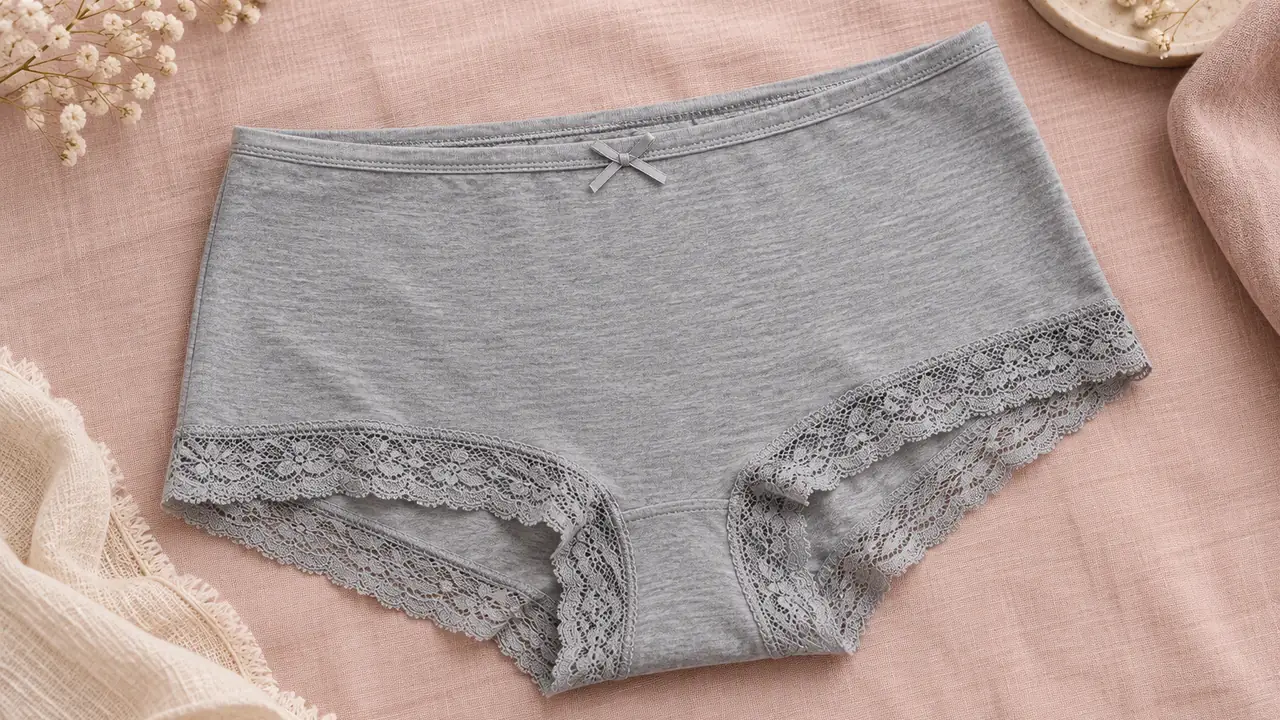
What a boyshort is
A boyshort is the full-coverage panty built on a boy-leg cut: the leg openings extend down the upper thigh instead of cutting up over the hip, the rear panel covers the seat completely, and the waistband sits at mid rise. The style borrows its geometry from men's briefs and keeps the promise in the name - no leg-line ride-up, no seat gap, a straight silhouette under trousers, skirts and loungewear.
In a sourcing program the boyshort plays two roles at once. It is a coverage basic for customers who want the brief's full seat with a different leg line, and it is a lounge-and-sleep style that brands often extend into matching sets. Both roles reward the same things: stable knit fabrics, hems that stay flat through the wash and a size run that grades cleanly across XS-3XL.
The six layers on the card
| Layer | What decides quality | Typical options |
|---|---|---|
| 1 Body fabric | Softness, four-way recovery, pilling resistance | Modal or cotton-modal jersey, combed cotton |
| 2 Gusset lining | Fiber purity, stitch plan, breathability | OEKO-TEX cotton, single layer |
| 3 Rear and leg panels | Cut geometry, seat coverage, leg-opening shape | Boy-leg cut, side-seam or seamless tube |
| 4 Waistband and leg hems | Roll resistance, hem flatness after wash | Coverstitched elastic, bonded hems, lace trim |
| 5 Fixings and labels | Label comfort, brand tab placement | Heat-transfer labels, tagless print, woven tabs |
| 6 Packaging | Presentation and set readiness | Poly bag, tissue wrap, printed box, set bands |
Size runs and fabric options on this page are typical ranges seen across the category, not a datasheet. Each program carries its own spec sheet, and the figures a brand prints are confirmed from that sheet. The style is positioned against the brief in the panty styles guide.
Boy-leg geometry and what it changes
The cut changes the production conversation in two places. First, the leg openings are longer and rounder than a brief's, so the hem construction carries more load: a leg hem that rolls or waves is the style's main defect risk, and bonded or coverstitched hems are sampled across the size run before the batch is confirmed. Second, the fuller pattern uses more fabric per unit, which moves the fabric decision toward stable, high-recovery knits that hold shape without heavier elastics.
There is also a construction fork worth naming at program start: cut-and-sew boyshorts with side seams grade predictably and suit print and lace-trim work, while seamless tubes knitted on circular machines remove the side seams altogether and suit jersey programs at volume. The two routes differ in sample timing and MOQ behavior, and the desk sets them out in the program sheet. The cut itself is profiled in the boyshorts guide.
Fabrics and trims
Modal and cotton-modal jerseys are the workhorse choices: soft hand, good recovery, low pilling when knitted to spec. Combed cotton serves the value tier; a lace trim at the leg hem or waistband is the usual feminine counterpoint and is specified with its stretch and recovery named on the sheet, as for the bikini line. Fiber trade-offs are compared in cotton vs modal panties, and elastic behavior over time in elastic types in intimates.
Certification and labeling
The category baseline holds: OEKO-TEX Standard 100 per lot, covering yarn to finished product, gusset and elastics included. US programs add fiber content labeling under the Textile Fiber Products Identification Act, care labeling under the FTC Care Labeling Rule and 16 CFR 1610 flammability; EU-bound batches add REACH SVHC screening. Because boyshorts often ship as lounge sets, the labeling plan is agreed across the set, not per garment alone. The full route is in the fabric certifications guide.
Where boyshorts are made
Cut-and-sew boyshorts come primarily from the Puning belt in Guangdong, which carries the deepest cut-and-sew panty chain in the country, while seamless-tube boyshorts draw on Yiwu's seamless-knitting capacity and Shantou's lace handling. The desk shortlists plants by knit sourcing, hem construction discipline and the certificate file they can produce per lot. More on the clusters.
Inspection before shipment
- Waistband circumference, leg-opening shape and seat coverage on sampled units against the program sheet.
- Hem flatness after stretch and wash cycles at waist and both leg openings.
- Rear panel alignment and, on seamless tubes, knitting grade consistency across the size run.
- Gusset lining attachment, fiber content and stitch density.
- Color against the retained swatch under a standard lamp, set components included.
- Carton drop test, fiber and care labels, and pack contents against the approved sheet.
The inspection plan is written per program and confirmed before the first batch; see quality control. Reference quantities and timing sit on the MOQ and lead time page, and the quote form lists what the plants will ask for.