
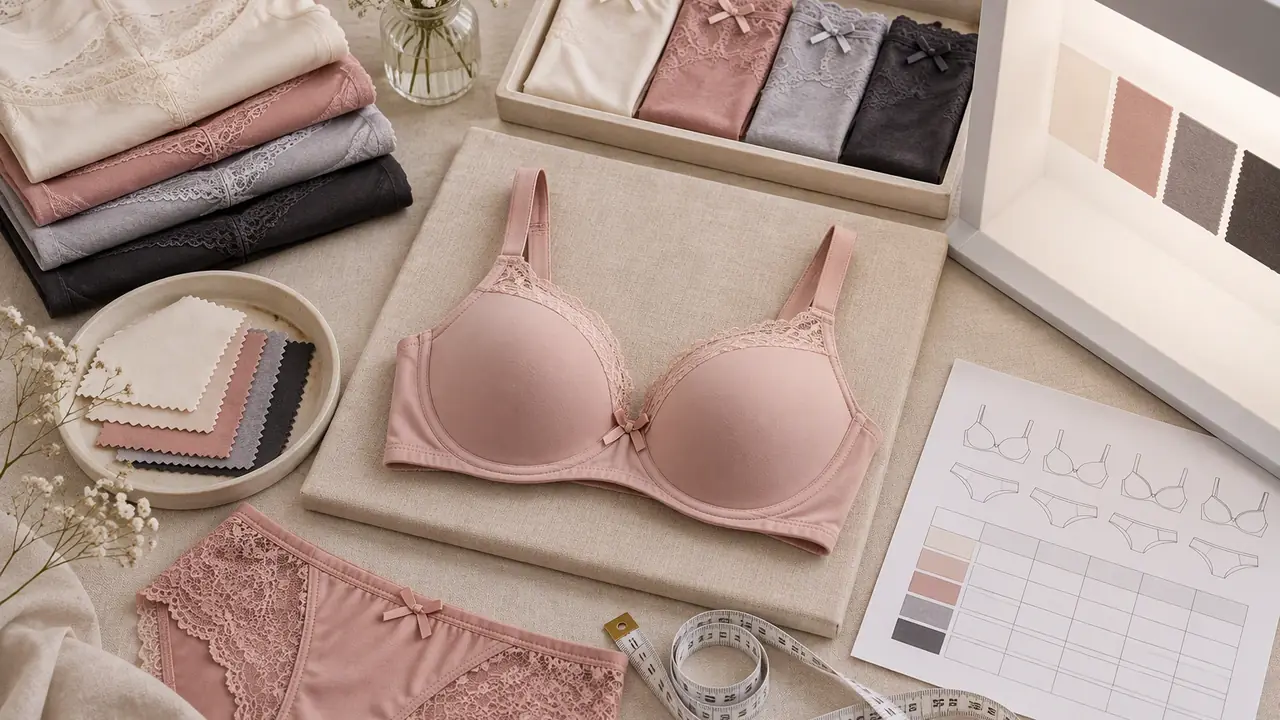
Two numbers decide the label
A bra label carries two pieces of information: a band number and a cup letter. The band number tracks the circumference of the ribcage directly under the bust, called the underbust. The cup letter is not a measurement in its own right; it expresses the difference between the full bust and the underbust at that particular band. This is why a 34C and a 36B can hold a similar volume of breast tissue, and why a bust measurement alone produces a number nobody can use.
For a buyer, the two-number logic matters beyond consumer education. Every size on a range plan translates into a graded pattern, a wire length, an elastic cut length and, where the cup is molded, a molding form. When the desk scopes a program with a brand, the measurement convention is fixed first, because it decides how the grade rules are written and which plants can serve the range.
Measuring step by step
The method below is the version most commonly published in English-language fit guides. A soft tape measure and a mirror are enough. Measurements are taken snug against the skin, standing upright with relaxed shoulders, at the end of a normal exhale.
- Underbust: wrap the tape around the ribcage directly under the bust, keep it level all the way round, exhale gently and read. Record inches or centimetres and stay in that unit.
- Full bust: wrap the tape around the fullest part of the bust, usually across the nipple line, keeping it level and without compressing the tissue. A thin, unpadded bra may be worn; a padded or molded one should not.
- Round the underbust to the band label in the convention you are using. Most US and UK charts round to the nearest even number; most European charts round to the nearest 5 cm step.
- Subtract the band measurement from the bust measurement. In the common US and UK sequences, each full inch of difference corresponds to one cup letter.
- Write the pair down as a starting size, not a verdict. Confirmation happens against a worn garment, not against the tape.
From tape to size: the common conventions
The tables below show the rounding most English-language charts publish. They are conventions, not regulations; individual ranges shift the boundaries by a step in either direction, which is one reason the same person can wear two different labels in two different ranges.
| Underbust (in) | Underbust (cm) | Band label |
|---|---|---|
| 26-27 | 66-69 | 28 |
| 28-29 | 71-74 | 30 |
| 30-31 | 76-79 | 32 |
| 32-33 | 81-84 | 34 |
| 34-35 | 86-89 | 36 |
| 36-37 | 91-94 | 38 |
| 38-39 | 96-99 | 40 |
| Difference (in) | US letter | Note |
|---|---|---|
| 1 | A | Smallest lettered volume in most ranges |
| 2 | B | Core volume for everyday lines |
| 3 | C | Core volume for everyday lines |
| 4 | D | Grading widens here for many plants |
| 5 | DD | UK charts write E at this step |
| 6 | DDD or F | Publishers split on the label |
| 7 | G | Construction limits start to matter |
European labels work differently: the band number is the underbust in centimetres rounded to a 5 cm step, so a 75 band sits close to a 75 cm underbust. The letter sequences also stop matching above a D, where US charts double letters and European charts continue with single letters. The regional differences are laid out in the conversion guide.
Where measuring goes wrong
Four errors account for most useless measurements. Tape tension: a tape pulled tight compresses the underbust and understates the band, which then pushes the cup letter up. Posture: measuring while bent forward inflates the bust reading. Padding: measuring over a padded or molded cup adds the cup's internal volume to the bust. Mixed units: writing the band in centimetres and reading it against an inch-based letter sequence shifts the result by several steps.
There is also a structural limit. A tape measures circumference at two levels; it cannot see breast shape, root width, projection or spacing. Two people with identical tape readings can need different wire lengths and different cup depths from the same label size. This is why consumer-facing fit content ends with the same instruction: treat the measured size as a starting point and confirm against a worn garment. The observable checks are listed in the fit signs note.
From a personal size to a production grid
Consumer measurement and production sizing are related but not identical jobs. A consumer wants one label; a brand needs a grid that covers its market with as few size SKUs as possible. The desk's workflow converts the measurement convention into a grade plan: a core band run, a cup run matched to the line's construction limits, and a defined set of sister sizes so the grid stays compact. The lines on the bras category page publish the band and cup ranges each construction typically covers, from balconette at 30-44 to sports constructions graded A-H.
Grade depth has a direct cost effect. A style graded across six bands and four cups is twenty-four size SKUs before colors are counted, and plants quote minimums per color rather than per size, so the size ratio inside each color lot is a planning decision, not an afterthought. Reference minimums and sampling timelines are on MOQ and lead time, and the quote form asks for the size run up front so plants price the grading work correctly.
Fit sessions close the loop. Samples are made across the size grid, not only at the middle size, because a pattern that fits at 34C can drift at 38DD where wire length, side depth and elastic recovery interact. Sampling for catalog constructions typically runs one to three weeks; every figure is confirmed in writing per program.