
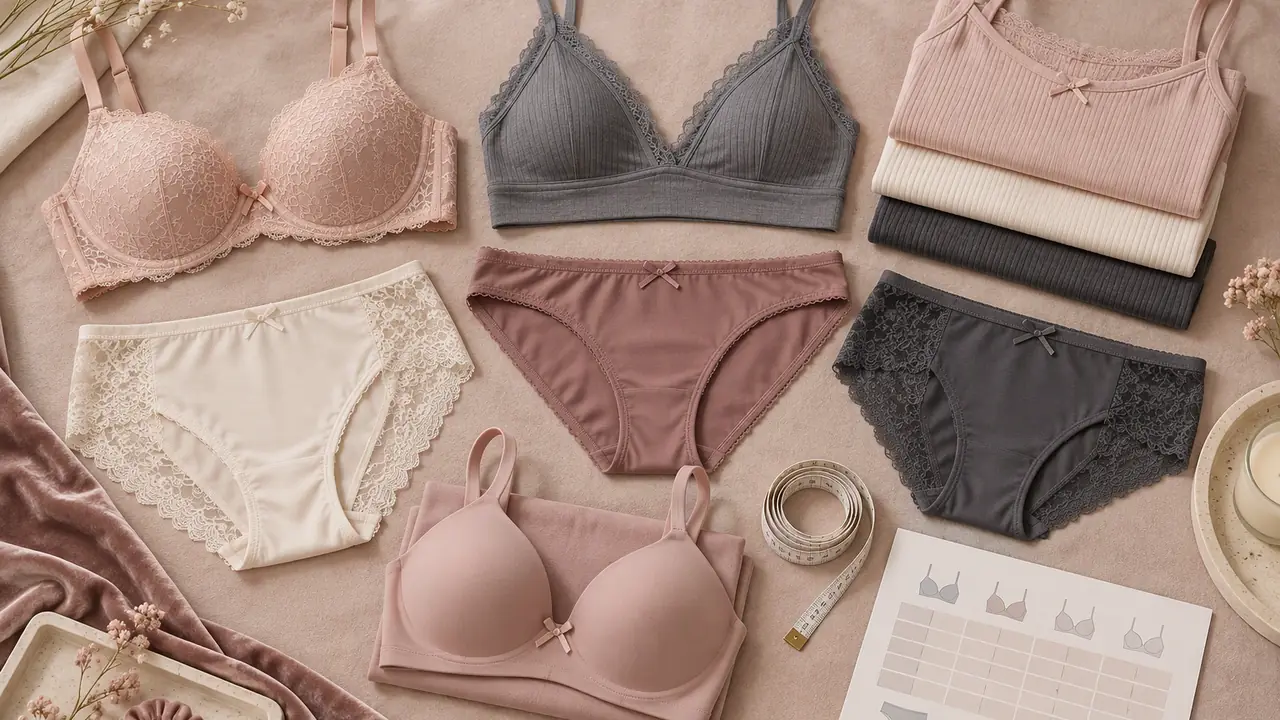
Band and cup: the measuring method
Bra sizing starts with two body measurements. The underbust sets the band; the difference between underbust and bust at the fullest point sets the cup letter. Most charts round the underbust to an even band number and assign one cup letter per increment of difference, which is why the same person can wear different letters on different bands - the letter describes a ratio, not a fixed volume.
On the garment side the equivalent checks are physical: band circumference cut and stretched against the sheet, cup depth on a form, elastic recovery after cycling. Keyword tools rank bra size calculator among the highest-volume searches in the whole category, which tells a buyer how much attention the chart will get once the range is live; a chart that matches the garment earns that attention, and one that does not pays for it in returns.
Cup volume and sister sizes
Sister sizing is the chart's internal logic: as the band moves one step, the cup letter moves the other way to hold the same cup volume, so a 34C holds roughly the volume of a 32D and a 36B. Buyers use the logic twice. In range planning it shows which graded sizes share cup molds, which trims tooling cost across a chart. In listing content it lets one style be described across adjacent sizes without implying three different garments. The sister sizes explainer works an example in full, and the size chart guide maps the whole grid.
Plus size programs
Plus size is an engineering brief, not a larger label. Bands extend toward the upper end of the 30-44 span, cups toward DD+ and beyond on capable plants, and the support structure changes with them: wider bands, more hook rows, firmer wings, straps that widen with cup volume. Plants differ most here; molding and grading capability at the upper spans is scarcer than at the core of the chart, which is why the desk shortlists plus size programs by plant capability first rather than by any other criterion. The plus size guide details the construction changes size by size.
International conversion
Band numbers differ by market convention: US and UK share inch-based bands, EU uses centimeter bands, France applies its own offset, and Australia numbers bands by dress size. Cup letters diverge past D - a US DD equals an EU E on most published tables, and beyond that point the charts disagree with each other. The table below is the commonly published reference shape; it is a reading aid for comparing listings, not a substitute for the program chart.
| US band | UK | EU | FR | AU |
|---|---|---|---|---|
| 32 | 32 | 70 | 85 | 10 |
| 34 | 34 | 75 | 90 | 12 |
| 36 | 36 | 80 | 95 | 14 |
| 38 | 38 | 85 | 100 | 16 |
Converters on listing pages are fine for shoppers; for production they are a risk. The garment is cut to the program chart, so every listing, bar code and carton copy should trace back to that chart rather than to a conversion site.
From chart to production: grading
A size chart becomes a production tool through grading: each size increments the pattern by set amounts at the band, the cup and the strap. The increments are per program, agreed with the plant and proven on a graded fit set - not on the base size alone. Tolerances travel with the chart onto the inspection plan, so a band measured in the batch is compared against the program sheet rather than against a general notion of correct. The grading for production guide shows the increment structure style by style.
Sizing documentation and returns
Sizing failures surface as returns, and returns are fought with documents: a listing chart copied from the program chart, fit notes that say which sister size to choose at the margins of the range, and inspection records that show the batch matched the chart it shipped against. Panty sizing runs simpler - waist and hip mapped to the XS-3XL spans - but the same discipline applies, and the quality control page shows where size checks sit in the lot inspection. For multi-line programs the charts are kept in one file, so a brand listing a bra beside its matching brief quotes one source of truth instead of two.