
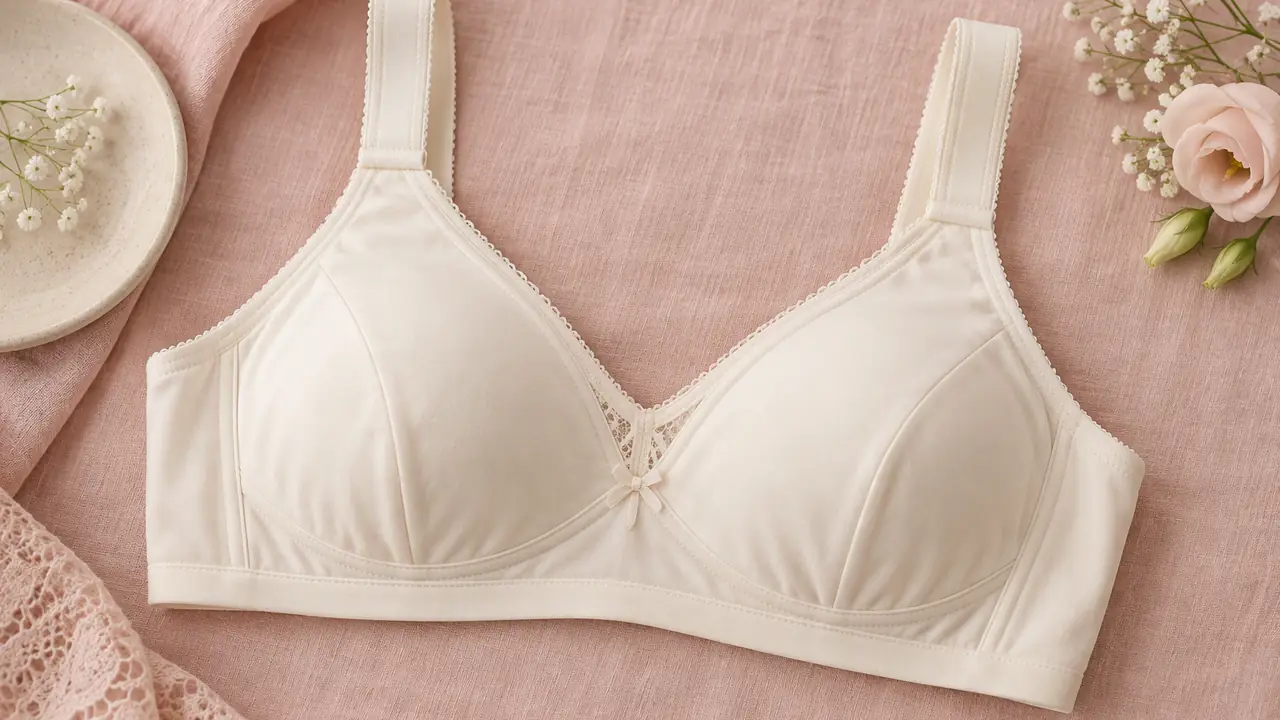
What a wireless bra is
A wireless bra removes the metal underwire and rebuilds support from structure: a wider underband, a higher and firmer side wing, an internal support frame or sling, and cups that hold their shape on their own. Cup ranges run A-DD+ and band ranges 32-44 as category references, with two- or three-hook closures or pullover bodies depending on the style. It is the line closest to everyday comfort and, for many brands, the line with the deepest repeat purchase.
The construction looks simpler than a wired bra and is not. Without a wire to carry load, the band and frame do the work, which raises the standard on elastic quality, frame stitching and cup firmness. A wireless style that skimps on the underband reads as loose within a week of wear, so the desk checks band tension and recovery as first-order items rather than as an afterthought.
The six layers on the card
| Layer | What decides quality | Typical options |
|---|---|---|
| 1 Cups | Self-holding shape, foam density or panel geometry | Molded soft cup; 2-3 piece cut-and-sew; A-DD+ |
| 2 Band | Underband depth, elastic quality, closure rows | 32-44 band; 2-3 hooks or pullover |
| 3 Straps | Width, padding, center or wide set | Padded options; fixed or adjustable |
| 4 Wing and side | Side height, frame rigidity, elastic grade | Elastic side panel; internal frame or sling |
| 5 Fabric | Face fiber and hand feel, OEKO-TEX class | Cotton blend, modal or microfiber; cotton gusset |
| 6 Hardware and trims | Slider and ring finish, labeling method | Nickel-free plastic; woven or tagless labels |
Every layer above is confirmed on the program spec sheet; the figures on this page are category references. The construction anatomy post explains how the frame replaces the wire, layer by layer.
How support works without a wire
Three elements replace the wire. The underband carries most of the load and typically runs deeper than a wired sister style; its elastic is specified by width and tension on the program sheet. The internal frame - a rigid or semi-rigid panel between cup and wing - keeps the side wall tall so the cup does not fold in wear. And the cup itself holds shape through foam density or panel geometry, whether molded or cut-and-sewn. Compared with the wired balconette, the line trades edge definition for everyday wearability, which is why the two lines so often sit side by side in a first program.
Fabric choices and the comfort story
Cotton blends lead programs that sell on skin feel, modal reads as a smoother drape under thin knits, and microfiber carries the cleanest surface for seamless-looking styles. Whatever the face, the gusset lining stays cotton and the whole article sits under OEKO-TEX Standard 100 per certificate per lot. United States labeling applies unchanged - fiber content under the Textile Fiber Products Identification Act, care instructions under the FTC Care Labeling Rule - with 16 CFR 1610 for flammability. The certifications guide lists the document set per lot, and the cotton versus modal post gives a fabric comparison teams can reuse across categories.
Options worth specifying
- Support frame. Internal sling, structured side panel, or layered wing.
- Closure. Two or three hook rows; pullover for a lounge crossover.
- Strap plan. Padded straps for fuller cups; front-adjust for easy wear.
- Surface. Seamless-knit body where the style allows; see the production process.
- Branding. Tagless printed neck label; woven flag at the side; see OEM and private label.
Where wireless lines are made
The line runs on two production bases. Shantou and Puning build structured wireless styles - molded soft cups, frames, hook closures - on the same benches as wired programs. The seamless-knit base around Yiwu builds pullover and lounge-leaning bodies where the knit itself forms the cup. The desk matches construction to base at shortlist stage, because a pullover style quoted on a cut-and-sew bench loses its cost logic. The cluster page describes both bases.
Inspection before shipment
- Underband tension and elastic recovery after three stretch cycles.
- Frame stitching and side wall height on sampled units.
- Cup depth symmetry across the size run.
- Closure gauge and stitch density at the back.
- Color against the retained swatch under a standard lamp.
- Carton check: label set, poly or box spec and pack count per the approved sheet.
Reference MOQ and lead ranges sit on the MOQ and lead time page; the quote form collects the size grid, fabric direction and closure type a plant responds to first.