
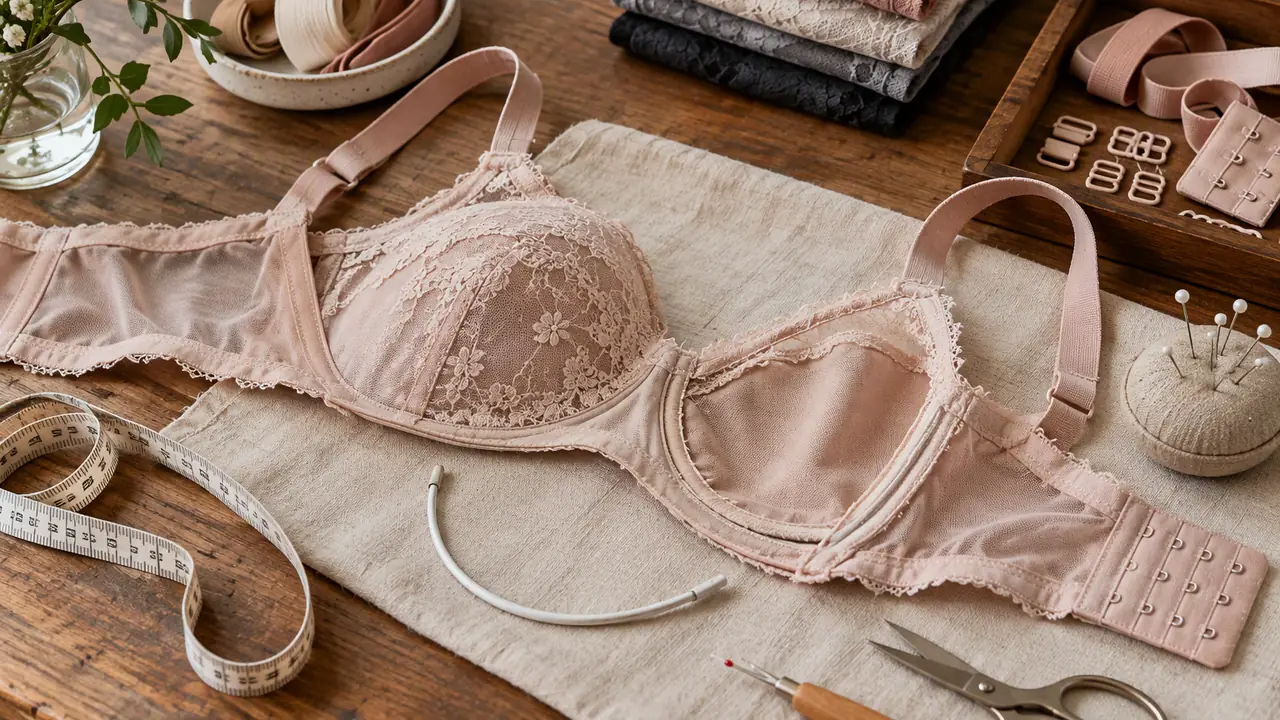
What gapping is telling you
A seated cup meets the torso along its whole edge: the underwire or the structured bottom edge follows the crease where the breast meets the chest, and the top edge lies against the tissue without pressing it. Gapping is any place that contact fails - the classic sign is a top edge that stands away from the breast or folds outward when the wearer leans forward. The fold matters more than the photograph: a gap visible only in a mirror check is a warning, a gap that opens in movement is a return.
For a fit reviewer the first sort is when and where. A gap at the top edge on both sides at a center size points to volume. A gap that appears only at the smallest or largest sizes of the ladder points to grading. A gap that appears after laundering points to materials. A gap on one side only points to pattern symmetry. Each has a different owner at the plant, which is why the sort is worth doing before a correction is sent; the note on signs of a good fit places the cup check inside the full fitting sequence.
Fit causes: volume, sister sizes and balance
The most common cause is simply too much cup volume for the tissue the style is sold to. Cup volume moves in non-obvious ways across the size grid: going down a band and up a cup letter keeps the cup volume roughly constant while changing the band, which is the logic behind sister sizes. A wearer who has sized for band comfort alone can easily finish in a cup that fits the band arithmetic but carries more volume than the tissue holds, and the surplus shows up as a top-edge gap. The note on cup volume and sister sizes works the grid in detail.
Balance is the second fit cause. A band set too loose lets the whole frame sit lower, which drops the cup edge away from the tissue even when the cup volume is correct; fixing the band can close a gap that was never a cup problem. This is why the desk asks fit reviewers to confirm band tension and cup seating as separate findings - a correction sent to the pattern room that mixes the two produces a new sample with a new problem. Consumer demand reflects how widespread this confusion is: Semrush keyword data puts the phrase bra size calculator at roughly 74,000 US searches per month, a volume that only exists because two-number fitting is genuinely hard to do without guidance.
Construction causes
When volume and band are right and the edge still refuses to seat, construction is the suspect. Molded cups hold a fixed geometry from a heat press; if the mold radius at the top edge is too open for the tissue distribution the size is sold to, the edge stands away no matter how the size run is adjusted. Cut-and-sew cups are more forgiving at the edge but introduce their own cause: a top-edge elastic that is too firm presses the edge flat at rest and folds it in movement, while one that is too loose never closes the contact. Fabric is the third lever - a cup fabric with high stretch modulus relaxes away from the tissue, and one with poor recovery lets the edge grow over the wear cycle. The note on molded versus unlined cups frames the wider choice, and the note on padding types covers how foam construction changes edge behavior.
| Gap pattern | Likely cause | Check | Spec response |
|---|---|---|---|
| Top edge stands away, both sides, center sizes | Cup volume too large for the audience | Sister-size check on the fitting notes | Adjust the grade center; confirm the size chart wording |
| Gap only at ladder ends | One pattern scaled linearly across the run | Fit the smallest and largest sizes | Sub-ladder patterns or tooling at breakpoints |
| Gap appears after laundering | Fabric or foam relaxation | Wash test with edge photos before and after | Lock fabric construction; recovery as a test item |
| Gap on one side only | Pattern asymmetry or mold error | Pattern audit against the graded nest | Pattern correction; in-line check at the molding press |
Grading and the ladder ends
Gapping concentrates at the ends of a size run because grading scales the pattern while tissue distribution does not scale linearly. A cup graded smoothly from a B center can read correct at C and gap at DD; the reverse happens at the small end, where a scaled pattern can press rather than seat. Plants that run wide ladders regularly solve this with sub-ladders - the pattern is re-blocked, or the mold re-tooled, at set size breakpoints instead of scaling one geometry across the whole run. The practical buying action is to ask, before sampling, where the breakpoints sit and what changes at each; the answer separates plants that make the full ladder from plants that make its center.
Molded programs carry a tooling dimension as well. Each molded cup size needs a mold, and a plant will quote the sizes it already has tooled faster and more reliably than sizes that need new tooling. When a program asks for gapping-free seating across an unusual ladder, the mold map is part of the quotation, not an implementation detail discovered at bulk.
Specifying cups that seat
- State the full band and cup run before sampling, and ask where the pattern or mold breakpoints sit in it.
- Fit the smallest and largest sizes in movement, not only the center size in a mirror check.
- Name the cup construction - molded, cut-and-sew, lined, unlined - and the top-edge elastic, so substitutions need re-approval.
- Require a wash test with top-edge photographs before and after, which catches relaxation gapping before bulk.
- Record material certificates per lot, with OEKO-TEX Standard 100 as the baseline for skin-contact layers.
Reference timing across the category: catalog-model samples in 7-15 days, branded samples in 15-25 days, bulk in 30-45 days for catalog models and 35-50 days for branded programs, all confirmed in writing per order; reference quantities sit on MOQ and lead time. Because gapping corrections usually route through the pattern room, the desk asks plants to return the corrected pattern nest with the second sample so the review can confirm the fix at the breakpoints. The quote form carries the size run and cup construction so partner plants quote the same geometry.