
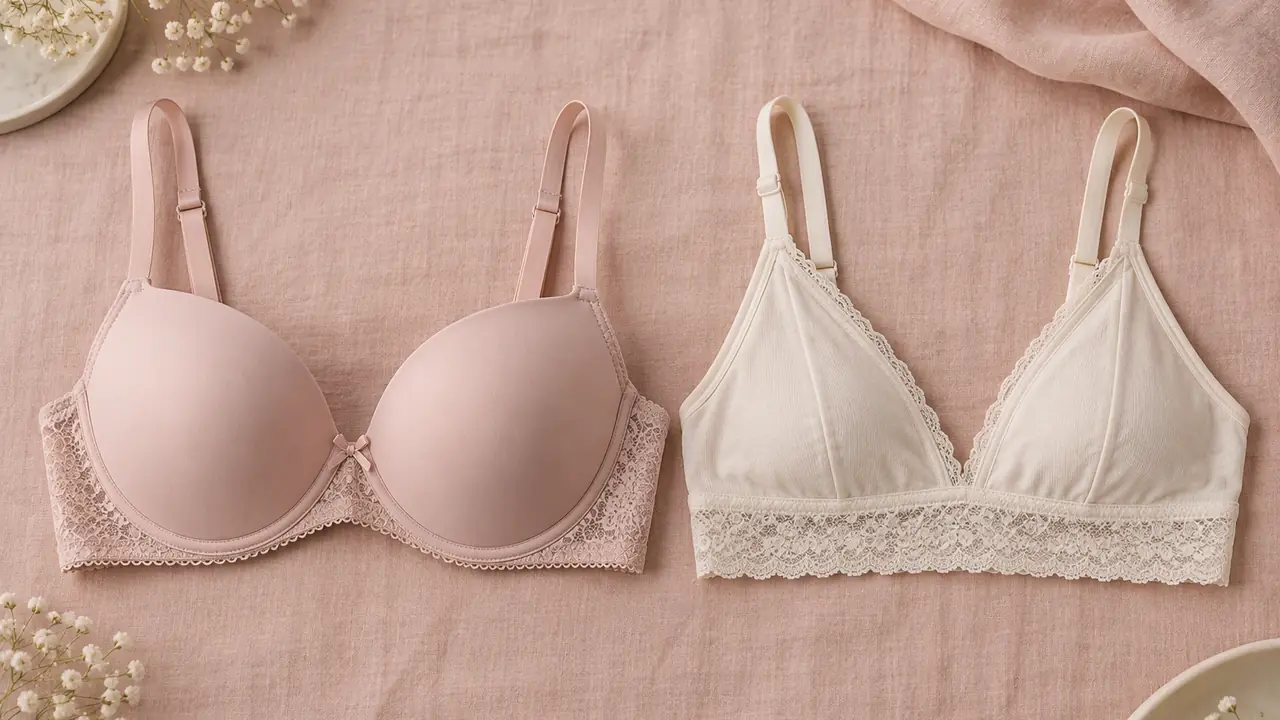
What each construction actually is
A molded cup is formed, not sewn. Layers of foam or dense-knit fabric are laminated and pressed over a heated mold shaped like the finished cup, so the cup comes out as a single smooth form with no seams across its face. An unlined cup is an assembly: two or three fabric panels cut from a pattern and joined with seams, with no foam at the cup face - at most a light lining layer. The distinction sits in the structure of the cup itself, separate from the padding question; a padded style and a push-up style use molded components, but so does the smoothest unpadded t-shirt bra.
Both constructions appear across every bra family. A balconette can be molded or cut-and-sewn; the same is true of full-coverage and demi styles. The padding types note covers the padding dimension - molded, removable, graduated - while this note stays on the structure of the cup, which is the decision with tooling and cost consequences.
Side by side: the cup decision
| Aspect | Molded | Unlined |
|---|---|---|
| How it is made | Laminated layers pressed over a heated mold | Panels cut and joined with seams |
| Look under clothing | Smooth line, no seam texture | Seam texture can show on fine knits |
| Feel in wear | Structured, holds its form | Lighter, moves with the tissue |
| Opacity | Higher, a layer by construction | Follows the face fabric |
| Grading | A mold per cup size | Pattern grading on the cutting table |
| Tooling | Mold library or custom molds | Pattern work, standard machinery |
| Suits best | Smooth everyday, t-shirt tiers | Lace and fashion tiers, lightness stories |
The opacity row is understated in most buying guides and matters at retail: a molded cup adds a layer by construction, so it reads more opaque in the same fabric. Unlined styles follow the face fabric, which is why lace and sheer-tricot fashion styles are almost always cut-and-sewn - the fabric is the point, and covering it would defeat the design.
Tooling and the mold library
Molded construction concentrates its cost in tooling. Every cup size needs a mold, and plants hold mold libraries covering the common size runs; that is why catalog-model molded bras quote fast - the balconette line, for instance, sits on tooling the Shantou cluster already runs. A brand bringing its own cup geometry needs custom molds, which adds tooling time before sampling and ties the program to a minimum run that amortizes the molds. Unlined construction spreads its cost differently: pattern work and sewing operations instead of molds, so a new unlined style samples without tooling but carries more sewing minutes per piece in bulk.
That arithmetic drives lead times. Typical reference ranges across the category: sampling in 7-15 days on a catalog model and 15-25 days on an OEM sample, with bulk in 30-45 days for public-mold programs and 35-50 days for OEM programs. A custom-mold program adds mold-making ahead of those figures and is quoted per project. Every figure is a category reference confirmed in writing per program on the MOQ and lead time page.
Wear behavior: what the wearer notices
In wear the two constructions diverge on three points. First, form: a molded cup holds its form on a drying rack and in a drawer, which is why the smooth line survives packing and washing; an unlined cup relaxes and depends on fit to read well. Second, weight and air: unlined cups carry less material and breathe more, which wearers register as lightness, particularly in warm months. Third, texture: seams sit against the tissue on an unlined style, so seam placement and type - flatlock against the skin rather than a raised decorative seam - decide comfort, as the stitching methods note details.
None of these points makes one construction better. They make each construction right for a tier: the smooth structured result suits the everyday tier where the bra is meant to disappear under clothing, and the light tactile result suits the fashion tier where the fabric and the seaming are the visible design. The construction anatomy note shows where the cup sits in the full component list.
Where each construction wins in a range
Ranges that carry both usually assign them by tier and season. The molded smooth cup anchors the core tier - restocked colors, dependable fit, the listing that never photographs badly. The unlined cut-and-sew cup carries the seasonal and fashion tiers, where lace overlays, panel seaming and sheer upper cups give the range something to say. A hybrid construction covers the middle: a molded lower cup for structure with an unlined or lace upper panel for texture, common on balconettes and demi styles where the upper edge is a design feature.
The hybrid has a QC consequence worth flagging: joining a molded component to a sewn panel puts the tolerance stack in one seam, and that seam is where the desk's inspection checks concentrate. When the join is clean, the hybrid gives a range its best of both; when it is rushed, it is the first point of failure.
Specifying the cup for a program
- Assign constructions by tier: molded for the smooth core, unlined for fashion, hybrid for the middle.
- For molded styles, confirm which cup sizes the plant's mold library covers before fixing the size range.
- For custom cup geometry, quote the mold tooling and its amortization quantity as a separate line.
- For unlined styles, specify seam types and placements per panel, not just the fabric.
- Put cup form retention and seam strength on the per-order test list.
- Sample the same size in both constructions if the tier split is undecided.
When the cup construction is set per tier, the quote form takes construction, size range and quantity per color in one pass, and the plants the desk works with quote molded and cut-and-sew lines in parallel so the comparison arrives on real numbers rather than assumptions.