
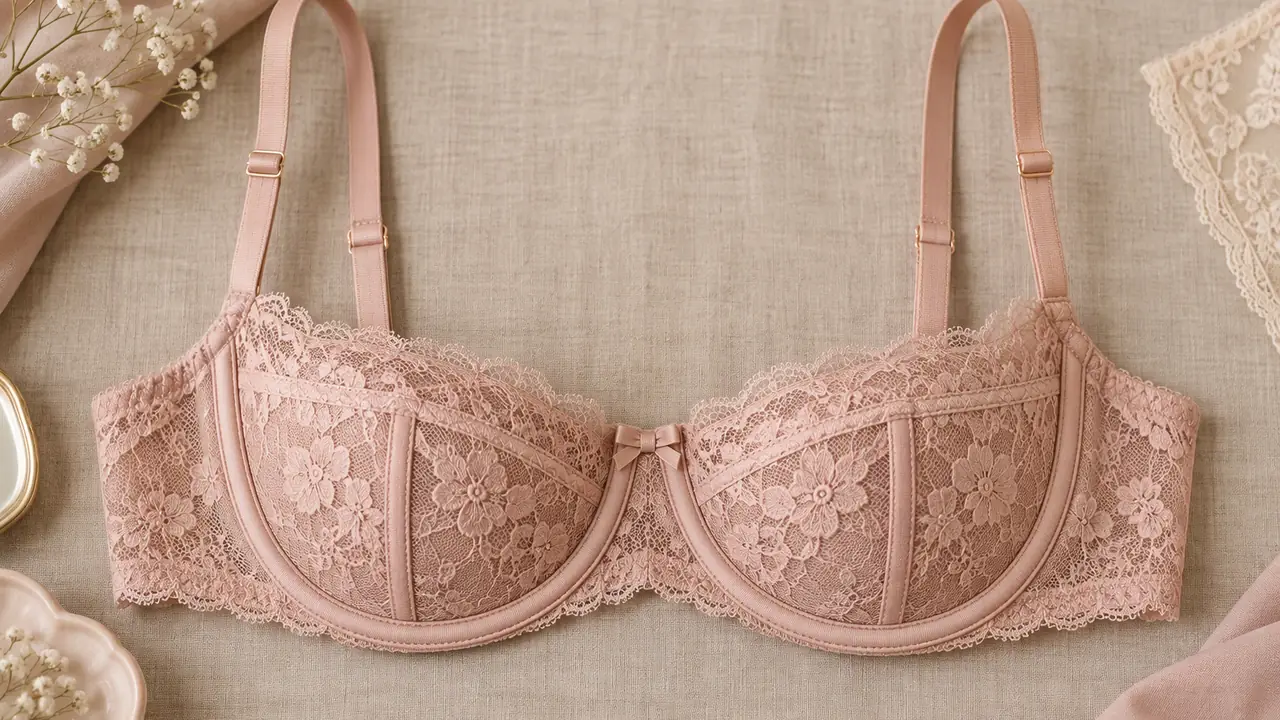
What a balconette bra is
A balconette bra is defined by its cut: the cups cover roughly half the breast, the neckline runs horizontally across, and the straps set slightly wider than a demi. The name comes from the balcony shape of the cup edge, which lifts and rounds without full coverage. Band sizes range from 30 to 44, cup sizes from A to DD and beyond depending on the plant's grading capability. The style sits between a demi and a full-coverage bra, offering a lower neckline than the former and less coverage than the latter.
For brands, the balconette is usually the first style specified because it suits the widest range of outer garments and reads as both everyday and slightly dressy. The trade-off: a balconette demands more precision in cup moulding and underwire curvature than a full-coverage bra, because less fabric means less room to hide fit imperfections.
The six layers on the card
| Layer | What decides quality | Typical options |
|---|---|---|
| 1 Cups | Molding precision, cup depth consistency, seam placement | Molded or cut-and-sew; unlined or lightly padded |
| 2 Band | Elastic quality, hook gauge, band depth | 30-44 band; 2-4 hook rows; wire or wire-free |
| 3 Straps | Elastic recovery, attachment point, adjustability | Semi-convertible; center-glide or fixed; 10-15 mm width |
| 4 Wing and side | Side boning, powermesh compression | Powermesh lining; removable side boning |
| 5 Fabric | Lace or microfiber quality, OEKO-TEX class, hand feel | Leaversoy or Raschel lace; microfiber; cotton blend |
| 6 Hardware and trims | Slider durability, ring gauge, bow placement | Metal or nylon; decorative or functional bows |
Sizes, cup ranges and lead times are typical ranges seen across the category, not a datasheet. Each program carries its own spec sheet, and the figures a brand prints are confirmed from that sheet, not from this page. The bra types guide explains how balconette compares with demi, plunge and full-coverage.
Color, lace and batch matching
Color is the first conversation and the first risk. A blush lace from one millimeter of difference in dye bath temperature reads as a different color under a store's lighting. Engineered lace repeats more predictably than natural or Leaversoy lace and is the usual choice once a range passes three or four colors. The desk keeps a retained swatch per program and checks every lot under a standard lamp. The quality control describes the process.
Certification and fabric safety
The intimate category sits close to skin and mucous membrane contact, which raises the bar on fabric safety. OEKO-TEX Standard 100 is the baseline certificate buyers should ask for; it tests over 300 harmful substances from yarn to finished product, including the threads and elastics, not just the face fabric. In the United States, fiber content labeling follows the Textile Fiber Products Identification Act and care labeling follows the FTC Care Labeling Rule. The fabric certifications guide covers the full route.
Options worth specifying
- Cup construction. Molded cups for a smooth silhouette; cut-and-sew for a rounder, more natural shape.
- Lace placement. Full-cup overlay, side-panel accent, or neckline trim only.
- Strap system. Fixed, adjustable, or convertible (detachable for strapless wear).
- Packaging. Folded in tissue with a color card; boxed for retail; poly bag for marketplace.
- Branding. Logo on the band (woven or printed), on the box, and on the color card; see OEM and private label.
Where the balconettes are made
Balconette and other wired bras come primarily from the Shantou cluster in Guangdong, where bra-specific supply chains (underwire, sliders, elastic, lace, moulding) sit within an hour of each other, and from the Puning belt, which adds depth in cut-and-sew and lace handling. The desk shortlists plants by cup moulding capability, underwire sourcing and the OEKO-TEX certificate file they can produce. More on the clusters.
Inspection before shipment
- Band circumference and cup depth on sampled units against the program sheet.
- Underwire curvature and tip sealing on sampled wires.
- Hook-and-eye gauge and stitch density on the back closure.
- Elastic recovery after three stretch cycles on straps and band.
- Color against the retained swatch under a standard lamp.
- Carton drop test and label, color card and pack contents against the approved sheet.
The plan is written per program and confirmed before the first batch; see quality control. For reference quantities and timing, the MOQ and lead time page sets the ranges, and the quote form asks what a plant will ask.