
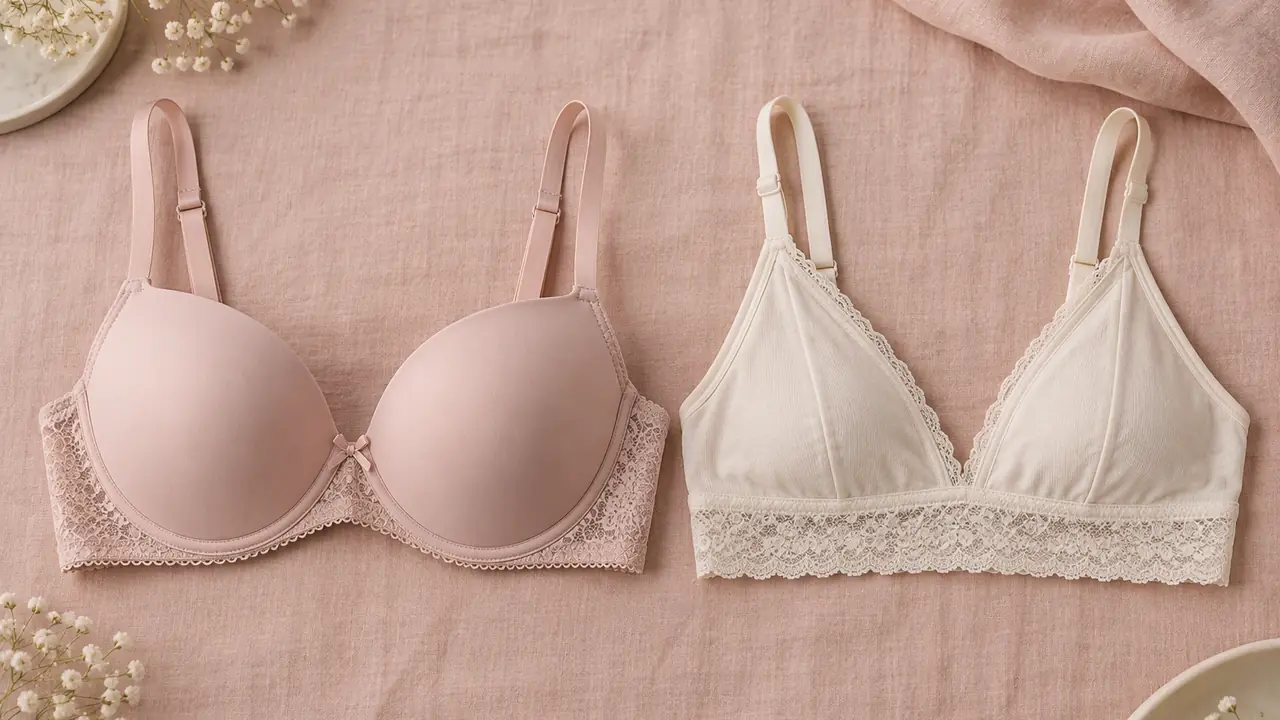
Two ways to manage motion
Compression is the simpler mechanism: a firm, stretchy knit holds breast tissue against the chest wall, so tissue and fabric move as one. Encapsulation is the tailored mechanism: individual cups - seamed or molded, wired or not - support each side separately, the way an everyday bra does, with the structure to hold that support under load. Hybrid styles combine both, compressing over encapsulated cups, and carry the strongest constructions in the category.
The mechanisms map to impact levels, which is how the line at the sports bra page is organized: low, medium and high. Compression dominates at low and medium impact, where its simplicity is an advantage; encapsulation dominates at high impact and at fuller cup sizes, where holding everything against the chest wall with fabric alone stops being comfortable or effective. Neither mechanism is the better one - they answer different loads, and a range usually needs both.
Side by side: mechanism and fit
| Aspect | Compression | Encapsulation |
|---|---|---|
| Support mechanism | Knit tension holds tissue close | Individual cups carry each side |
| Typical impact levels | Low and medium | Medium and high |
| Sizing model | Band or dress sizing, grouped | Bra sizing, band and cup |
| Cup structure | Knitted body, no cup seams | Seamed or molded cups |
| Wire | Usually none | Optional, common at fuller cups |
| Typical size range | XS-2XL grouped spans | A-H per line spec |
| Suits best | Short sessions, smaller cups | Long sessions, fuller cups, high impact |
The sizing row drives the program more than any other. Compression sizing groups several bra sizes into one knit size, which simplifies inventory but accepts a coarser fit; encapsulation sizes like a bra, which doubles or triples the SKU count and makes grading the central engineering task. A buyer choosing compression is partly choosing a smaller inventory footprint, and should make that trade consciously.
Compression in detail
A compression sports bra is an engineering exercise in knitted tension. The body is a circular-knit or cut-and-sewn tube with density varied by zone: firmest under the bust, supportive across the cup area, elastic at the openings. Elastane share is the active ingredient - the fabric must stretch four ways and recover completely, session after session, which is why stretch recovery sits first on the test list. The elastane percentages note explains how share and recovery interact.
Because the whole garment works in tension, every component is a support component. The underbust band is wider than an everyday band; the straps are wider and often convert to a racer back, which changes the load path for overhead movement; seams are flatlock to sit flat under sustained pressure. Compression fails in a specific, visible way - the garment relaxes and stops holding - so the quality question is recovery retention after repeated wash and wear, not a single seam. That is a fabric and knitting question before it is a sewing question, which is why the desk quotes compression programs from knitting-capable plants.
Encapsulation in detail
An encapsulation sports bra borrows the everyday bra structure and hardens it for load: defined cups, a firm underbust band, and often an underwire at medium and high impact and at fuller cups. The cups themselves can be cut-and-sewn with supportive seam geometry or molded for a smooth line under performance fabrics; the construction anatomy note maps the components. Straps are a design center here - padded, wider, crossable - because strap load at high impact is the comfort limit of the whole design.
Grading is the engineering task. A bra-sized program runs A through H per the line spec across the band range, and every size needs the cup geometry to hold under load, not just to fit statically. Plants grade and then fit-test the extreme sizes before bulk, because a cup that works at 34B and fails at 36E is the classic high-impact failure. The impact levels note explains how low, medium and high change the structure requirements.
Testing and claims discipline
The desk keeps sports bra claims structural, for two reasons: the category allows it, and the provable version is the version that survives marketplace review. What goes in the tech pack and the test list: stretch and recovery rates, strap attachment strength, band elastic retention after wash cycles, colorfastness on performance fabrics, and seam strength at load points - the standard per-order test items, weighted for the demands of the construction. What stays out: performance percentages, physiological outcomes and any wording that promises a result rather than a construction. The listing describes construction and impact level per spec sheet; the wearer decides how it performs.
Fabric safety follows the same documentation route as the rest of the range: OEKO-TEX Standard 100 certification held per certificate per lot by the partner plant, and market labeling per destination. Performance fabrics carry the same duties as everyday fabrics here - no exemptions come with the elastane.
Planning a sports program
Bra program economics apply: typical reference ranges are 1,000-3,000 pieces per color for OEM programs and 500-1,000 for stock public-mold programs, sampling in 7-15 days on catalog models and 15-25 on OEM samples, bulk in 30-45 or 35-50 days, confirmed in writing per program on the MOQ and lead time page. The planning question specific to sports is how to ladder impact: opening with low and medium compression covers the widest audience at the smallest inventory footprint, and adding encapsulation at high impact serves the committed segment that repurchases on a wear-out cycle rather than a fashion cycle.
- Ladder the range by impact: low and medium compression first, high-impact encapsulation as the second wave.
- Pick the sizing model consciously: grouped sizes shrink inventory, bra sizing grows fit credibility.
- Put stretch recovery and strap attachment strength first on the test list.
- Fit-test graded extremes before bulk on any encapsulation program.
- Write impact levels per spec sheet on the listing, with no performance percentages.
- Confirm OEKO-TEX certification per lot with the shipment documents, not before.
When the mechanism split and the impact ladder are set, the quote form takes mechanism, impact levels, size model and quantity per color in one pass, and the testing and inspection page shows where each test sits in the order flow.