
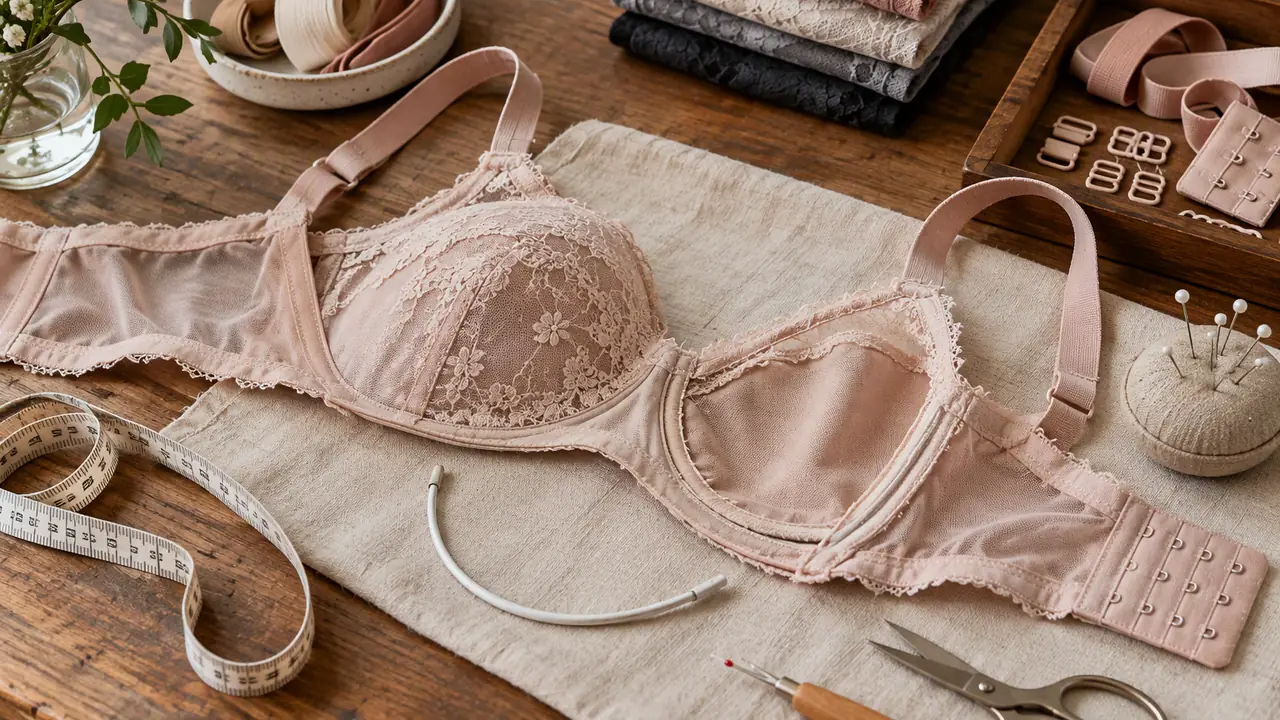
Where strap pressure comes from
In a well-engineered bra the band does the anchoring and the straps carry a stabilizing share of the vertical load. Straps begin to dig when that share grows: the band loosens and hands its work upward, the cup volume is wrong and pushes load outward, or the strap itself concentrates what it carries into too little surface. Each cause has a different fix, which is why a sample review that jumps straight to wider straps often solves nothing - a wider strap under a failing band just spreads the same overload a little thinner while the root cause continues.
The review order that works is: band first, cup second, strap third. The note on band tightness covers the two-finger check that starts the sequence, and the note on signs of a good fit puts strap checks in context. Once the band and cup are confirmed, the strap decisions that remain are construction decisions, and they are the subject of the rest of this note.
Width, padding and edge construction
Strap builds fall into a small set of families. The right choice is a function of cup volume and channel - a strap that reads fine on an A cup concentrates pressure on a DD cup, and a padded strap that suits a sports program looks heavy on a bralette. The families compare as follows, with exact widths set per program on the tech pack rather than fixed by any rule.
| Strap build | Construction | Typical placement | Program note |
|---|---|---|---|
| Narrow unpadded | Single elastic, clean edge | Small cups, bralettes | Lowest cost, least load spread; sample the ladder ends |
| Standard flat | Flat elastic, straight or lightly contoured | Everyday A-DD programs | The workhorse; width should step with cup tier |
| Cushioned | Padding strip inside a sleeve | Larger cups, sports programs | Comfort at high tension; adds cost and a component |
| Wide load-spreading | Broad elastic, often shaped at the shoulder | Full-bust and high-impact programs | Grade the width with the cup tier, not one width across |
The grading point in the last row is the one buyers miss most often. A single strap width across a full ladder means the top sizes carry the most load on the least surface, which is exactly the arithmetic that produces digging. Plants that serve full-bust programs regularly quote width steps at cup breakpoints; plants that improvise quote one width and let the top of the ladder find out.
Elastic quality and recovery
Strap elastic works harder per centimeter than band elastic: it flexes on every step, holds constant tension all day and rubs against clothing. Recovery - how completely it returns after stretching - decides whether the strap keeps its designed tension or sags into a situation where the wearer shortens it to compensate, which raises pressure again. The note on elastic types separates woven from knitted constructions and where each belongs. Recovery is an order-agreed test item in the desk checklist, reported before and after repeated laundering, because strap elastic that passes a first fitting can still be the component that fails the program at week six.
Grades sit underneath the geometry. Straps are skin-contact components, so materials are verified per certificate per lot with OEKO-TEX Standard 100 as the baseline the desk asks for on intimate programs, and edge finishing matters as much as the elastic body: a hard or loosely wound edge reads as digging even when the width is correct.
Attachment, hardware and strap angle
The strap does not act alone; it acts through its ends. At the back, the attachment coordinate sets the strap angle, and an angle that turns inward on a full-bust body pulls the cup edge down while the strap fights the shoulder. At the front, the attachment into the cup must survive both static tension and the repeated flexing of wear, which makes the stitch specification and any reinforcement a fitting-room issue as much as a sewing issue. The note on strap construction and attachment covers the methods that survive re-threading and laundering.
Hardware is the quiet failure point. Rings and sliders that look identical can differ in gauge, and lightweight hardware deforms at the top of the ladder, letting the strap lengthen in wear. Specify hardware gauge per size breakpoint for convertibles and adjustable styles, and check the hardware source early rather than at bulk, because substitutions here are hard to see on a finished sample.
Fit causes behind digging straps
Three fit errors present as strap pain. A band that is too loose transfers anchoring duty to the straps, which then carry load they were never sized for; the fix is at the band, covered in the note on band tightness. A cup volume too small pushes breast tissue back and down, loading the strap from below; the fix is at the cup, and the note on cup volume and sister sizes explains how volume moves across the size grid. And straps set too wide at the back slide off the shoulder, which wearers answer by over-tightening; the fix is the attachment coordinate from the section above.
For a program, the practical consequence is that strap complaints cannot be diagnosed from photographs or from the strap alone. The desk asks for the full wear context - band behavior, cup seating, strap angle - before sending a correction to a plant, because a change made at the strap to answer a band problem tends to reappear as a cup problem one revision later.
Specifying straps for production
- Set strap width per cup tier, not one width for the ladder, and record it on the tech pack at each breakpoint.
- Name the elastic construction and require stretch recovery as an order-agreed test item, before and after laundering.
- Specify hardware gauge per size for adjustable and convertible styles, with the source verified before bulk.
- Wear-test at the smallest and largest sizes through a movement sequence - arms up, seated, leaning - not a mirror check.
- Align the care instructions with the elastic grade, following the FTC Care Labeling Rule for the US market.
Reference timing across the category runs: catalog-model samples in 7-15 days, branded samples in 15-25 days, bulk in 30-45 days for catalog models and 35-50 days for branded programs, confirmed in writing per order with reference quantities on MOQ and lead time. Because strap comfort is proven in wear rather than on the table, the desk builds a wear-test round into the sample plan for full-bust and sports programs, and the note on testing and inspection lists the checkpoints partner plants run before shipment. The quote form carries the strap specification with the size run so plants quote the same program.