
A working definition
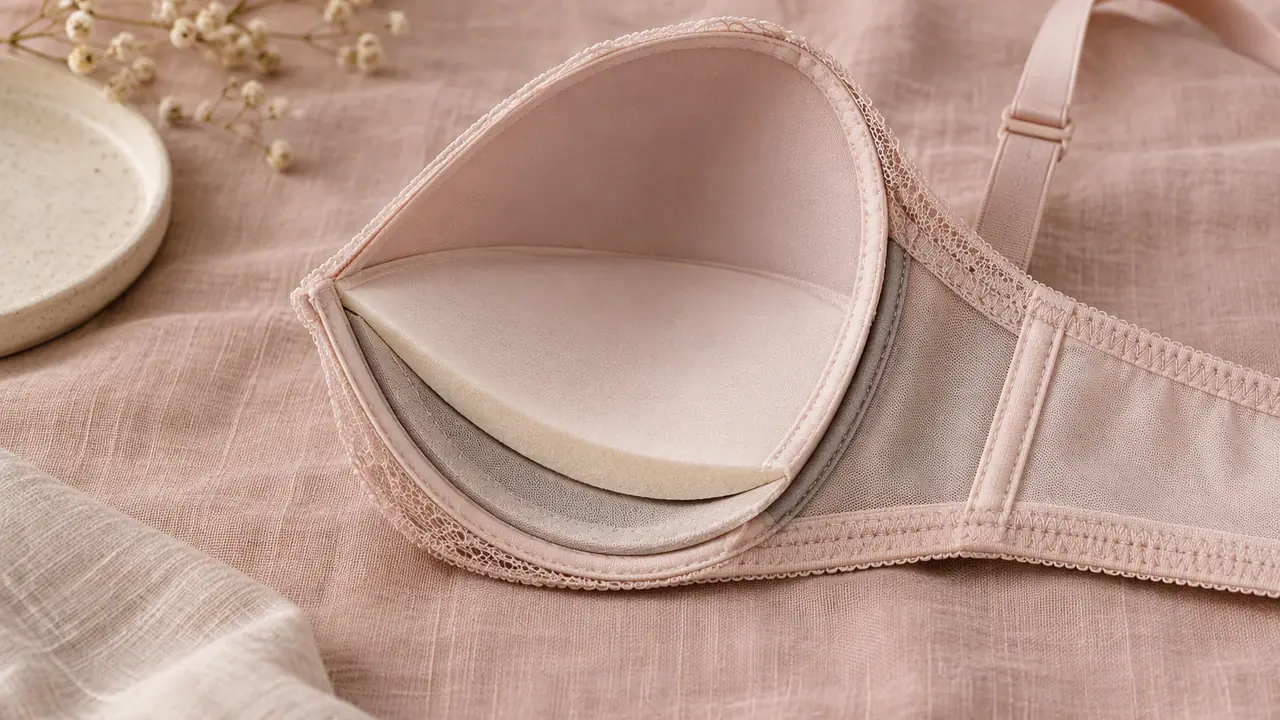
The balconette takes its name from the balcony shape of the cup edge, which runs horizontally across the breast rather than curving up toward the shoulder. The cups cover roughly the lower half of the breast tissue. The straps set slightly wider than a demi bra, which means they are less likely to slip off the shoulder but also provide less inward pull at the cup edge. Band sizes typically run 30 to 44, cup sizes from A to DD and beyond depending on the plant's grading range.
The construction is relatively simple compared with a plunge or a sports bra, which is why it is the first style many brands specify. But the simplicity is deceptive: with less fabric on the cup, the moulding precision and underwire curvature must be tighter, because there is no full-coverage panel to hide a fit imperfection behind.
How balconette differs from demi and plunge
| Feature | Balconette | Demi | Plunge |
|---|---|---|---|
| Cup coverage | About half the breast | About three quarters | Minimal, deep V |
| Neckline | Horizontal | Slightly angled | Very deep V |
| Strap set | Wider than demi | Standard | Very close |
| Best for | Scoop necks, everyday wear | Everyday and light activity | Low-cut necklines |
| Underwire | Standard or wide | Standard | Narrow, angled |
The balconette and the demi are close cousins, and many brands use the terms interchangeably. The practical difference for a buyer is the strap position and the neckline height: a balconette's wider strap set means the bra works better under scoop-neck garments, while a demi's closer straps work under crew necks.
The components every balconette shares
| Component | What it does | What varies |
|---|---|---|
| Cups | Shape and support the breast tissue | Molded or cut-and-sew; lined or unlined; lace overlay or smooth |
| Band | Anchors the bra around the torso | 30-44; 2-4 hook rows; elastic quality varies |
| Underwire | Gives shape and separates the cups | Gauge, curvature, tip coating; or wire-free |
| Straps | Transfer tension from the band to the shoulders | Elastic or fixed; width; convertible or not |
| Wing | Compresses the side tissue | Powermesh or plain; boning or no boning |
| Fabric | Carries the color and the texture | Lace, microfiber, cotton blend; OEKO-TEX grade varies |
On this site each product line carries a spec card with these components, the options a plant will ask about for each, and the reference ranges a buyer can quote. The bras category covers all six bra lines.
Balconette construction in detail
The balconette cup is typically a two-panel or three-panel construction. A two-panel cup has an upper and lower section joined at a horizontal seam; the upper section is often sheer or lace while the lower section is lined for support. A three-panel cup adds a side panel, which gives better forward projection and is the standard for larger cup sizes. The seam type matters: a flatlock seam lies flat against the skin and is the norm for everyday balconettes, while a zigzag seam adds decorative texture but can be less comfortable under thin garments.
The underwire in a balconette is typically a standard gauge wire, not the heavy-gauge wire used in full-coverage bras. The wire follows the inframammary fold - the crease where the breast meets the chest wall - and its curvature must match the cup's bottom edge. A mismatch between wire curvature and cup seam causes the wire to poke through the channeling, which is the number one warranty claim for wired bras.
The band on a balconette is usually the same depth as the cup's lower edge, which means it is narrower than a full-coverage band. This narrower band contributes to the style's visual lightness but also means the elastic must be higher quality to provide the same level of anchoring without digging. A two-ply band with powermesh lining is the standard for bands above a D cup.
The wing - the side panel that extends from the cup edge to the back closure - on a balconette is typically made from powermesh or a similar compression fabric. Its job is to pull the cup flat against the side tissue and prevent the breast from spilling out of the side. A wider wing provides more lateral support but adds bulk under fitted garments.
Balconette across the market
The balconette is the entry point for most intimate apparel brands because it suits the broadest range of outer garments, from scoop necks to off-shoulder tops. Consumer demand data shows the style's stability: balconette-related searches in the United States run at roughly 49,500 per month, making it one of the top bra type queries alongside strapless and sports bras. For a sourcing desk, this translates to stable demand across seasons and channels, which in turn means the minimum order quantities are more predictable than for trend-driven styles like bralettes or sticky bras.
The balconette is also the construction base for many derivatives: a balconette with detachable straps becomes a multiway bra; a balconette with thicker padding becomes a light push-up; a balconlette with taller cups becomes a demi. This modularity is why plants in the Shantou cluster can quote a balconette quickly - the cup patterns, underwire sizes and band construction are already tooled, and the customization happens at the fabric and color level rather than at the construction level.
For a first program, a brand typically launches a balconette in two or three colors across a band range of 32 to 40 and a cup range of B to DD. This covers the majority of the market without requiring excessive grading depth. The color minimums, grading rules and fabric options are confirmed per program, and the desk keeps a retained swatch per color for batch matching across repeat orders.
What a buyer should ask first
What a buyer should ask first
- Which band and cup range, because that fixes the grading complexity and the plants that can serve it.
- Molded or cut-and-sew cups, because molding requires a heat press line and a longer tooling lead.
- Which fabric and color, since lace and microfiber have different MOQ and lead profiles.
- Wire or wire-free, which changes the underwire sourcing and the OEKO-TEX testing scope.
- What the quantity per color and the in-warehouse date are. The quote form asks exactly these.
Reference quantities and timing are on MOQ and lead time; bra types explained is the natural next note.