
Why the style name matters in sourcing
A bra style name compresses a bundle of construction decisions into one word: how much of the breast the cups cover, where the straps anchor, whether an underwire or a fabric structure carries the load, and how the band closes at the back. Those decisions drive pattern complexity, grading depth, moulding tooling and the list of partner plants that can quote a program competitively. When a buyer says balconette rather than demi, the sample room hears a different wire curvature, a different strap attachment coordinate and a different neckline tolerance, and it cuts a different pattern.
The name also anchors the commercial side. Search demand clusters around a handful of type queries - the head term bra alone runs at roughly 90,500 US searches per month according to Semrush keyword data, and most of the high-volume long-tail phrases around it contain a style word. A range plan that names its styles precisely is easier to merchandise, easier to review with a plant and easier to audit for compliance documents.
The six core bra families
Most programs draw from six families. The ranges below are typical across the category and vary by plant and grading ladder; they are planning references, not a promise for any specific style, and every figure is confirmed in writing per program.
| Family | Coverage | Support source | Typical range | Program note |
|---|---|---|---|---|
| Balconette | Half cup, horizontal neckline | Underwire or structured frame | Cups A-DD+, band 30-44 | Broad everyday appeal, modular base style |
| Strapless | Full cup, straight top edge | Silicone grip tape and band structure | Cups A-DD+, band 32-42 | Detachable straps enable multiway use |
| Push-up | Low to half cup | Graduated padding, levels 1-3 | Cups A-D, band 30-40 | Molding line needed; removable pads common |
| Sports | Full cup | Compression or encapsulation | Cups A-H, impact low to high | Four-way stretch fabrics, heavier test load |
| Wireless | Half to full cup | Wide band and molded cup structure | Cups A-DD+, band 32-44 | Comfort-led, simpler component set |
| Bralette | Triangle or sports cut | Fabric only, no wire, no padding | XS-2XL, lace, cotton or modal | Fashion-led, shorter life cycles |
Coverage and neckline vocabulary
Coverage words describe how much of the breast sits inside the cup. A full-coverage cup encloses the whole breast with a top edge that runs high across the bust. A half cup - which is what balconette means - covers roughly the lower half with a horizontal top edge. A demi covers about three quarters with a slightly angled edge, and a plunge lowers the center bridge into a deep V so the style reads clean under low necklines. Bandeau and triangle shapes, common in bralettes, set structured cups aside in favor of a single stretch panel or two soft triangles.
Neckline words describe the top edge as worn: straight, angled, V-shaped or square. For a buyer the useful discipline is to state coverage and neckline separately in the spec sheet instead of relying on a style name alone, because regions and plants use the same words differently. Fixing the center bridge height and the strap attachment coordinates in the pattern pack removes most of the ambiguity before the first sample is cut.
Support structures: wire, padding, fabric
Underwired styles carry load through a wire sewn into channeling that follows the underband and the inframammary fold. Wire gauge, tip coating and curvature are specified per cup size, and a mismatch between wire curvature and the cup seam is a recurring warranty issue, covered in the note on underwire types and sizing. Wireless styles replace the wire with structure: a wider band, a deeper wing, internal side slings or a molded cup with a reinforced cradle. In a wireless bra, support quality is a fabric and pattern problem, not a hardware problem.
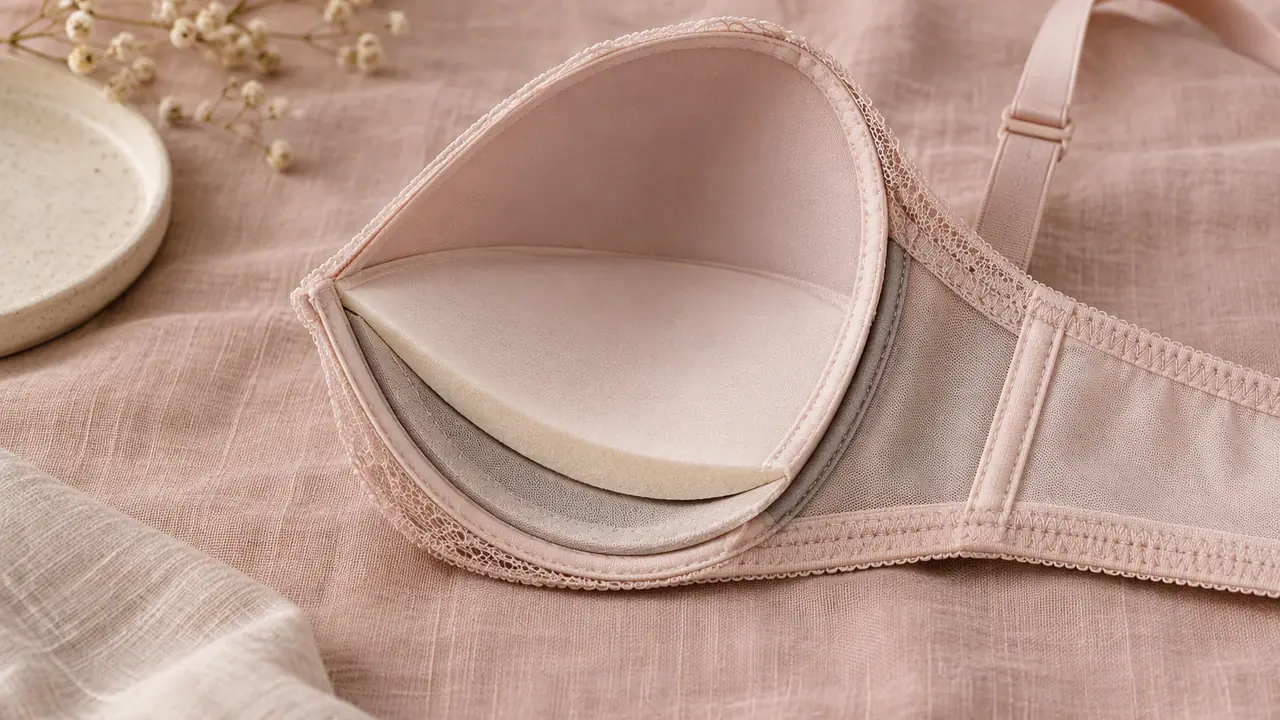
Sports bras add a second axis: whether the design compresses tissue against the chest or encapsulates each breast in a shaped cup, and how the stated impact level - low, medium or high - maps to fabric modulus and strap geometry. Padding is the third lever. A push-up builds graduated foam along the lower cup edge in one to three levels, often with removable pads; a lightly lined style uses a single thin layer; an unlined cup relies on fabric alone. The construction details sit in the note on padding types.
Which style suits which program
Style choice follows channel. DTC brands usually open with wireless and bralette families, where the component set is simpler, the fabric story carries the brand and small multi-color runs are realistic. Marketplace sellers favor families with stable size ladders and low fit risk, which points to wireless and lightly lined styles. Retail chains build around core everyday families - balconette and full-coverage wireless - and add fashion capsules seasonally. Distributors and wholesalers care most about ladder depth, which favors families whose grading is proven across many plants.
Minimum order quantities follow the same logic. Across the category, branded bra programs typically start around 1,000-3,000 pieces per color and catalog-model programs around 500-1,000, with samples in 7-15 days for a catalog model and 15-25 days for a branded sample. These are reference ranges, and every figure is confirmed in writing per order; the current table sits on MOQ and lead time.
Shortlisting a style mix
- Fix the channel and the audience first, because that decides how many styles a first range can carry.
- Pick one anchor family with the broadest size coverage and one or two accent families for story and margin.
- Check each family against plant capability: molding lines for push-up and molded cups, cutting and sewing discipline for wired balconettes, fabric development for sports.
- Grade the ladder deliberately - depth in the anchor family, shallow in accents - and confirm grading rules with the plant before sampling.
- Align the fabric story across the mix so trims and certification scope stay consistent family to family.
Before committing a range
Sample before scale, and sample the anchor family at the extreme ends of the ladder, not only at the center sizes. Review band closure rows, strap attachments and fabric certifications family by family - OEKO-TEX Standard 100 per certificate per lot is the baseline the desk asks for on every intimate program. Where a style depends on hardware, such as the multiway hardware on a strapless, verify the hardware source early rather than at bulk. The desk shortlists partner plants per family, coordinates the sample round and sends the questions on the quote form together with the program brief.
The next notes in this group take the families one at a time: strapless fit, push-up padding levels and bralette construction.