
What a sticky bra is
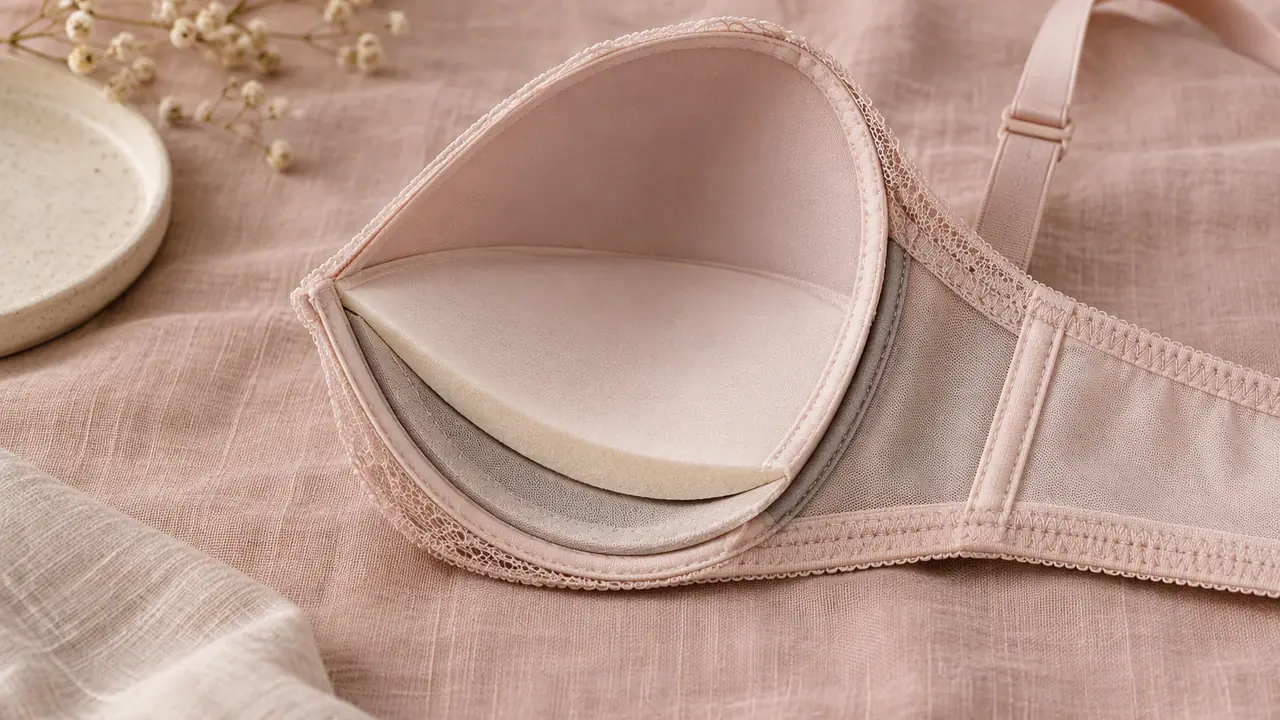
The garment is minimal by design: two cup forms, each lined on the inner face with a skin-contact adhesive, joined at the center by a clip or a fabric bridge. Some builds add side wings with adhesive edges; many are front-only. With no band around the torso, the adhesive is the only anchoring system, which makes it the component every other decision serves - the cup shape exists to present the adhesive flat against the skin, and the center closure ties the two sides into one frame. The style exists for garment reasons: backless cuts, deep necklines and strapless silhouettes where a band would read through or show entirely.
Because there is no band, sizing follows cup volume rather than band-and-cup combinations, and the fit logic differs from every banded bra. The cup must seat flat with no gaps at the edges - a gap breaks the adhesive seal and the garment peels. That is also why the family sits at the fashion end of assortment planning rather than at the everyday core: it is a solution garment, bought for specific outfits, and merchandised alongside the other bra families rather than instead of them.
How the adhesive system is built
The adhesive is a pressure-sensitive layer applied to the inner cup face and protected by a release film between wears. Formulations differ in tack level, in how many wear-and-wash cycles the tack survives and in how the layer is applied - sprayed, coated or laminated - and those differences are the real quality ladder in this family. The adhesive is a skin-contact component like any other, so its grade is verified per certificate per lot; the desk asks for OEKO-TEX Standard 100 documentation on the finished garment and keeps the adhesive specification in the program file alongside it. Absolute safety words do not belong in listings; what belongs is the certificate trail and the care instructions the formulation supports.
Cup construction underneath the adhesive is foam or a silicone-elastomer form. Foam cups are lighter and hold a molded shape; silicone forms are heavier, conform to the skin and are the common choice where the garment must disappear under thin fabric. Either way the outer face is fabric-covered or finished smooth, and edge taper decides whether the cup outline reads through the outer garment. The taper, not the thickness, is the detail to check on samples.
| Stage | Practice | Why it matters |
|---|---|---|
| Before first wear | Clean, dry skin, no lotions or oils on the contact area | Residues block the adhesive bond at the first application |
| Application | Seat one cup, then the other, close the center clip last | The closure sets the frame; seating order avoids edge gaps |
| During wear | Expect a bounded wear window per application | Tack and skin moisture set the practical limit, per spec |
| After wear | Rinse with mild soap, air dry, dust-free surface down | Restores tack; heat and friction destroy the adhesive face |
| Storage | Re-apply the release film, store flat in original shape | Exposed adhesive collects lint and loses cycles |
Wear behavior and honest limits
A sticky bra is a reusable consumable. Tack degrades with each wear-and-wash cycle, and the cycle count a pair delivers is a specification outcome - formulations and care discipline decide it - rather than a fixed number to promise in listings. Heat, humidity and skin products all shorten the practical wear window per application. Listings that state construction facts and care routines return less than listings that imply banded-bra permanence; the note on listing content shows how to phrase construction truth so buyers know what they are buying.
Support expectations should be set the same way. With no band, the garment presents the cup shape; it is not engineered for the load control a banded or high-impact construction provides, and it is not a sports garment. The merchandising frame that works is occasion-based: the specific garments it enables, the care routine that keeps it working, and a clearly stated wear window. The same honesty applies to disposal - adhesive faces are not indefinitely restorable, and care pages should say when a pair is finished.
Care instructions that protect the adhesive
Care is where sticky bras are won and lost, and it is also where listings earn their returns rate down. The routine in the table above compresses to four rules: clean dry skin at application, no heat at any stage, mild soap and air drying after wear, and the release film back on before storage. Machine washing, wringing and towel drying all destroy the adhesive face faster than wear does. These instructions belong on the pack-in card and on the listing, phrased to match the adhesive specification the plant supplies - the note on care labeling rules covers how care claims and labels align for the US market.
Packaging is part of the product here. The release film, a rigid or semi-rigid cradle that holds cup shape, and a printed care card are not accessories but the conditions for the cycle count the spec claims. The note on packaging and retail boxes covers how the desk specifies sticky-bra packaging so the garment survives shipping and arrives with its adhesive face protected.
Quality checks and program notes
The inspection points are specific. Adhesive coverage must be even across the contact face with no voids at the edges, where peeling starts; the release film must seat fully; the center closure must hold without deforming the cups; and edge taper must be verified against the approved sample at every size. Cycle testing - a defined number of wear-and-wash repetitions with tack assessed after each - is the order-agreed test that predicts real performance, and the desk puts it in the checklist for every sticky program. The note on testing and inspection describes the general framework.
- Approve the adhesive specification and its certificate trail per lot before sampling.
- Approve edge taper on the cup against the outer garment it must disappear under.
- Run the cycle test and record tack after each defined repetition.
- Fix the care card wording to the formulation, not to generic promises.
- Specify packaging with release film and shape-holding cradle as standard.
Quantities run at the catalog-model end of the bra ranges - typically 500-1,000 pieces per color for catalog programs and 1,000-3,000 for branded programs - with samples in 7-15 days and bulk lead confirmed per program. Every figure is confirmed in writing per order; the reference tables sit on MOQ and lead time, and the quote form carries the adhesive spec so plants quote like for like.