
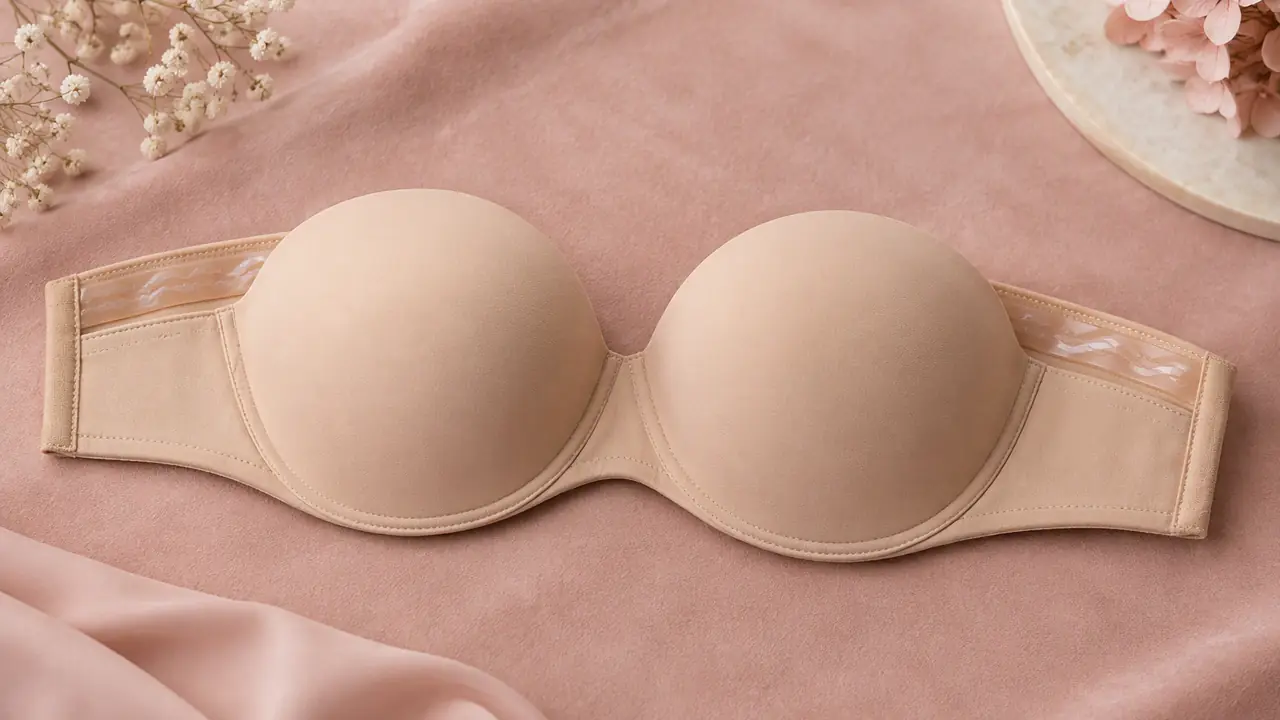
What a strapless bra is
A strapless bra holds its position through band engineering rather than shoulder straps: a silicone grip tape runs along the inner top edge and often the wings, the back closure typically carries an extra hook row compared with a standard band, and the cup wall is firmer so the construction keeps its line without upward pull from straps. Cup ranges run A-DD+ and band ranges 32-42 as category references. Removable, convertible straps turn the same garment into a multiway piece - halter, cross-back or one-shoulder - which is why buyers often specify the line as an add-on to a balconette core.
The construction is less forgiving than any other line in the bra range. Because nothing hangs from the shoulders, every tolerance matters: band circumference, grip tape placement, hook gauge and cup wall firmness all show up in wear. The desk treats strapless programs as a fitting-heavy line and reviews tolerances more closely at pre-production than on sister styles.
The six layers on the card
| Layer | What decides quality | Typical options |
|---|---|---|
| 1 Cups | Wall firmness, molded edge thinness, cup depth consistency | Molded A-DD+; firmer wall; low-profile top edge |
| 2 Band | Circumference stability, hook gauge, wing depth | 32-42 band; 3-4 hook rows; deeper back wing |
| 3 Straps | Attachment strength, convertibility, hardware finish | Detachable; convertible; clear and tonal sets |
| 4 Wing and side | Grip tape grade and placement, side stay options | Silicone grip at the inner edge; light stays |
| 5 Fabric | Face hand feel, grip compatibility, OEKO-TEX class | Microfiber or satin face; brushed back |
| 6 Hardware and trims | Hook tape quality, slider finish, spare strap kit | Nickel-free metal or plastic; boxed strap set |
Silicone grip is the component buyers under-specify most often. Tape width, tack grade and placement are set per spec sheet, and the same tape behaves differently on a brushed back than on a smooth knit, so the fabric and grip decisions are made together. The construction anatomy post explains each layer in plain terms.
Stay-put engineering
Three components decide whether the construction works, and none of them is the cup. First, the band: a strapless band runs slightly deeper under the arm and carries three or four hook rows, which spreads load across a wider back panel. Second, the grip: silicone tape is specified by width and tack on the program sheet and checked against the chosen face fabric. Third, structure: light side stays or a firmer wing panel keep the side wall from folding in wear. Samples should be reviewed on a fit model across the size run, not only on the base size; the strapless fit guide post lists what to look for.
Certification and labeling
The baseline matches the rest of the range: OEKO-TEX Standard 100 per certificate per lot, with the silicone components named in the tested article set. United States programs carry fiber content labeling under the Textile Fiber Products Identification Act, care instructions under the FTC Care Labeling Rule, and general apparel flammability under 16 CFR 1610; EU programs add REACH screening for restricted substances. The certifications guide sets out the document list the desk asks partner plants to produce per lot.
Options worth specifying
- Strap kits. Clear tonal straps, fabric straps, halter and cross-back conversions in one box.
- Grip layout. Full inner perimeter, top edge only, or wings only, per spec.
- Back closure. Three or four hook rows; deeper wing for fuller cups.
- Surface. Smooth microfiber to sit under fine knits, or satin for occasion wear.
- Branding. Woven label at the back wing, printed care set, retail box; see packaging and retail boxes.
Where strapless lines are made
Strapless work concentrates where wired bra capability already sits: the Shantou cluster in Guangdong for molded cups and hardware, and Puning for cut-and-sew depth and lace handling. Plants that mold their own cups keep edge thinness consistent, which matters most at the neckline where a thick molded edge would show under fine fabrics. The cluster page explains how the desk splits programs between the two bases.
Inspection before shipment
- Band circumference and hook row count against the program sheet.
- Grip tape placement and tack on sampled units, with wash durability per the agreed cycle count.
- Strap attachment pull strength on rings and sliders.
- Cup depth symmetry across the size run.
- Color against the retained swatch under a standard lamp.
- Carton check: strap kit present, label set and care booklet per the approved sheet.
The inspection plan is written per program and confirmed before the first batch; see quality control. Reference quantities sit on the MOQ and lead time page, and the quote form lists what a plant will ask for.