
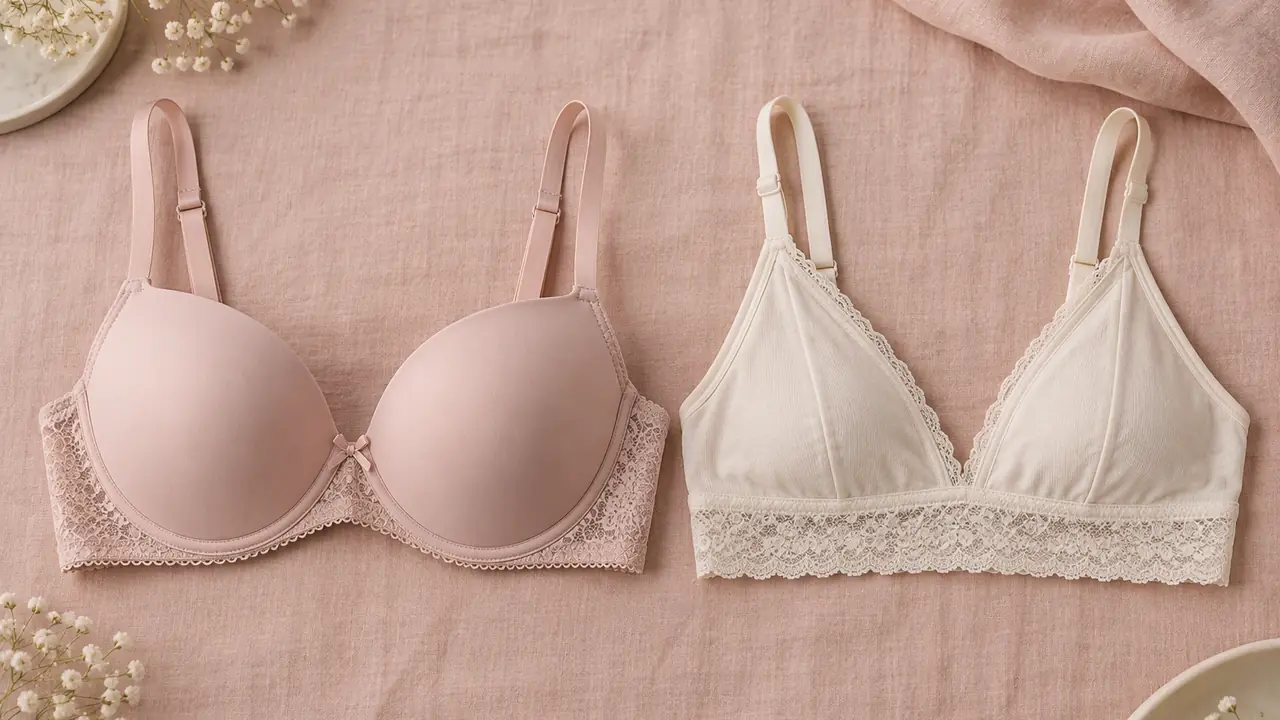
Two answers to the same support question
The wired version of the support problem uses a semi-rigid wire that follows the inframammary fold, transferring load into the band. The wireless version solves it with fabric alone: a deeper band, engineered side panels and cups that carry tension without a metal or plastic wire. Neither approach is a lesser copy of the other; they are different structures with different fit profiles, and most established ranges carry both.
The desk sees the two constructions divide by audience more than by quality. Wireless styles dominate comfort-first programs - lounge, sleep, long days at a desk - and typically grade across 32-44 bands with cups to DD and above depending on the plant. Wired styles dominate structured everyday and fuller-bust programs, where the wire lets a thinner band do more work. The wireless bra line on this site and the dedicated wireless versus underwired note in the bra types group cover the individual styles.
Side by side: where support comes from
| Aspect | Wireless | Underwired |
|---|---|---|
| Support source | Band depth, side panels, cup tension | Wire plus band and cup structure |
| Band behavior | Deeper and firmer, carries more load | Can run narrower, wire offsets load |
| Typical band range | 32-44 per line spec | 30-44 per line spec |
| Cup structure | Molded soft cups or seamed panels | Cut-and-sew or molded with channeling |
| Comfort profile | No pressure points, relaxes with the body | Crisper definition, firmer anchoring |
| Wash and wear | No wire channel to fail | Wire poke-through is the watch item |
| Suits best | Comfort-led lines, lounge, travel | Structured everyday, fuller busts |
Read the table as a load map. In a wired bra the wire does the defining and the band does the anchoring, so each component can be optimized separately. In a wireless bra every component does a share of both jobs, which is why the fabric specification carries more of the program: a weak band elastic or a soft side panel shows up immediately as a bra that rides up.
Inside a wireless construction
Take the wire out and three elements take over its work. The first is the band: wireless styles run a deeper underbust band, often two-ply with a powermesh or firm-knit lining, because the band is now the primary anchor. The second is the side structure: a bonded or sewn-in side sling moves tissue toward the center and forward, doing quietly what a wire does at the wireline. The third is the cup itself: either a molded soft cup, formed from dense-knit fabric over heat, or a seamed cup whose darts and panels carry tension.
Because there is no wire channel, the failure points shift. Seams and bonding lines take more stress, so seam type matters: a flatlock or coverstitch seam at the underbust, tested for stretch recovery per the order's test list, outlasts a decorative seam in the same position. Band elastic quality decides the lifespan, a subject the elastic stretch note covers in detail. And grading is less forgiving: without a wire to set the cup base, a wireless pattern that grades carelessly loses its anchoring first at the largest sizes.
Inside an underwired construction
The wire is a measured component, not an accessory. Its gauge, curvature and length are matched to the cup pattern, and the channeling that holds it is stitched through the lower cup and the wing so the load path runs from the cup edge into the band. That load path is why a wired bra can hold a cup at the top of a plant's grading range on a 30-44 band without a heavy underbust: the wire lifts the fabric assembly clear and hands the load to the band.
The cost of that structure is a watch item in quality control: wire poke-through. The desk's inspection lists check channeling stitch density, wire tip coating and the channel ends at every inspection stage, because a single exposed wire tip turns into a returns statistic. Plants in the Shantou cluster run standard wire libraries; matching a new cup pattern to the nearest stock wire keeps cost down, and the underwire note explains how wire sizing follows cup size rather than band size.
Returns, wear and care behavior
Return patterns differ by construction. Wireless styles come back most often for fit drift after washing - a band that relaxed a size - and for wearers between sizes who bought for comfort and kept a loose band. Wired styles come back for wire issues and for cup mismatch. The mitigation is the same in both cases and lives in the fit assets: a clear fit signs note on the listing, a band-tightness explainer, and sizing that states the band range plainly.
Care labeling follows the construction. Both types carry care labels under the FTC Care Labeling Rule for United States shipments, but the wording differs: wired styles warn against twisting the wire channel, wireless styles give gentler wash guidance to protect band elastic. Fiber content labeling under the Textile Fiber Products Identification Act applies identically to both. The desk has care-label artwork checked against the construction before bulk, since a label that says one thing and a garment that demands another is an avoidable claim source.
Planning a program that uses one or both
For production the two constructions share a supply chain - same fabric suppliers, same elastics, same accessory vendors - and diverge at the cup and finishing stages, where the wired style adds channeling and wire insertion. That is why many programs run both from one color story: the wireless version serves comfort-led shoppers and the wired version serves structure-led shoppers, with shared fabric minimums spread across both. Typical reference ranges hold across the category: 1,000-3,000 pieces per color for OEM bra programs, 500-1,000 for stock public-mold programs, sampling in 7-15 days on catalog models and 15-25 on OEM samples, bulk in 30-45 or 35-50 days. Figures are confirmed in writing per program on the MOQ and lead time page.
- Decide which audience leads the range: comfort-led programs open with wireless, structure-led with wired.
- Set the band range per construction: 32-44 is the typical wireless span, 30-44 wired, per line spec.
- Specify band depth and elastic grade for wireless first - it is the component that carries the support.
- For wired styles, match cup patterns to the plant's wire library before sampling.
- Put stretch recovery and seam strength on the per-order test list for either construction.
- Book one color story across both constructions so the fabric minimum works twice.
When the split between the two constructions is set, the quote form takes band range, cup range and construction per style, and the bra types note maps where each construction sits in the wider family.