
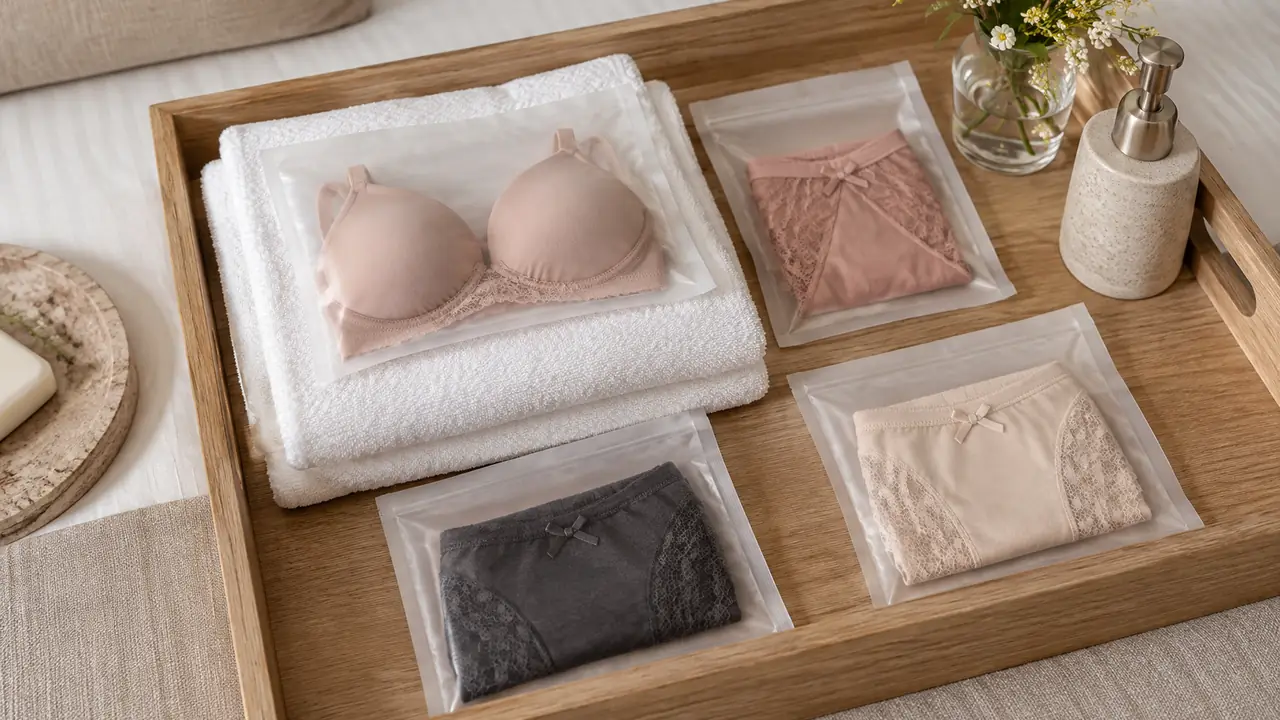
What a hospitality kit contains
Hospitality underwear is a small product with a long specification: a brief or bikini in sealed packaging, a size story the front desk can explain without opening anything, and a box that fits a drawer or a vanity tray. The desk coordinates the brief and bikini lines into kits, with thong and boyshort available where a property standard asks. The composition is written per property:
| Kit element | Options | Decided by |
|---|---|---|
| Garment | Brief or bikini; thong or boyshort on request | Property standard and guest profile |
| Fabric | Cotton blend or soft nonwoven per spec sheet | Property tier and single-use policy |
| Seal | Sealed envelope or resealable pouch | Housekeeping workflow |
| Outer box | Drawer box, envelope card, or tray pack | Room styling standard |
| Size story | Size sticker on the seal; chart on the box base | Front desk and housekeeping |
Sealed and single-use by design
Single-use in this category means the garment is packed sealed and intended for one guest stay, which is a procurement convention rather than a material claim. The seal stays closed until the guest opens it; the property replaces the kit between stays under its own housekeeping rules. What the desk specifies is structural: a seal that survives transport and drawer handling, a pack that opens without scissors, and a size visible without breaking the seal. Fabric choices - a cotton blend or a soft nonwoven - are written per spec sheet with the property's tier in mind, and every fabric ships with the OEKO-TEX Standard 100 certificate per lot, because a garment that sits against skin for even one night holds the same baseline as any other intimate.
Specifying per property
Occupancy drives the math. A property that fills two hundred rooms at a high turnover consumes kits on a schedule closer to restocking amenities than to fashion buying, and the program is sized accordingly: units per room per period, size mix per guest profile, reorder trigger tied to the sea freight window. The desk writes the project sheet per property - composition, seal, box, size mix, reorder cadence - so a group with several properties can run one standard with local quantities. Where a property group rebrands or refreshes rooms, the box and artwork change while the garment spec holds.
- Project sheet: composition, seal, box, size mix, units per room per period, per property.
- Samples against the sheet; seal and box tested on packed units for transport and drawer handling.
- Pilot floor or wing; housekeeping feedback on the open-and-replace workflow folded back into the spec.
- Batch production with the inspection plan agreed; certificates per lot attached.
- Standing reorders against occupancy, with the size mix reviewed per season from property data.
Fabric and certificate notes
The certificate file looks like any intimates program because it is one: OEKO-TEX Standard 100 per lot as the baseline, fiber content and origin per the Textile Fiber Products Identification Act, care labeling per the FTC Care Labeling Rule where care applies, and 16 CFR 1610 for general wearing apparel flammability. Where a group claims organic cotton, GOTS documentation moves per lot. Certificates are held by the partner plants, never by the desk, and are verified per project. The fabric certifications guide covers the route by market.
Box formats and drawer presence
The box is the only part of the kit a guest sees before opening it, and properties treat it as part of the room styling. Drawer boxes, envelope cards and tray packs are specified with the property's stationery and amenity palette in mind, and artwork follows the group standard where one exists. Formats and their structural decisions sit on the packaging and retail boxes page; what changes in hospitality is the arithmetic - smaller unit dimensions, larger unit counts, and a seal that has to survive a distribution center before it reaches a drawer.
Logistics to property groups
Property groups rarely receive in one place. Kits ship by sea in cartons labeled per property - or per floor plan where a single large property takes phased deliveries - with roughly 15-25 days to a US West Coast port and 30-45 to Europe, and express at 5-8 days for shortfalls between sea windows. Air is available where a reopening date is fixed, since the kits carry neither batteries nor liquids. The logistics page carries container practice; reference MOQ and lead ranges sit on the MOQ and lead time page, confirmed in writing per project sheet.
To open a project, the quote form takes the property profile - rooms, turnover, tier - and returns a draft project sheet with quantities as ranges, not promises.