
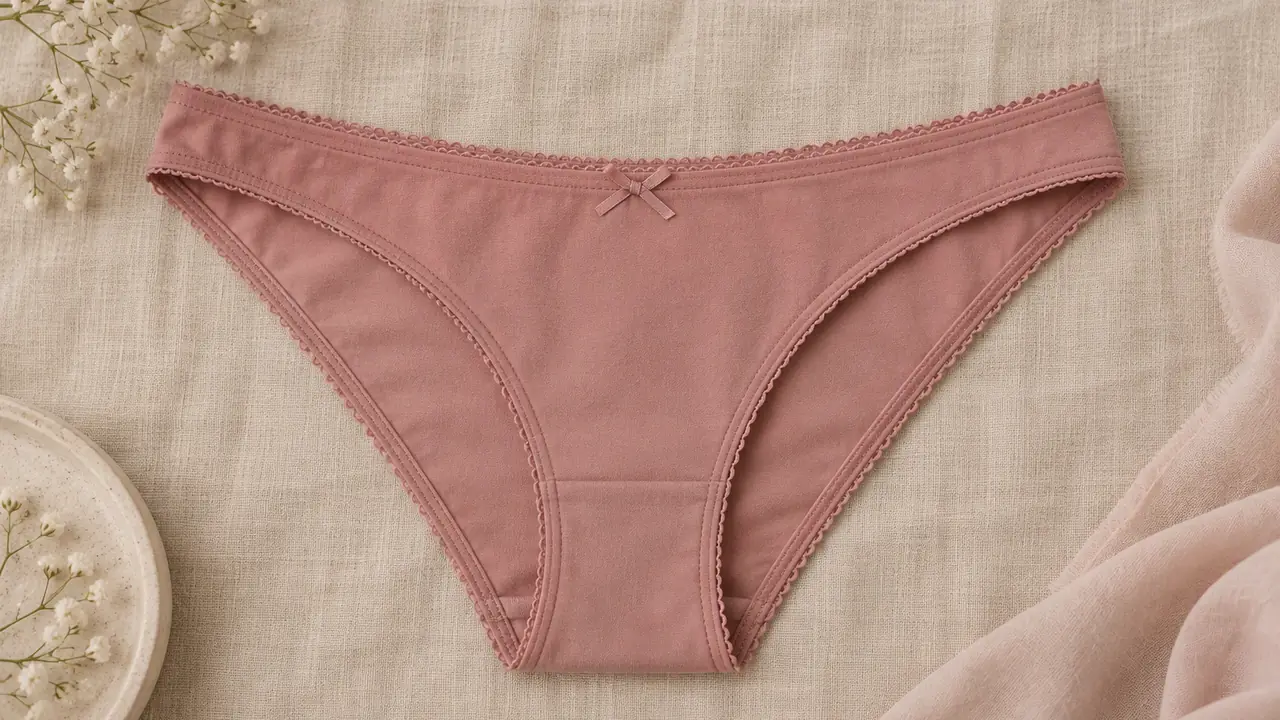
What a bikini panty is
A bikini panty sits on the hip with a low to mid rise and narrow sides, typically 5-8 cm from waistband to leg opening, and covers the seat moderately - less than a brief, more than a thong. It is the style that bridges the basics shelf and the fashion shelf: cut close enough to disappear under light summer fabrics, familiar enough to carry replenishment volume inside the same color ladder as a brief.
In a sourcing program the bikini is usually specified second, right after the brief, and often on the same cutting ticket. The shared fabric rolls and elastic lots are where program margin sits. What the style adds is a harder geometry problem at the side seam and leg line: with only 5-8 cm of side panel, the leg opening does more of the holding work, and every millimeter of elastic tension and edge construction becomes measurable in wear.
The six layers on the card
| Layer | What decides quality | Typical options |
|---|---|---|
| 1 Body fabric | Hand feel, recovery, opacity of light colors | Cotton blend jersey, microfiber, stretch lace, mesh panels |
| 2 Gusset lining | Fiber purity, stitch plan, breathability | OEKO-TEX cotton, single layer |
| 3 Rear panel | Cut geometry, seat coverage, seam placement | Moderate coverage, hip-hugging cut |
| 4 Sides and leg edges | Edge flatness, tension consistency, chafe resistance | Bonded, laser-cut, picot or lace edges on 5-8 cm sides |
| 5 Fixings and labels | Label comfort, brand tab durability | Heat-transfer labels, tagless print, woven brand tabs |
| 6 Packaging | Presentation and channel readiness | Poly bag, tissue wrap, printed box |
Side widths, rises and size runs on this page are typical ranges seen across the category, not a datasheet. Each program carries its own spec sheet, and the figures a brand prints are confirmed from that sheet. The style-to-style differences are set out in how to choose a panty style.
Side panels and leg-line geometry
The narrow side panel is the defining constraint. Three constructions cover the range:
- Cut-and-sew sides. A joined side seam or a one-piece cut; the value position, easiest to grade across XS-3XL.
- Stretch lace sides. A lace wing replaces the side panel entirely; the fashion position, with elastic behavior decided by the lace lot.
- Bonded sides. Seam-free edges from adhesive bonding; the smooth-line position, dependent on bond discipline in wash.
Wherever the sides sit, the leg opening has to hold without marking. Plants sample the leg-line tension across the size run before the batch is confirmed, because a setting that reads soft at XS can dig at 2XL. The fit consequences are covered in brief vs bikini panties and the sizing method in the sizing and fit guide.
Lace, mesh and fabric choices
Cotton blends serve the basics tier; microfiber gives the smooth line under close garments; stretch lace and mesh panels serve the fashion and warm-weather tiers. Stretch lace is specified with its stretch percentage and recovery named on the sheet, because two laces that look alike can behave differently after ten washes. Mesh panels are checked for hand feel on both faces - a mesh that reads airy on the shelf can feel rough at the leg line if the edge finish is wrong. The fiber comparisons sit in lace vs microfiber panties and cotton vs synthetic panties.
Certification and labeling
The same discipline applies as across the category: OEKO-TEX Standard 100 per lot as the baseline, with lace, mesh and elastics covered alongside the body fabric - trims are tested with the garment, not separately. US programs add fiber content labeling under the Textile Fiber Products Identification Act, care labeling under the FTC Care Labeling Rule and 16 CFR 1610 flammability; EU programs add REACH SVHC screening. The route is laid out in the fabric certifications guide.
Where bikinis are made
Cut-and-sew bikinis come mainly from the Puning belt in Guangdong, where the panty supply chain runs from tricot and elastic to finished-goods inspection, with Shantou strong in lace handling and Yiwu in value-tier volume and seamless work. The desk shortlists plants by lace and elastic sourcing, bonded-edge capability where the program needs it, and the certificate file they can produce per lot. More on the clusters.
Inspection before shipment
- Side panel width and rise on sampled units against the program sheet.
- Leg-opening tension across the size run, from XS to 3XL.
- Edge flatness and bond or stitch integrity at the sides after stretch cycles.
- Lace and mesh lot conformance against the approved trim card.
- Color against the retained swatch under a standard lamp.
- Carton drop test, fiber and care labels, and pack contents against the approved sheet.
The plan is written per program and confirmed before the first batch; see quality control. Reference quantities and timing sit on the MOQ and lead time page, and the quote form lists what the plants will ask for.