
Why the order of stages matters
Intimate apparel looks simple folded in a drawer and is anything but on the line. A bra carries molded or cut-and-sew cups, elastics that must recover, hooks that must align, and lace that must sit symmetric - and the panty line beside it runs its own bonding and gusset steps. The sequence below is the common route through the partner plants this desk coordinates, written here so a buyer can see where the calendar actually goes and where defects are caught or missed. It is also why the batch windows on the MOQ and lead time page are ranges, not dates: the stages are the same, the queue depths are not.
The seven stages in order
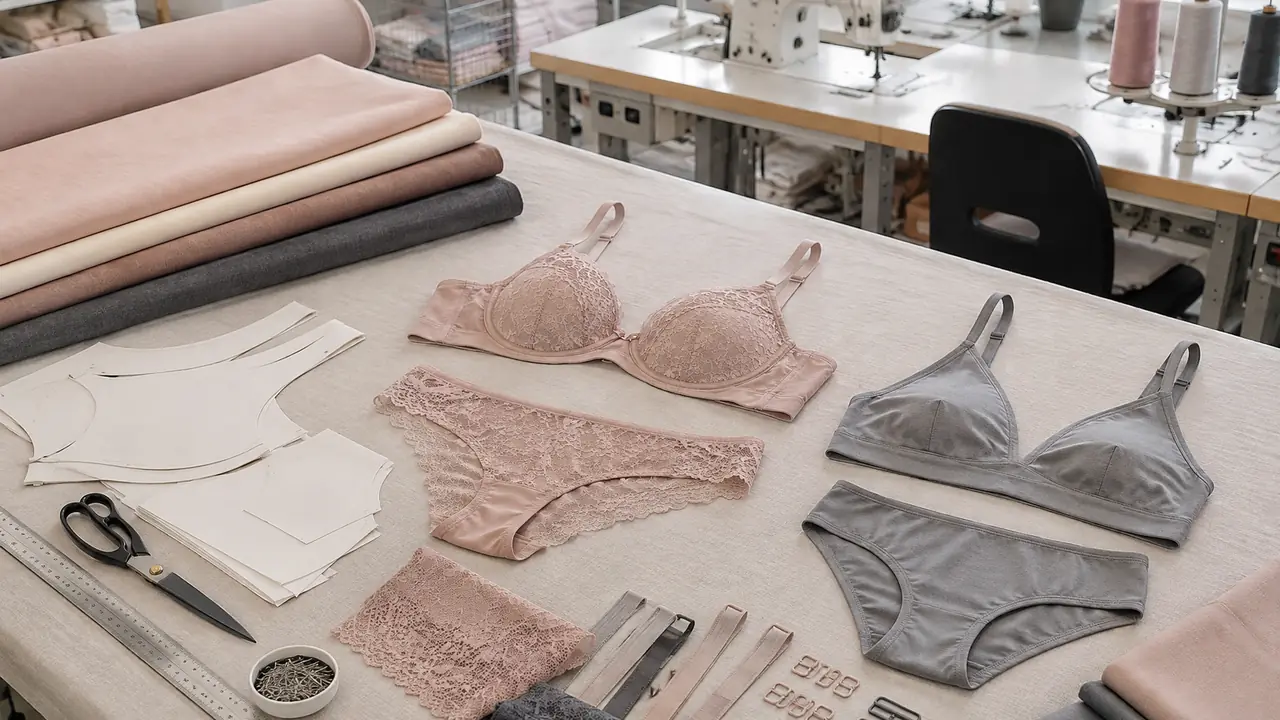
- Fabric selection. Face fabrics, elastics and linings arrive against the approved swatch; each roll is checked for shade, weight and hand before it enters the lay. The OEKO-TEX article for each fabric is confirmed per lot at this door.
- Cutting. Lace, microfiber and powermesh are laid and cut to markers; engineered lace repeats are matched panel to panel so motifs land where the design put them. Mis-matched repeats here show on every finished piece.
- Sewing. Elastic attachment, coverstitch and flatlock seams, strap assembly, hook-and-eye application. Stitch density and seam allowance are checked at the line, not after the batch, because a skipped feed dog shows up as a full carton of open seams.
- Molding. For molded cups, laminated fabric is pressed in molds and cup depth is verified against the size set; the mold inventory decides which cup ranges a plant can run without a tooling wait.
- Bonding. Seamless and no-show pieces are ultrasonic- or glue-bonded; bond strength is sampled per run so a hem that peels in the wash is caught in the plant, not in a review.
- Color checking. Finished pieces are compared against the retained swatch in a standard light booth, per lot, before packing. Shade drift caught here costs a note; caught after packing it costs a rework.
- Packing. Fold standard applied, poly bag or tissue plus color card, inner carton counts reconciled by size and color, carton marks printed, and the carton drop check per the pack spec.
Where the calendar goes
| Stage | What sets the time | Watch item |
|---|---|---|
| Fabric and trims in | Dye lot queue; custom color adds days over stock shades | Shade against retained swatch, certificate article per lot |
| Cutting | Lay depth and repeat matching on lace | Panel alignment on engineered lace |
| Sewing | Line count and style complexity | Stitch density at elastic attachment |
| Molding | Mold availability; new cup sizes need tooling | Cup depth vs the approved size set |
| Bonding | Press capacity for seamless work | Bond strength samples per run |
| Color check | Booth capacity; runs after dye lots, not before | Lot comparison against the retained swatch |
| Packing | Pack format; boxes take longer than bags | Carton marks and inner carton counts |
Two stages are the usual calendar surprises. Molding waits on molds: a private label build that needs a new cup size inherits tooling time, which is why ODM first orders run 60-90 days while reorders settle into 30-45. Packing waits on packaging: a custom box is developed against the folded garment, and the packaging page explains how that sits on the same critical path.
Who checks what, at which stage
The plant's line inspectors carry in-process checks - stitch density, seam allowance, cup depth - and the desk's inspection rides on top at the agreed gates: fabric in, first article off the line, final AQL sampling before packing closes. The split is written into the program sheet so both sides know which record belongs to whom. The full gate structure is on the quality control page, and the laboratory tests that sit outside the factory are on the testing and inspection page.
What a buyer sees of the process
Program reports land at fixed points rather than on request: fabric and trims approved, pre-production sample sealed, batch started, in-process notes, final inspection result, packing record. Each point names the stage, the record and any deviation, so a delay is visible the week it happens instead of the week the container was due. The construction details behind each stage - elastics, gussets, hook gauge - are itemized in bra construction anatomy, and the desk's end-to-end route from brief to these stages is on the sourcing process page.