
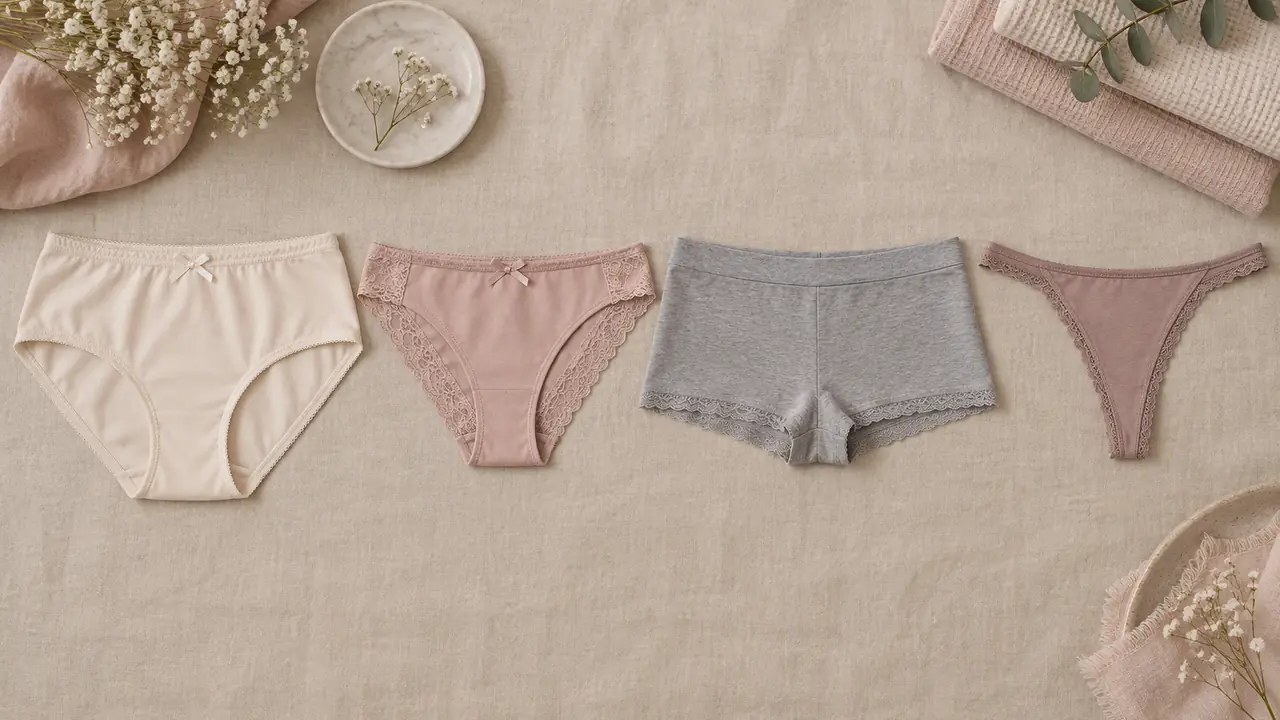
Two axes: rise and coverage
Nearly every panty argument resolves into two measurements. Rise is where the waistband sits on the torso: high, mid or low. Coverage is how much of the rear the cut covers, from full through open cuts to the T of a thong. Style names are just points on that grid - a high-rise brief and a low-rise bikini differ on both axes, while a boyshort and a brief share the rise but differ at the rear.
For a range plan the grid matters more than the names, because it shows gaps. A program with three briefs and no low-rise option has a coverage gap that marketplace reviews will find before the buyer does. Plotting the five families on the grid also exposes where two styles are close enough to merge into one SKU, which directly trims the MOQ commitment of the first buy.
Brief and bikini: the volume lines
Briefs cover fully and come in high, mid and low rise, sized XS-3XL in cotton, modal or lace-trimmed builds; they are the volume anchor of most panty programs because the construction is stable and the fit arguments are few. Bikinis drop the rise and shorten the side to roughly 5-8 cm, in cotton, lace or mesh, also XS-3XL. The bikini trades coverage for wardrobe flexibility under lower-rise clothing, and its short side seam moves the quality conversation toward elastic recovery: a bikini leg elastic that relaxes early pulls the whole style out of shape after a few wash cycles.
Boyshorts and thong: coverage at both ends
Boyshorts take the full-coverage end further with a flat, short-like cut, sized XS-3XL in cotton, modal or lace-edged builds; seam placement decides comfort, since the rear panel carries more seam length than a brief. Thongs take the other end: a T-shaped rear in seamless knit or lace, sized XS-2XL with a cotton gusset as standard. Thong quality concentrates in two points - the softness of the rear seam and the gusset - because the cut leaves little fabric to forgive either. Both styles grade cleanly on waist and hip, which keeps them simple to add to an existing program chart.
Period panties: the four-layer build
Period panties are an engineering product. The gusset stacks four layers - a moisture-wicking face, one or more absorbent layers, and a leak-resistant barrier - and the program is graded by flow, light or heavy, across XS-3XL. Claims discipline matters here: the build is described as leak-resistant per spec, and the spec is exactly what a buyer hands to the plant. Gusset absorption is a named test item agreed per order, and it is the one inspection point unique to this line. The period panties line carries the full layer card.
Fabrics and the gusset
Cotton remains the reference for everyday builds; modal softens the hand and holds up well in repeated washing; lace and mesh carry the fashion tier with elastane added for recovery, typically a small percentage tuned per style - the elastane percentages guide shows how stretch and recovery trade against comfort. Across all of them the gusset is the component buyers should never leave unspecified: cotton or an OEKO-TEX-lined gusset, stated on the spec card with its stitching method. The cotton versus modal comparison covers the everyday trade-offs in more depth.
Comparing the five families
| Style | Rise | Rear coverage | Size span | Common fabrics |
|---|---|---|---|---|
| Brief | High, mid or low | Full | XS-3XL | Cotton, modal, lace trim |
| Bikini | Low | Moderate | XS-3XL | Cotton, lace, mesh |
| Boyshorts | Mid | Full, flat cut | XS-3XL | Cotton, modal, lace edge |
| Thong | Low to mid | T-shaped rear | XS-2XL | Seamless knit, lace |
| Period | Mid to high | Full | XS-3XL | Wicking face over absorbent layers |
Building a panty range
A common opening range is two briefs, one bikini and one boyshort on a shared color ladder, with a thong added where the channel skews fashion and a period line where the channel rewards function. Because panty MOQs count per color, the color ladder decides the size of the buy: five styles in three colors is fifteen lots, which is why the desk plans color before style count. The OEM and private label guide shows how that planning turns into purchase orders, and the quote form captures styles, sizes and colors in the format plants quote against.