
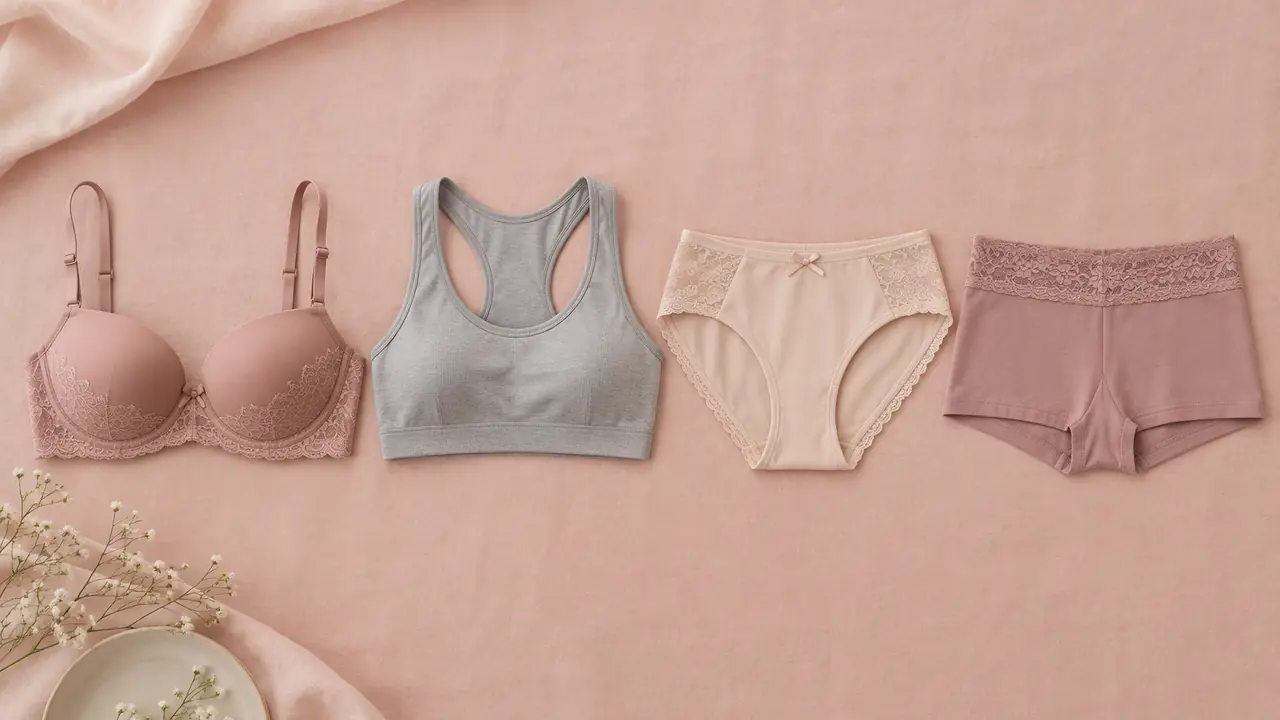
Where the two cuts diverge
A brief is defined by full rear coverage and a rise that can be high, mid or low. A bikini is defined by a low rise and a narrower side strip, commonly in the 5-8 cm range across the category, with a trimmed rear panel that still covers most of the seat. Both grade across XS-3XL in typical runs, and both are cut from the same fabric families - cotton, modal and lace - which is why brands so often carry both.
The divergence is in the pattern block. The bikini front panel is cut lower and angled toward the hip, so its side seam - or its bonded edge, on seamless bodies - sits on the hip bone. The brief front panel rises higher and is drafted straighter, which shifts the waistband engineering from decoration to function: the band is the part that decides whether the style stays put through a day of movement.
The brief: full coverage by default
The brief is the category default for a reason. A complete rear panel and a leg opening drafted to hold it make the cut forgiving across body types, which reduces fit-driven returns in multipack and basics programs. High-, mid- and low-rise variants let one block family serve several garment pairings, and the grading effort concentrates in the waist and leg curves rather than in novel panel work.
Commercially the brief dominates everyday channels. Retail chains stocking private-label basics, marketplace sellers building multipacks and hospitality programs that need a simple, neutral cut all start here, because the style carries a plain cotton blend as gracefully as a lace trim. The construction is also forgiving of late changes: swapping a waistband finish or a leg elastic does not force a new block.
One grading note: because brief variants span three rises, decide early which rise is the base block and derive the others from it, rather than drafting each rise independently. Derived blocks share seam positions and elastic lengths, which trims sampling rounds and keeps the three variants feeling like one family in wear.
The bikini: low rise and narrower sides
The bikini trades some coverage for a lower, less obtrusive outline. Sides in the 5-8 cm range use less elastic and less fabric per piece, but they concentrate the load on a shorter strip, so elastic quality matters more per centimeter. The rear panel is trimmed but not minimal; a bikini that loses too much rear coverage becomes a different style with different fit problems, and the block should say so honestly rather than drift between definitions.
Fabric leans lighter than a brief program: cotton blends for basics, mesh and lace for fashion lines. Because the rise sits low, the waistband is often a thin bonded finish or a narrow covered elastic rather than a deep band. The bikini line page lists the reference options a plant will ask about before quoting.
Side by side
| Dimension | Brief | Bikini |
|---|---|---|
| Rise | High, mid or low | Low, on the hip |
| Side strip | Moderate to wide | 5-8 cm typical |
| Rear coverage | Full panel | Moderate, trimmed panel |
| Typical sizes | XS-3XL | XS-3XL |
| Usual fabrics | Cotton, modal, lace | Cotton, lace, mesh |
| Waistband | Deep band or covered elastic | Narrow bonded or covered finish |
| Common failure mode | Waistband rolling at high rise | Leg ride-up on light fabrics |
The table is a specification starting point, not a rulebook. Sizing letters for both cuts rest on waist and hip measurements, and the panty sizing note explains how those measurements map to letters across a run.
Wear behavior and failure modes
Each cut fails differently. A brief fails at the waistband first: at high rise, an under-powered band rolls down as the wearer moves, which is a construction question - elastic width, stitch type, fabric recovery - rather than a sizing one; the rolling note walks the mechanics. A bikini fails at the leg line first: light fabrics with narrow sides ride up when the leg elastic lacks recovery or the leg curve is drafted too straight. The elastic note covers how leg and waist elastics differ in width, stretch and application.
Both failure modes are catchable before bulk. A stretch-recovery check on the elastics and a wear-wash trial on the sample set surface most of the problems, and both are standard per-order test items in the category when the inspection scope is written for the program.
Fabric and colorway notes
Cotton and cotton-rich blends carry the basics end of both cuts; modal carries the smooth, dark-colorway end thanks to its dye depth and hand; lace and mesh sit on top as trims or panels rather than as the whole garment in most programs. Because the two cuts usually share a fabric ladder, buyers can consolidate dye lots across cuts, which keeps batch color matching simpler across a range and across repeat orders.
Whatever the shell, the gusset lining stays cotton in both cuts across most programs, and the contact-safety documentation standard is OEKO-TEX Standard 100 per certificate per lot from the producing plant. Buyers who consolidate the two cuts with one plant should ask for certificate numbers to be listed per fabric lot on the test documents, so a channel audit later does not require reconstructing which roll went into which style.
Planning a two-cut range
- Decide which cut leads the program; the lead cut gets the fit samples first and sets the shared block conventions.
- Share fabrics across cuts where possible: one cotton blend and one modal base cover most basics channels.
- Keep the rear definitions honest: a full panel for briefs, a trimmed panel for bikinis, no drift between blocks.
- Specify waistband and leg elastic construction per cut, not per program.
- Confirm quantity per color per cut - combining cuts in one program does not always combine their minimums.
The quote form treats brief and bikini as separate lines precisely so the desk can match plants by block capability rather than by fabric alone.