
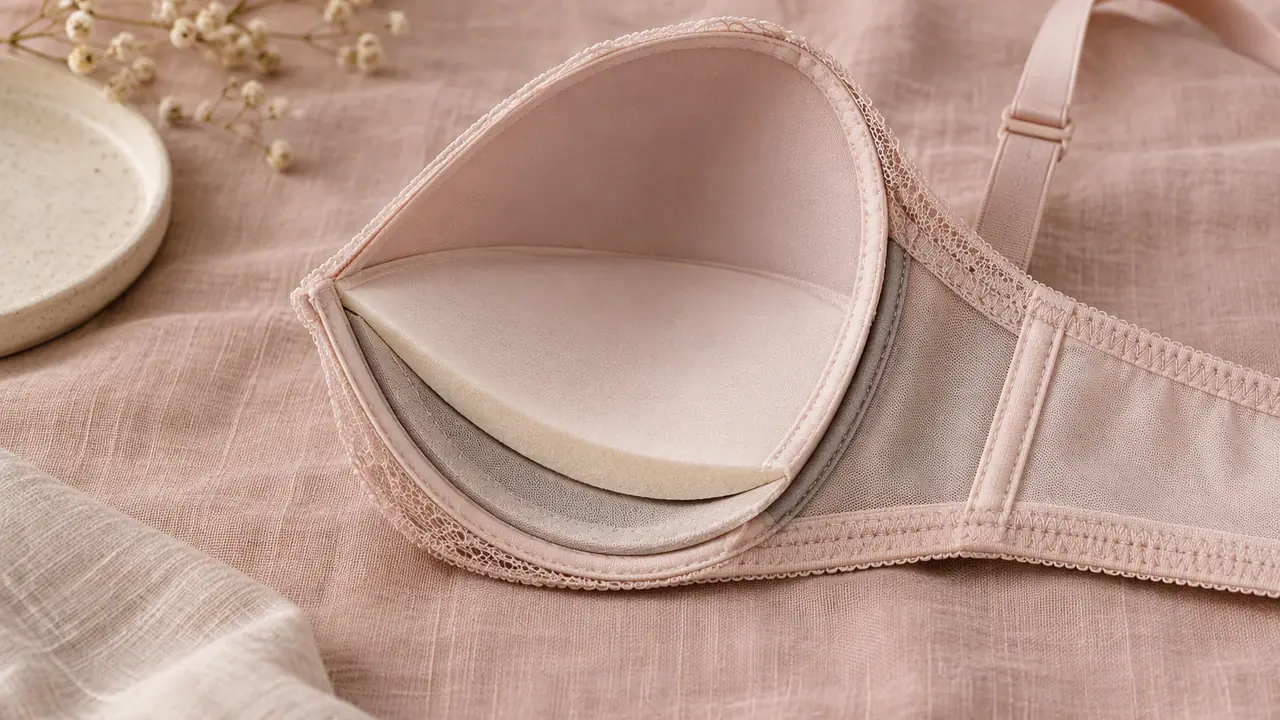
The one function that changes everything
Every nursing bra answers the same brief: everyday support plus cup access that one hand can operate. The access requirement cascades through the construction. The cup splits into a body panel and a drop panel; a clip or clasp joins them at the strap point; the drop panel needs enough structure to hold closed and enough softness to fold away; and every fabric in the cup must recover its shape after hundreds of open-and-close cycles. A style that fails any one of those quietly fails the brief, which is why the family is specified and tested differently from fashion bras even when the silhouettes look identical on a hanger.
The comfort requirement is equally structural. Across the category most nursing styles are wireless - support from band, wing and molded cup rather than hardware - because the body changes across the wearing period and rigid structure ages poorly against it. That makes the family a natural extension of a wireless program: same band logic, same fabric discipline, one added access system. The note on bra types places the family in the wider map.
Access systems: drop-cup, crossover, pull-aside
Three access systems cover the market. The drop-cup clip is the standard: the cup separates into two panels, and a plastic clasp at the strap junction releases the top panel forward. One-hand operation is the design gate - the clip must open with thumb and forefinger, stay closed under wear load and survive repeated cycling. Crossover and wrap builds pull aside with no hardware at all, common in sleep and early-weeks styles where softness outweighs structure. Pull-aside stretch necklines appear on sports-style and seamless builds. Each system implies a different plant capability, as the table shows.
| System | Construction | Hardware | Program note |
|---|---|---|---|
| Drop-cup clip | Split cup, drop panel on clasp | Plastic clip per side | Clip cycle testing; one-hand operation check |
| Crossover wrap | Overlapping fabric panels, no closure | None | Simplest build; softness-led, sleep styles |
| Pull-aside neck | Stretch neckline, seamless or sports cut | None | Recovery of neckline edge is the test item |
The clip itself is a sourced component, not a sewing detail. Clip quality splits into retention force - how hard it resists opening in wear - release force, and cycle life, and all three are testable per report. Programs that treat clips as an afterthought meet the two failure modes of the family: clips that pop open in wear and clips that need two hands to open at all.
Fabrics, stretch and recovery
Nursing programs lean on stretch: the cup volume a wearer needs shifts over time, and the construction absorbs the shift instead of forcing a wardrobe change every few weeks. Molded stretch cups, high-elastane jerseys and ribbed body fabrics are the standard kit, and recovery is the property that decides whether the construction keeps working after months of laundering. The note on elastane percentages explains how recovery changes across the blend range, and stretch-recovery testing is the item the desk weights heaviest in this family's checklists.
Softness specifications are structural here, not cosmetic. Seams sit away from sensitive areas, labels are heat-transfer or printed rather than sewn - the note on tagless labeling covers the methods - and elastics are covered rather than exposed against the skin. Material grades are verified per certificate per lot, with OEKO-TEX Standard 100 as the baseline for every skin-contact component, elastics included.
Fabric choices also set the wash story. Molded stretch cups tolerate warm washes better than laminated foam; covered elastics survive laundering longer than exposed ones; and the care label must match what the construction supports, since a nursing program is washed far more often than an everyday line. The desk confirms care-method wording against the fabric and elastic specifications before listings go live, so the label, the certificate file and the listing tell the same story from the first carton onward.
Sizing across a changing body
Sizing has to absorb change, and the construction answers with three tools. Stretch fabric absorbs short-term volume variation. Band multi-row closures - often more rows than an everyday bra at the same size - let the band move with the torso, and the row logic is the same one described in the note on hook and eye closures. And many programs ship band extenders in the box, which lets one purchase span a longer wearing period. Ladders typically extend deeper into back sizes than the equivalent everyday line, typical across the category and confirmed per program.
Fit reviews should therefore sample the ladder ends and test the adjustment path: the smallest cup at the loosest rows, the largest cup at the tightest rows, access operated one-handed in both. A nursing bra that only fits and functions at the center of its ladder is a returns generator, because the ladder is exactly what the purchase is for.
Testing and quality items
The test list adds three items to the everyday checklist. Clip cycle testing, a defined number of open-close repetitions with retention and release forces checked after, predicts the access function's lifespan. Stretch recovery after repeated laundering predicts the fit lifespan. And colorfastness to perspiration and washing protects both the garment and the skin-contact story. All are order-agreed items evidenced per test report; the note on testing and inspection describes how the desk assembles checklists and reviews reports per lot. In-line, the sewing checkpoints that matter are the clip attachment reinforcements and the drop-panel seam, the two points where access systems fail in production.
Planning a nursing program
- Choose the access system per style: drop-cup clips for structured everyday builds, crossover or pull-aside for sleep and soft styles.
- Source clips as a specified component with retention, release and cycle values per report.
- Lock fabric recovery values in the spec and weight stretch-recovery testing in the checklist.
- Set a deeper-than-everyday ladder with extra closure rows and boxed band extenders.
- Sample the ladder extremes and run the one-hand access test in both states of adjustment.
Quantities follow the bra ranges: branded programs typically from 1,000-3,000 pieces per color, catalog models from 500-1,000, samples in 7-15 days for catalog models and 15-25 days branded, confirmed in writing per order. Listings should carry construction facts rather than promises - the note on listing content shows the pattern - and the desk coordinates quotes through the quote form with the access specification attached. Reference tables sit on MOQ and lead time.