
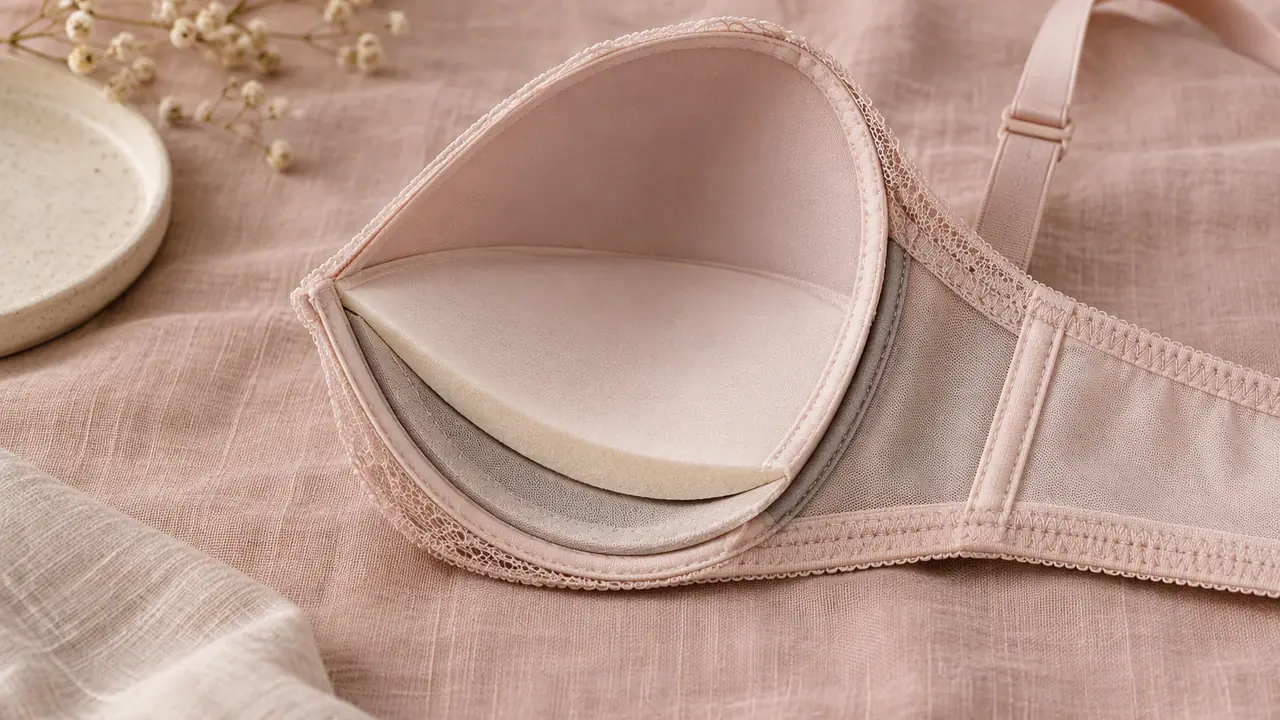
What the padding levels describe
Across the category, push-up padding is quoted in three levels. Level one adds a thin, even layer along the lower cup - a lightly lined cup in most plants' vocabulary. Level two builds thickness toward the lower outer quadrant, so the profile gains depth progressively rather than uniformly. Level three stacks the most foam, usually in a molded cup with a defined internal geometry. The levels describe construction, not results: what a buyer specifies is foam distribution and cup geometry, and the sample proves both. Cup sizes typically run A to D and band sizes 30 to 40, ranges that are typical across the category and confirmed per program.
Because the levels are not an industry standard with numbered definitions, two plants can quote level two and mean different foam maps. The practical fix is to ask for the foam thickness per zone in millimeters, or for the mold reference if the cup is molded, and to treat the sample - not the level name - as the specification. The note on padding types covers molded, removable and graduated options in one comparison.
How graduated padding is built
A graduated pad is foam cut or molded so thickness varies by zone: minimal at the top edge, increasing through the lower cup. In cut-and-sew construction the foam is die-cut in one or more pieces and laminated to the cup fabric, then assembled so the seams sit away from the visible edge. In molded construction a heat press forms cup fabric and foam into a single three-dimensional shell, which is why a molding line is a capability question when shortlisting plants - not every plant runs one, and mold tooling for a new cup geometry adds lead time to the program.
Foam choice matters as much as geometry. Cup foams differ in density, resilience and wash behavior, and the lamination adhesive decides whether the foam and fabric stay bonded through laundering. Delamination - foam separating from fabric after washes - is a warranty-level defect, so the lamination method and the wash-test result belong in the program file. Material grades are verified per certificate per lot, with OEKO-TEX Standard 100 as the baseline the desk asks for on skin-contact programs.
| Level | Typical construction | Cup build | Program implication |
|---|---|---|---|
| Level 1 | Thin even layer, lower cup | Cut-and-sew or light molding | Lowest tooling need, closest to a lined cup |
| Level 2 | Thickness increasing to lower outer quadrant | Molded or multi-piece foam | Mold or die-cut set required per cup size |
| Level 3 | Deepest stack, defined internal geometry | Molded shell, defined zones | Full mold tooling, longest sample lead |
Removable pads versus sewn-in padding
Removable pads - inserts placed into a pocket between cup layers - are the flexible option. One program covers several profiles, the pads can be replaced or washed separately, and marketplace sellers use the feature as a listing attribute. The costs are fit drift and returns: a pad that shifts inside the pocket reads as a defect, and removing a pad changes the cup profile the pattern was graded for. Sewn-in graduated padding is stable through the ladder and through the wash, at the price of one profile per pattern.
The decision usually follows channel. DTC brands that merchandise one silhouette prefer sewn-in consistency; multi-profile sellers and gift-led assortments prefer pockets with matched pad sets. Either way, state the pad construction on the spec sheet: foam density, pocket opening width, pad shape and whether the pads are symmetrical or mirrored per side. The note on molded versus unlined cups frames the wider choice between structured and fabric-only cups.
Sizing, grading and the foam map
A push-up ladder is really two ladders in one: the fabric pattern grade and the foam grade. The fabric pattern scales the way any cup pattern does, but the foam must scale with it - a level two profile sized for a B cup reads wrong on a D cup if the foam map was not re-cut per size. Plants that run push-up regularly hold a foam die set or a mold per cup size and re-check the tooling when a size re-enters production. Plants that improvise reuse one foam across several sizes and let the fit drift at the ladder ends.
This is why the brief should state the full ladder before sampling rather than after. Ask which sizes have dedicated tooling, which share, and what the charge and lead are for a new size. Where removable pads are specified, the pads themselves need a size ladder too, and a pad that fits the smallest cup will gap at the largest. The desk records the tooling map in the program file so repeat orders do not rediscover it, and the note on signs of a good fit lists what the graded samples should prove at each end of the ladder.
Where push-up programs fail in production
Three defects account for most push-up claims. First, delamination after laundering, which traces to lamination adhesive or press parameters and is caught by a wash test before bulk. Second, foam show-through at the cup edge, where the fabric is too light for the foam below and the pad outline reads through the garment - a fabric weight decision, not a foam decision. Third, asymmetry between cups at the larger sizes, where the mold or the die-cut set drifted; the fix is per-size tooling checks rather than end-of-line inspection alone.
None of these are exotic. They are the standard defects of foam-and-fabric lamination, and they respond to the same discipline as any intimate program: verified material certificates per lot, a documented wash test, in-line checks at the lamination and molding stations, and a final inspection with a defined sample plan. The desk's note on quality control describes the checkpoints partner plants run for foam programs.
Specifying a push-up program
- Name the level in construction terms: foam thickness per zone or a mold reference, not just a number one to three.
- Decide removable pads or sewn-in padding per channel, and fix the pocket or lamination detail in the spec.
- Set the ladder - typically A to D cups on 30-40 bands - and ask how the mold or die-cut set changes across it.
- Require a wash test on the laminated cup at bulk fabric weight, plus material certificates per lot.
- Agree the sample round: catalog-model samples in 7-15 days, branded samples in 15-25 days, mold tooling quoted separately.
Quantities follow the usual bra ranges - branded programs typically from 1,000-3,000 pieces per color, catalog models from 500-1,000 - and every figure is confirmed in writing per order. The reference table sits on MOQ and lead time, and the desk coordinates the quote round through the quote form with the foam specification attached.