
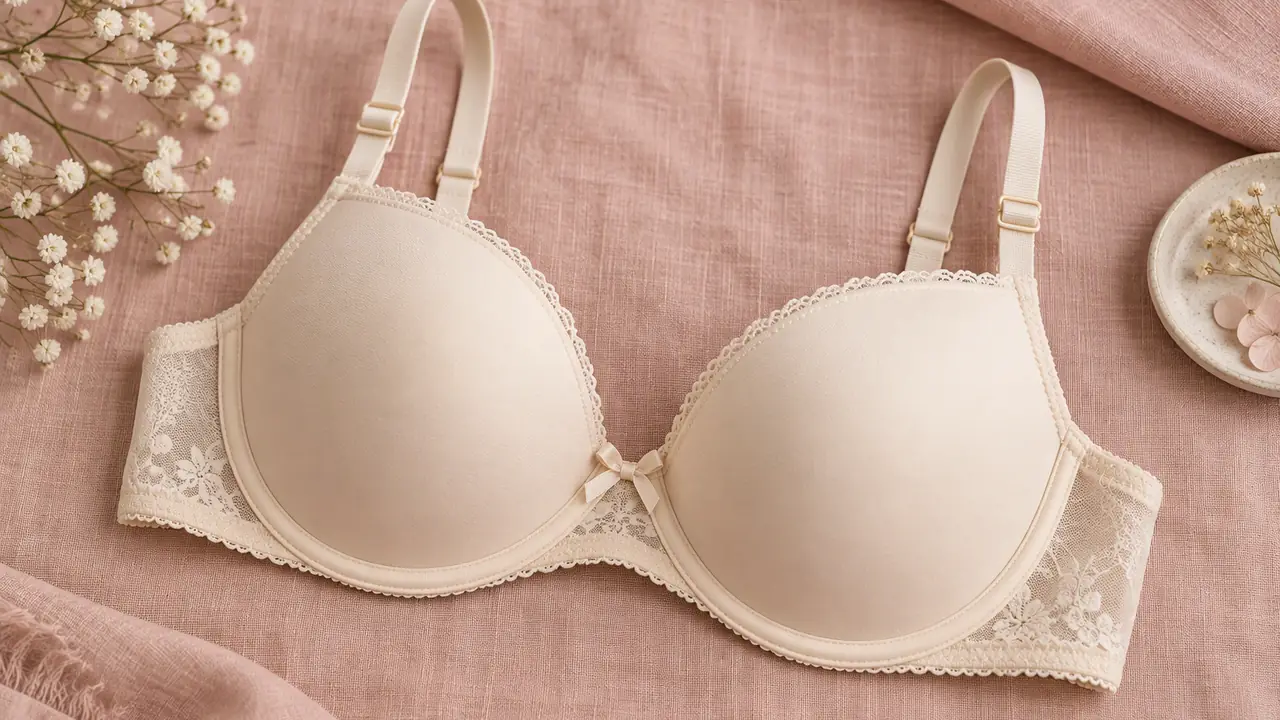
What a push-up bra is
A push-up bra is defined by its padding architecture: the cups carry graduated foam along the lower and outer panel, and the padding is graded in levels - commonly level 1 for a light contour, level 2 for the core construction and level 3 for the densest insert - so a brand can run one silhouette across three padding depths. Cup ranges run A-D and band ranges 30-40 as category references, and most programs make the pad removable so one garment covers two constructions and simplifies care.
The line rewards precision. Padding thickness must stay consistent across a size run, pocket openings must hold the insert without bulging, and the chassis - wired in most programs - has to sit slightly lower to balance the cup volume. Plants that mold their own foam keep thickness tolerance tight; plants that buy pads in need a pad-specific incoming check. The desk shortlists accordingly and writes the pad specification into the program sheet before sampling.
The six layers on the card
| Layer | What decides quality | Typical options |
|---|---|---|
| 1 Cups | Graduated pad thickness, pocket stitching, molded edge | Levels 1-3; removable pad pocket; A-D range |
| 2 Band | Circumference, hook gauge, chassis height | 30-40 band; 2-3 hook rows; lowered chassis |
| 3 Straps | Center-set placement, elasticity, convertibility | Center-set; semi-convertible; 10-15 mm elastic |
| 4 Wing and side | Wing depth, powermesh grade, side seam flatness | Low-profile wing; powermesh side panel |
| 5 Fabric | Face hand, pad breathability, OEKO-TEX class | Smooth microfiber or light lace; cotton gusset |
| 6 Hardware and trims | Pad set spec, slider and ring finish, tags | Foam pad set per spec; nickel-free hardware |
Padding level is a specification, not a mood: the program sheet records pad thickness at defined points of the cup, and incoming inspection measures against it. That is what keeps level 1 and level 3 recognizable on a shelf when the silhouette is identical.
Padding levels and pad sets
The three levels describe pad architecture per spec sheet - nothing more. Level 1 reads as a lightly contoured cup, level 2 as the core construction and level 3 as the fullest insert. Removable pads are the usual choice for a first program because one shell serves several merchandising stories and the pad can be taken out for washing. Sewn-in graduated foam suits higher-volume programs where the silhouette must hold exactly in wear and the extra assembly step is amortized. Pad material - polyurethane foam or a gel-type alternative - is confirmed per order, and the pad carries its own entry in the lot certificate file.
Certification and labeling
OEKO-TEX Standard 100 per certificate per lot covers the whole tested article, pads and elastics included. United States labeling runs on the Textile Fiber Products Identification Act and the FTC Care Labeling Rule, with 16 CFR 1610 flammability for general apparel. Care instructions deserve attention here: pad care, wash temperature and drying limits are printed from the tested construction, not copied from a sister line, because pad distortion in a hot wash is the most common avoidable complaint in this category. The certifications guide lists the document set per lot.
Options worth specifying
- Padding system. Removable pads, sewn-in graduated foam, or both across the range.
- Neckline. Plunge-leaning center, demi edge or balcony crossover.
- Strap system. Fixed, semi-convertible, or multiway with a clear strap set.
- Surface. Smooth microfiber for tee knits; light lace for occasion wear.
- Range shape. One silhouette across levels 1-3 for a clean shelf story; see OEM and private label.
Where push-up lines are made
The line sits where cup molding is strong: the Shantou cluster's Chendian and Gurao belt, where molding, underwire, sliders and elastic suppliers sit within an hour of each other, and Puning for cut-and-sew and lace versions. Because the chassis is wired in most programs, underwire sourcing and tip sealing belong on the plant shortlist checklist rather than after the first sample. The cluster page maps both bases and the split logic.
Inspection before shipment
- Pad thickness at defined cup points against the program sheet.
- Pad pocket opening stretch and recovery on sampled units.
- Underwire curvature and tip sealing where the chassis is wired.
- Hook-and-eye gauge and stitch density at the back closure.
- Strap elasticity after three stretch cycles.
- Carton check: pad set count, labels and color card per the approved sheet.
Reference MOQ and lead ranges are collected on the MOQ and lead time page; the quote form gathers the padding grade, size run and fabric direction a plant needs to respond. Figures on this page are category references, confirmed in writing per program.