
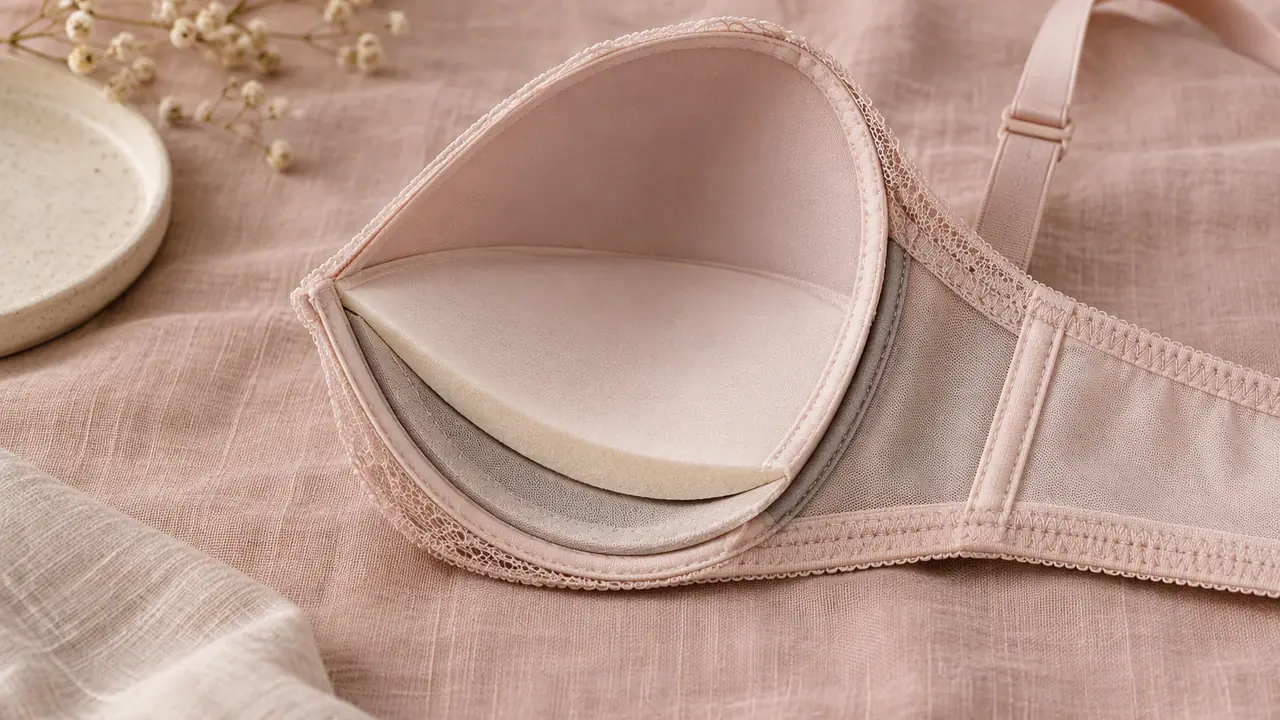
What makes strapless construction different
In a strapped bra, the band anchors the frame and the straps carry part of the vertical load. Remove the straps and the band takes all of it, all day, in every posture. That is why a strapless bra is not a regular bra with detachable straps; it is a different pattern with a deeper band, a firmer wing, a structured cup edge and a grip system at the top line. Plants that treat the strapless as an adaptation of a balconette pattern usually produce samples that ride down within an hour of wear, and the difference shows up in the pattern grade, not in the fabric weight alone.
The cup range typically runs A to DD and beyond and the band range 32 to 42, both typical across the category and confirmed per program. Larger cups need proportionally more structure: a deeper band, a wider grip tape and side panels that control the tissue from the wing inward. The note on bra construction anatomy covers each component in the order they appear on a spec sheet.
The grip system: silicone tape and band engineering
Most strapless designs rely on a band of silicone or rubberized tape sewn or bonded to the inside top edge of the cups and often again inside the wings. The tape adds friction against the skin so micro-movements do not translate into slippage. Tape placement is a fit decision: too high and it sits on soft tissue that moves; too low and the cup edge folds. Tape width scales with cup size, and the tape itself is a skin-contact component, so its grade is verified per certificate per lot like every other material against the skin.
The band does the structural work. A strapless band is typically deeper than the same brand's strapped equivalent, often with powermesh or a similar compression fabric in the wing and sometimes with flexible boning at the side seams to stop the band from rolling. Closure rows matter more than in strapped styles because the band cannot rely on straps to compensate; the note on hook and eye closures explains how row count changes anchoring. Band firmness is a balance: firm enough to hold, elastic enough to breathe and sit without digging.
| Component | Job in a strapless | What varies between programs |
|---|---|---|
| Grip tape | Friction at the cup top edge and wings | Width, placement, bond or stitch, skin-contact grade |
| Band | Carries the entire load path | Depth, elasticity, compression fabric, closure rows |
| Cups | Shape retention without strap pull | Molded or seamed, lining weight, side slings |
| Wings | Stabilize the band and control the side | Powermesh or plain, flexible boning, height |
| Strap hardware | Detachable or convertible straps | Ring and slider gauge, attachment points, optional |
Fit checks before a program
Strapless fit fails in movement, not in the mirror. A sample review should include a movement sequence, done in the fitting room and repeated at the extreme sizes of the grading ladder:
- Two-finger band check: the band should allow two flat fingers and no more, standing and after ten minutes of wear.
- Raise both arms overhead: the top edge should not drop more than a finger width, and the band should not shift.
- Sit and lean forward: the cups should stay seated without the top edge folding or gaping.
- Shoulder rotation: the wing should not roll or bunch at the side seam.
- Removal test: a strapless that holds only because it is overtight will be hard to remove and will be returned.
Each failure mode maps to a construction cause. A band that rides up points to elastic quality or pattern rise, the subject of the note on band riding up. A top edge that folds points to cup structure or tape placement. A band that rolls points to wing fabric or missing side boning.
Size range and grading
Grading a strapless is harder than grading a strapped bra because every size scales the load the band must carry. A pattern that holds at a 34B can fail at a 38DD if the tape width, band depth and wing construction were not re-engineered across the ladder. For that reason plants grade strapless programs in sub-ladders, with structure specifications that change at set breakpoints rather than scaling one pattern linearly. When briefing a program, state the full ladder up front and ask how the plant grades structure at the breakpoints; the answer separates plants that make strapless regularly from plants that improvise.
Detachable and convertible straps extend the use cases of one pattern: halter, cross-back and one-shoulder positions through rings and sliders. Hardware gauge is the detail to check, because lightweight hardware deforms at the larger cup sizes. The note on strap construction covers attachment methods that survive repeated re-threading.
What to specify for production
A strapless spec sheet should fix the following in writing: tape material, width and attachment method per size breakpoint; band depth and wing fabric; cup construction and lining weight; closure rows across the ladder; and the hardware set if the style is convertible. Material grades are verified per certificate per lot - OEKO-TEX Standard 100 is the baseline the desk asks for on skin-contact programs - and colorfastness and stretch recovery are the test items that matter most for a style whose fit depends on elastic performance over time.
Sample timing follows the usual pattern: 7-15 days for a catalog-model sample and 15-25 days for a branded sample, with bulk lead quoted per program. Because strapless fit carries more risk than everyday styles, the desk recommends an extra fit round at the ladder breakpoints before bulk is released; the incremental days are small against the return rate a failing strapless generates.
Program questions to close first
The questions that decide a strapless program are structural, not decorative. Which breakpoints does the plant grade at, and what changes at each? Is the grip tape bonded or stitched, and what is the wear-test result at high humidity? What is the closure row count per band size, and does the hardware set come from a verified source? The desk puts these questions to partner plants before sampling and records the answers in the program file, so the quote form conversation starts from the structure rather than from the color card. Reference quantities and timing sit on MOQ and lead time, and every figure is confirmed in writing per order.