
What a brand program asks for
A brand range succeeds or fails on consistency rather than on any single style. The first season sets a color language; the second season has to repeat it within a tolerance the eye accepts. Sizes graded in one plant have to fit the same in another. And when a retailer or an inspector asks for the file - the certificate, the grade chart, the retained swatch record - the file has to exist, per lot, without a scramble. Those are the three disciplines this page covers: custom color, batch discipline and the grade file.
The desk coordinates partner plants across the Shantou and Puning clusters and holds the program sheet as the single reference: one color standard, one graded chart, one inspection plan. Where a brand already has a technical package, the desk works from it; where it does not, the desk builds one from the first sample and hands it over as a document, not a conversation.
Custom colors without drift
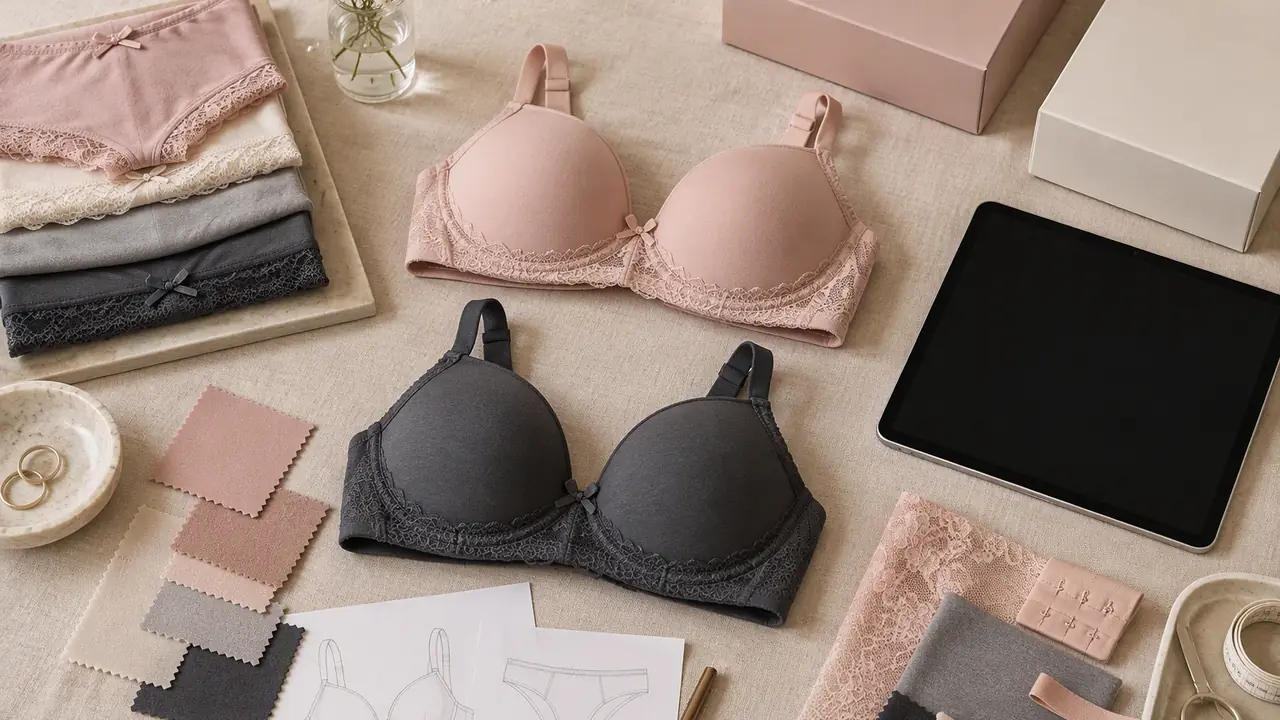
Color starts with a standard, not a screen. The desk converts a brand reference into a physical color standard - dyed swatches agreed in writing and split, one set kept by the brand, one by the desk, one by the plant. Lab dips follow, usually two rounds, then a strike-off on the actual production fabric. The usual tiers:
| Color tier | What it means | Discipline that protects it |
|---|---|---|
| Core | Blacks, whites and beiges that carry across seasons | One standard held for years; every lot checked under a standard lamp against the retained swatch |
| Seasonal | Two to four fashion shades per season | Lab dip per season; the prior season retained for comparison at reorders |
| Custom match | A shade matched to a brand or campaign reference | Strike-off on production fabric signed before bulk dyeing; engineered lace matched separately from elastics |
Engineered lace, dyed microfiber and elastics take custom color at slightly different rates of success, which is why the desk matches them side by side rather than sequentially. A colorway that passes on microfiber can drift on a stretch lace; the standard lamp catches that before the lot ships, not after a customer notices it.
Batch-to-batch discipline
Reorders are where brands get hurt. The plant that ran batch one may have rotated a trim supplier or adjusted dye timing by the time batch two is scheduled. The desk writes the discipline into the program sheet so it survives staff changes on either side:
- Retained references. A sealed swatch and a sample garment from every approved batch, kept on file for the life of the program.
- Elastic and trim lots. Elastics recorded by lot, so a stretch change traces to a supplier batch instead of being guessed at.
- Standard-lamp checks. Every production lot compared against the retained swatch under the same light, by the same procedure.
- Written deviations. If a substitute is proposed - a lace, a slider, a dye path - it is proposed in writing and approved in writing before use.
The quality control page describes how the inspection plan is built and what the record per lot contains.
The grade file
A grade file is the difference between a size run and a guess. It lists every measurement point on the garment - band circumference, cup depth and strap length for a bra; rise, leg opening and gusset width for a panty - per size, with the tolerance allowed at each point. Plants cut and sew against it; inspectors measure against it; disputes resolve against it. For bras the file also carries underwire lengths per size and hook-and-eye rows; for panties, waistband stretch ranges per size band. The desk maintains the file from the approved sample onward, and a change to any measurement goes through a written revision, not a verbal one. Brands extending a size run later - a longer cup range, an additional waist band - pull the extension from the same file so old and new sizes share one logic.
Certificates and label law
The certificate pack travels per lot. The baseline is OEKO-TEX Standard 100 for fabric safety, tested from yarn to finished piece, elastics and threads included. United States labeling follows the Textile Fiber Products Identification Act for fiber content and origin, with care instructions under the FTC Care Labeling Rule and flammability under 16 CFR 1610. Where an organic cotton claim is planned, GOTS documentation moves per lot; where a children's line is planned, CPSIA applies. Certificates are held by the partner plants, never by the desk, and are verified per project. The fabric certifications guide sets out the route market by market.
Choosing the first lines
Most brand programs start with three lines: a balconette bra as the signature style, a sports bra where the brand carries an active story, and a brief that opens a lower-commitment entry point for new customers. The three share a color language, which is precisely why color discipline comes first - a navy that matches across a lace cup, a powermesh wing and a cotton gusset reads as one brand; a navy that drifts reads as three suppliers. Each line page carries the construction detail: cups, bands, wings, elastics and hardware, layer by layer, with the options each layer accepts.
From brief to first batch
- Brief and references: lines, markets, size ranges, color ambitions, any existing technical package.
- Scope in writing: lines confirmed, plant profiles shortlisted, reference MOQ and lead ranges attached; see MOQ and lead time.
- Color standard and lab dips, then a branded sample per line, 15-25 working days once decisions are fixed.
- Pilot batch at production scale against the grade file, with the inspection plan agreed before cutting.
- First batch ships with its certificate pack and inspection record; retained references enter the file.
- Reorder season: same standard, same lamp, same records - the part that makes it a brand rather than a single buy.
To open a program, the quote form lists what to prepare. Bring the color references and the size ambition even in draft form; the scope reply will name what is missing.