
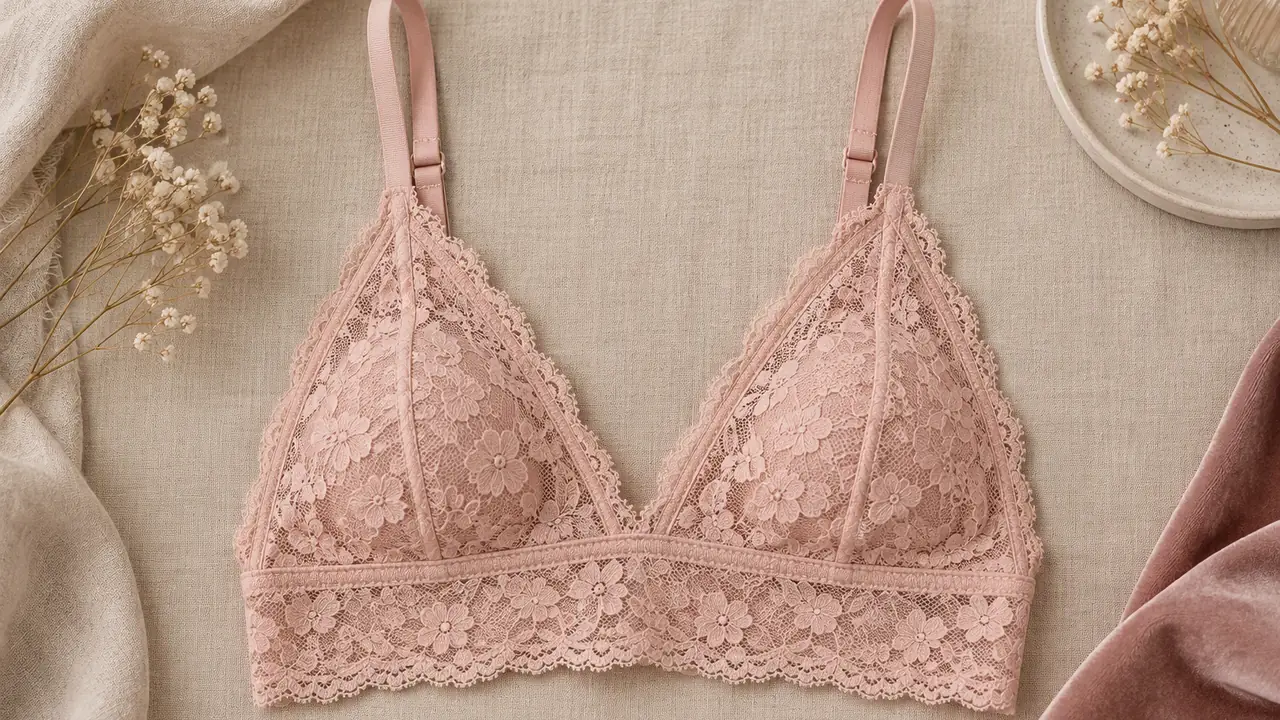
What a bralette is
A bralette is a soft, unlined bra with no underwire and no padding: triangle cups or a sporty two-panel cut, a stretch band or longline body, and strap layouts that range from functional adjustable webbing to decorative lace sets. Sizing usually runs XS-2XL as letter sizes rather than cup-and-band pairs, which simplifies the size chart for teams new to the category. Fabrics run on three families - lace, cotton and modal - and the line carries the lowest tooling burden in the bra range because styles borrow blocks from one another.
That simplicity is the commercial point. A bralette program can share one block across several colors and lace variations, packs flat, ships light and photographs as a flat lay without styling hardware. It is the line DTC brands use to open a collection and the line loungewear brands add when they extend into lingerie.
The six layers on the card
| Layer | What decides quality | Typical options |
|---|---|---|
| 1 Cups | Panel cut, self-finished edges, grading across XS-2XL | Triangle or two-panel sporty cut; unlined |
| 2 Band | Band depth, elastic quality, closure type | Pull-on or 2-hook; longline option |
| 3 Straps | Layout, adjustability, decorative sets | Fixed, adjustable, racerback, lace sets |
| 4 Wing and side | Side panel construction and stretch | Lace side panels or seamless knit body |
| 5 Fabric | Face family, hand feel, OEKO-TEX class | Lace, cotton or modal; cotton gusset lining |
| 6 Hardware and trims | Slider and ring finish, labeling method | Nylon or metal; bows; tagless print |
The lace decision shapes everything else: stretch lace panels can form the whole body, while rigid lace needs cut-and-sew panels behind it for structure. The lace types post compares the options with their cost logic.
Fabric and lace choices
Lace bralettes sell on pattern and hand feel; cotton bralettes sell on skin comfort and wash durability; modal bralettes sell on drape under thin tops. The three families can share one color story so a range reads as a single collection across fabrics, and one block often serves all three. Whatever the face, the gusset lining stays cotton and the article carries OEKO-TEX Standard 100 per certificate per lot - the same baseline as every other line the desk coordinates, with lace dyelots named in the tested article set. The certifications guide sets out the document list.
Why DTC brands start here
Three program economics favor bralettes as an opening line. Entry quantities sit lower than on wired lines - catalog models often run 500-1,000 pieces per color against 1,000-3,000 for private label work - because the construction borrows existing blocks and needs little tooling. Sampling is faster on the same logic: 7-15 working days for a catalog model, 15-25 for a branded sample. And the letter-size chart cuts fit iterations compared with cup-and-band grading. The trade is support: a bralette is a comfort category, not a construction competitor to the wired balconette or the wireless bra, so brands position it as the everyday and lounge end of a range. The DTC brand program page shows how small-batch, multi-color launches are structured, and production draws on the same Shantou, Puning and Yiwu bases described on the cluster page.
Certification and labeling
Nothing changes from the rest of the range: OEKO-TEX Standard 100 per certificate per lot, with elastics and trim components named in the certificate file rather than assumed. United States programs carry fiber content labeling under the Textile Fiber Products Identification Act, care instructions under the FTC Care Labeling Rule, and 16 CFR 1610 flammability for general apparel. Care labeling matters here because lace and modal wash differently; the printed instructions come from the tested construction, not from a sister line. The compliance page shows how the document pack is assembled for import.
Options worth specifying
- Silhouette. Triangle cup, two-panel sporty cut, or longline body.
- Strap story. Adjustable webbing, racerback, or decorative lace and strap layouts.
- Fabric family. Lace, cotton or modal; one color story across all three.
- Closure. Pull-on for lounge; 2-hook back for a dressier read.
- Pack. Flat-fold poly for marketplace; boxed sets for gifting; see packaging.
Inspection before shipment
- Lace and knit panel symmetry on sampled units.
- Band and strap elastic recovery after three stretch cycles.
- Stitch density and thread tension at strap anchors.
- Measurements across the XS-2XL run against the grade sheet.
- Color against the retained swatch under a standard lamp.
- Carton check: label set, fold spec and pack count per the approved sheet.
The plan is confirmed before the first batch; see quality control. Reference quantities and timing sit on the MOQ and lead time page, and the quote form collects fabric family, size run and pack format first.