
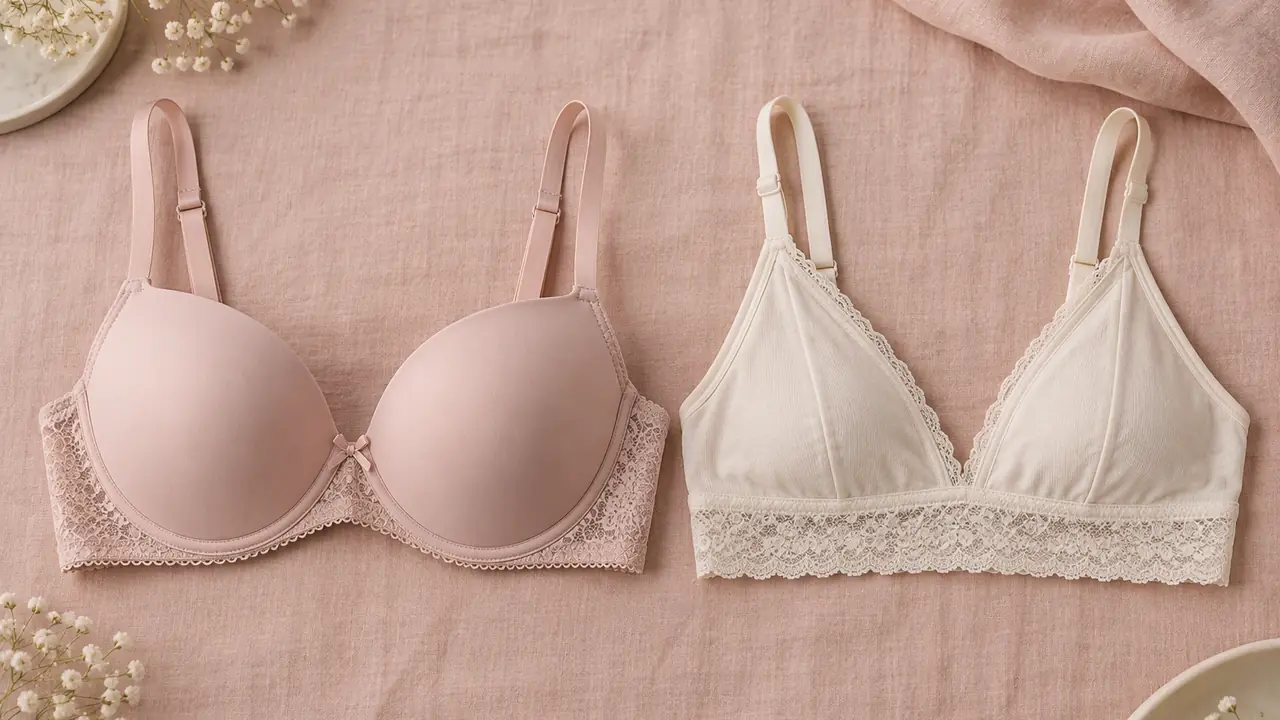
Two definitions that get blurred
A seamed bra is cut and sewn: fabric panels are cut from a pattern and joined with seams, and those seams do structural work - a horizontal cup seam carries tension, a side panel shapes the profile of the cup assembly. A seamless bra is knitted or bonded into its form: circular knitting produces a tube body with density varied zone by zone, or flat panels are joined with bonding instead of stitching. The marketing use of seamless is looser - anything that reads smooth under clothing - but for a buyer the manufacturing definition is the useful one, because it predicts the machinery, the cost structure and the failure modes.
The two families are not rivals so much as different trades. Seamed construction lives in the cut-and-sew plants of the bra clusters; seamless construction lives around the knitting machines, and Yiwu in particular concentrates seamless production across categories. A range can carry both, and most do, but a program should know which one it is commissioning before samples are booked.
Side by side: structure and look
| Aspect | Seamed (cut and sew) | Seamless (knit or bond) |
|---|---|---|
| Structure source | Panel geometry and seam tension | Knit density zones and bonding |
| Seams | Visible and functional | None stitched; bonded lines where needed |
| Look under clothing | Texture can show on fine knits | Smooth surface by construction |
| Stretch profile | Panels control where it gives | Zoned stretch knit into the body |
| Grading | Pattern grading per size | Machine programs per size tube |
| Cost structure | Sewing minutes per piece | Machine time and yarn supply |
| Common styles | Wired cups, balconettes, fashion bras | Bralettes, wireless, lounge, panty bodies |
The stretch profile row is the quiet difference. On a seamed cup the panels decide exactly where the fabric gives and where it holds - that is why structured and fuller-cup styles remain seamed. On a seamless body the machine varies knit density to create support zones, which is elegant at light support but hands less control to the pattern maker at heavier cup weights.
How seamed construction works
A two-panel cup joins an upper and lower section at a horizontal seam; a three-panel cup adds a side panel for forward projection and is the norm above a D cup. Seam type follows position: a flatlock seam lies flat against the skin and is the everyday default, a zigzag seam adds decorative texture where it will not sit against the body, and coverstitch carries elastic at the band and wing. The stitching methods note walks each seam type and where it belongs. Because the seams carry load, they are also the inspection points: stitch density and seam strength sit on the per-order test list, and a seamed style that fails in wear usually fails at a seam that was decorative where it needed to be structural.
Seamed construction is also where cup design lives. Lace placement, sheer upper panels, contrast seaming - the visible vocabulary of a bra range comes from panel geometry. Ranges that want a design story per season work in cut-and-sew for the same reason tailoring does: the pattern is the design.
How seamless construction works
Seamless knitting produces a tube with zones of varied density: firmer under the bust, giving at the cup, elastic at the openings, all programmed into the knit rather than sewn in afterward. Where a joint is needed, bonding - an adhesive film activated by heat - joins panels without stitch holes. The seamless knitting note covers circular and warp knitting and what each produces. The result is a garment whose support is a material property rather than an assembly, which is why seamless styles wash well, pack flat and return few seam-related complaints.
The trade-off is program rigidity. Each size tube needs a machine program, and machine capacity - not sewing lines - is the bottleneck, so seamless minimums behave differently: the machine run wants volume, and yarn supply decides the color story more than on a cut-and-sew floor. The production process page shows how the two workflows diverge from yarn to packing.
Cost, lead and QC differences
Seamed programs cost out per sewing minute: more panels and more operations mean a higher cost per piece but low tooling and fast pattern iteration. Seamless programs cost out per machine hour: a lower assembly cost per piece once running, but program changes carry machine-programming time and the minimums to fill machine runs. Typical reference ranges hold for sampling on both - 7-15 days on catalog models, 15-25 on OEM samples, bulk in 30-45 or 35-50 days depending on the track - confirmed in writing per program on the MOQ and lead time page.
Failure modes differ too, and QC follows. Seamed styles fail at seams - open seams, broken stitching, seam slippage - and inspection concentrates there. Seamless styles fail at bonding lines and at knit defects: laddering, uneven density, yarn variation between batches. A desk that inspects both checks different points per construction, which is why the inspection checklist is written per style, not per category.
Choosing the construction per program
- Match construction to support need: structured and fuller cups stay seamed; light and lounge support knits seamlessly.
- Match construction to design intent: panel geometry for visible design, knit zones for invisible smoothness.
- Cost the program the way the plant does: sewing minutes for seamed, machine hours and yarn for seamless.
- Check machine capacity and color minimums before promising a seamless color story.
- Write the inspection checklist per construction: seams for one, bonding lines and knit defects for the other.
- Book one sample round per construction before committing a tier split.
When the construction split is set, the quote form takes construction, size range and quantity per color, and the construction anatomy note gives the full component list a specification can be written against.