
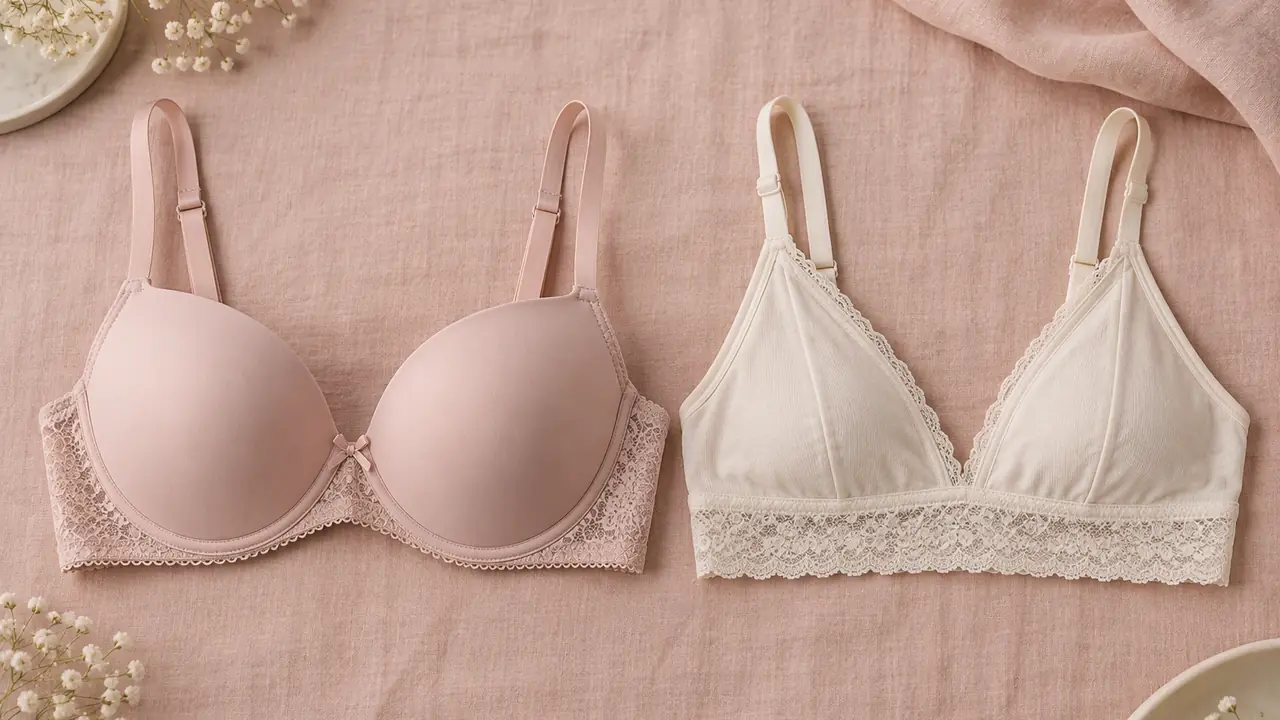
Two cuts in the same half-cup family
The balconette and the demi cup are the two half-cup styles buyers ask about first, and they are close enough that catalog pages often blur them together. Both cover roughly the lower half of the breast, both rely on the underwire and the band for most of their support, and both sit under a wider range of necklines than a full-coverage cup. The differences live in the details: the angle of the upper cup edge, the point where the strap meets the cup, and the height of the gore between the cups.
A balconette runs a horizontal upper edge across the breast and sets its straps noticeably wide on the shoulder; the name comes from the balcony line of the neckline. A demi angles that upper edge up toward the shoulder, sets the straps closer in, and usually keeps a little more fabric at the side of the cup. Neither cut is more advanced than the other. They solve different wardrobe and fit problems, and both are standard tooling in the plants the desk coordinates with across the Shantou and Puning clusters.
For a buying program the distinction matters in three places: which outer garments the style pairs with, which bust proportions find the cut comfortable through a full day, and how the pattern grades from the base size upward. The dedicated balconette construction note covers that style on its own; this note puts the two cuts side by side.
Side by side: geometry and support
| Feature | Balconette | Demi |
|---|---|---|
| Upper cup edge | Horizontal across the breast | Angled up toward the shoulder |
| Strap set | Wide on the shoulder | Closer to the neckline |
| Coverage | About half the breast | Half to three quarters |
| Gore | Often slightly taller and firmer | Lower and more open |
| Typical cup range | A-D, DD and above per plant grading | A-D, DD and above per plant grading |
| Typical band range | 30-44 | 30-44 |
| Pairs with | Scoop and square necklines | Crew necks and everyday wear |
The practical read of the table: strap position decides which garments the bra disappears under, gore height decides how much load transfers from straps to band, and coverage decides the returns profile. Two bras with identical fabric and the same size label can behave differently in wear purely because of these three choices, which is why the desk treats the cut as a specification item, not a styling detail.
How construction differs
Both cuts are usually built as two-panel or three-panel cut-and-sew cups. In a balconette the upper panel is often lace or a sheer tricot, with the lower panel lined for structure; the horizontal seam doubles as the style line. A demi keeps the side panel taller and the upper seam more steeply angled, which moves some of the support toward the side of the cup. Molded versions of both cuts exist, and switching from cut-and-sew to molded changes the tooling picture entirely, as the molded versus unlined note explains.
The underwire differs too. A balconette wire carries a flatter, wider curvature to sit under the horizontal cup edge, while a demi wire tapers more toward the gore. When a plant swaps wires between the two patterns without re-checking the channeling, the classic failure is wire poke-through at the side seam after wash cycles. The desk asks partner plants to confirm wire gauge and curvature against the cup pattern per style, as set out in the underwire sizing note.
Wide-set straps change the wing as well. Because the balconette strap lands further out on the shoulder, the wing between the cup edge and the back closure does more work holding the band level, so a two-ply wing with a powermesh lining is the usual specification above a D cup. On a demi the wing can run narrower, which trims a little fabric per piece but gives up some side anchoring.
Fit and size-range implications
In fit sessions the same patterns split by bust proportion. Wider-set straps suit shoulders that sit wider and cups that sit fuller at the side; closer-set demi straps suit narrow shoulders, where a balconette strap can wander off the edge. At the top of the cup range the demi often shows more gapping at the upper edge on fuller busts, because the angled seam has to curve away faster. These are fit patterns the desk sees across programs, not promises, and they are why fit sessions on live samples matter more than size charts.
Grading behaves differently as well. The balconette's horizontal seam stays roughly parallel as it grades up, so cup volume grows predictably; the demi's angled seam rotates, which is why plants check grading across more sizes before approving a bulk run on a demi. Typical ranges across the category run 30-44 in band and A through DD and above in cup depending on the plant's grading capability, confirmed per program. The sizing and fit guide explains how band and cup interact.
The same neckline geometry carries into wire-free constructions. A wireless bra in a balconette neckline works from band and side structure, typically across 32-44 bands, and a bralette borrows the triangle or demi geometry without padding, graded XS-2XL. Buyers extending a wired program into wire-free can keep the neckline language constant, which helps the range read as one family on a product page.
What each cut means for a buying program
On tooling, both cuts are commodity patterns in the Shantou cluster, which keeps quoting fast when a buyer works from a catalog model. Where a brand brings its own patterns or changes the cup panels, the program moves to the OEM track. Typical reference ranges the desk works from: 1,000-3,000 pieces per color for an OEM bra program, 500-1,000 pieces per color for stock public-mold programs, sampling in 7-15 days on a catalog model and 15-25 days on an OEM sample, and bulk in 30-45 or 35-50 days respectively. Every figure is a category reference, confirmed in writing per program on the MOQ and lead time page.
- Pick the cut against the wardrobe pairing, not the mood board: scoop-heavy assortments lean balconette, crew-neck everyday leans demi.
- Fix the band and cup grading first, because grading depth decides which plants can serve the program.
- Choose cut-and-sew or molded cups, which sets the tooling and sampling lead.
- Select fabric and color, noting that lace fabrics carry their own typical minimums of 500-1,000 meters per design.
- Confirm closure rows and wing construction per size range with the plant in writing.
- Book samples in both cuts if the range plan is undecided; the fabric story stays the same.
Which cut to launch first
For a first program the desk usually steers by channel. An everyday-focused DTC line starts with a demi because it pairs with the widest set of daily garments and carries the simplest grading story. A boutique or fashion-led assortment starts with a balconette because the horizontal neckline photographs clearly and reads as a deliberate style rather than a basic. Neither choice is wrong; the wrong move is launching both cuts at once with shallow sizes in each, which doubles the sampling load before any signal exists.
Demand supports the category either way: Semrush keyword data cited in the desk's research notes puts United States searches for the word bra at around 90,500 per month, a base that covers every half-cup variant. The question is which cut a brand's audience will meet first, and that is a positioning decision more than a construction one. When the cut is decided, the quote form captures band range, cup range, fabric direction and quantity per color in one pass, and the bra types note maps where each cut sits in the wider family.